

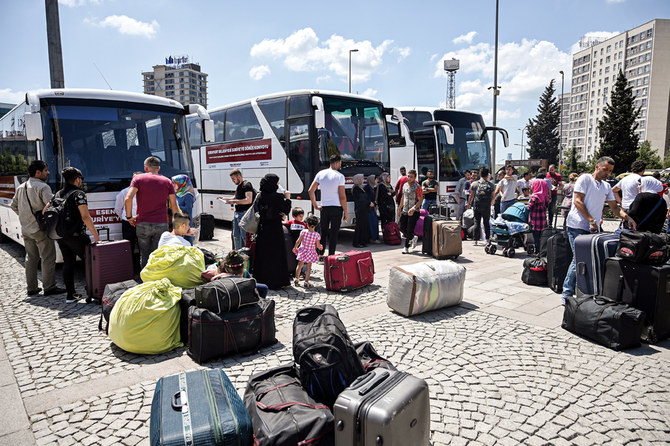

JEDDAH: For eight years now, Turkey has absorbed waves of refugees representing the full gamut of Syrian society from rebel fighters to civilians. But in recent months, the Syrians, who number 3.6 million, have seen the host government’s attitude toward them sour as it struggles with falling popularity and election setbacks.
In July the Turkish government announced that all Syrians should comply with the Temporary Protection Regulation — which states Syrians should be living in the provinces they were officially registered in, and that they need travel permits to go to other provinces.
On July 22, authorities in Istanbul gave Syrians who were not registered in the province until August 20 to leave. This deadline was subsequently extended until Oct. 30 by the Ministry of Interior. According to the International Organization for Migration, there are at least 600,000 Syrian refugees registered in Istanbul.
These announcements have become a source of uncertainty and anxiety among refugee communities as well as international humanitarian organizations. At the same time, reports from Turkey say Syrians found to be not registered in Istanbul or among the estimated half-million lacking Turkish documents have either been sent to another province or deported back to Syria.
The Syrian Observatory for Human Rights has said that more than 6,200 Syrians, including people with valid residency cards who had been found guilty of code violations or crimes, were deported from Turkey to Syria’s embattled north, including Idlib, in August.
A Syrian regime offensive against rebels in Idlib has piled insecurity and misery on nearly three million people, many of them displaced by fighting in other parts of the country.
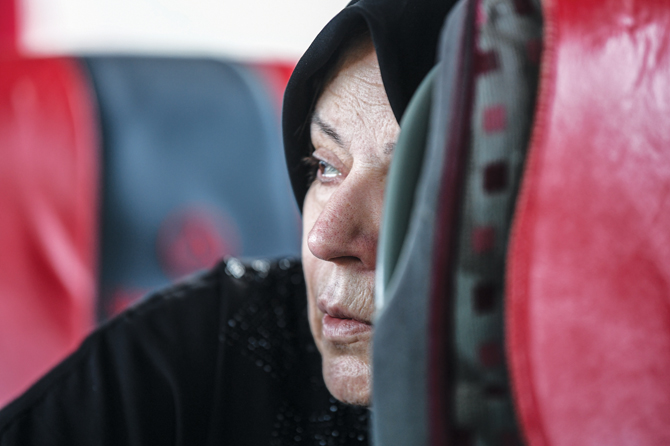
Since March 2011, the conflict in Syria is believed to have claimed over 400,000 lives and displaced millions more. Nearly 13 million people in the country need humanitarian assistance while at least 5.6 million have become refugees in neighboring countries and in Europe.
Nine years into the conflict, Turkey views the latest developments in Idlib and Hama with apprehension, wary of a fresh influx. About 500,000 Syrians have fled their homes and sought refuge in camps or along the border with Turkey.
But Turkey is no longer the sanctuary it once was. Reports from Istanbul tell of Syrians without proper documents having to dodge surprise identity checks by police that could lead to their deportation. Many refugees are said to be adopting extra precautions before stepping out of their homes and trying to imitate the ways of Turks to blend in with the local population.
Selin Unal, a UNHCR spokesperson, explained that when Syrian refugees arrive in Turkey, they are registered by the Turkish authorities and given “temporary protection” allowing them to stay.
“The Temporary Protection Regulation clearly mandates the Directorate General of Migration Management (DGMM) to carry out the registration of individuals under temporary protection,” she told Arab News.
“Syrian nationals, refugees and stateless persons coming from Syria who need international protection are under temporary protection. The comprehensive legal framework in Turkey provides for Syrians under temporary protection to access services in the national system alongside citizens.”
Responding to the outcry over the treatment of vulnerable Syrians, the Turkish government said what was happening in Istanbul was aimed at tackling irregular migration, while unregistered Syrians were being transferred to temporary accommodation centers for registration.
“We are not sending Syrians back. Allegations to the contrary are baseless,” Hami Aksoy, spokesman for the Turkish Ministry of Foreign Affairs, told Arab News.
INNUMBERS
370,000 - Turkey’s non-Syrian refugee population.
400,000 - Syrian child refugees not in school in Turkey.
“We fully comply with our international obligations. Syrians are under our protection. Of course, we do hope that one day they can return to Syria safely and voluntarily.
“In fact, when you look at the relevant data that is also the wish of Syrians. However, for that to happen, the international community should work more to create necessary conditions for return.
“Today more than 352,000 have voluntarily returned to Syria. It shows that when the right conditions are there, Syrians are willing to return.”
Speaking at conference of the Human Rights Council of the UN in Switzerland earlier this month, Sadik Arslan, Turkey’s representative to the UN, appealed to the EU to take on a bigger share.
Under a March 2016 agreement with the EU, Turkey imposed stronger controls to curb the flow of migrants and refugees to Europe in return for billions of euros in aid. However, President Recep Tayyip Erdogan has warned that Turkey will not be able to handle a new wave of refugees.
Erdogan has also pushed the US to create a so-called safe zone on Syrian territory where the Kurds dominate. Turkey views the YPG, the mainly Kurdish backbone of the US-backed Syrian Democratic Forces (SDF) battling Daesh in the area, as an extension of the Kurdistan Workers’ Party (PKK), which has waged an armed insurgency since 1984 for greater cultural and political rights for Turkey’s Kurds.
Claiming that up to three million Syrian refugees could return to their country to live in the “safe zone,” Erdogan has said Turkey might “open its doors” to allow Syrian refugees to cross into Europe if it does not get support.
The EU had pledged $6.6 billion in aid to improve living conditions for Syrian refugees, but according to Turkey’s semi-official Anadolu Agency, only $2.45 billion had been disbursed as of June 2019.
Whatever the truth, Ankara’s generosity towards Syrian refugees since 2011 is not in dispute. “For any country to receive such a high number of people, in this length of time and in such dramatic circumstances, is an enormous challenge,” Unal told Arab News. “We are very aware of the pressures on the host communities and public services in hosting such an unprecedented number of refugees.”
Unal also acknowledges that Turkey’s public system and national institutions “have expanded their services to enable Syrian refugees to access health, education and social services and to pursue self-reliance through work opportunities made possible through work permit regulations.”
However, Unal pointed out that “when people are forced to flee their homes, they leave with only the basics, and in the country of asylum, their capabilities to earn income are limited."
“Refugees, including Syrians, may express their interest to return to their country of origin and approach Provincial Departments for Migration Management (PDMMs) to this effect," she said.

Syrian refugees, for so long welcome in Turkey, have become victims of crackdowns. (AFP)
"We work with the PDMMs and are present during voluntary return interviews to monitor that the person is making a free, informed and voluntary decision to go back.
“All refugees have the fundamental human right to return in safety and dignity to their country of origin at a time of their own choosing. As per the Temporary Protection Regulation, temporary protection status of those who voluntarily return to Syria cease. They may accordingly face challenges if they later wish to return to Turkey.
“Reinstatement of temporary protection status, in this case, may only be possible if a positive assessment is delivered by the national authorities following an individual interview conducted with them as regulated in the legislation.”
Aksoy, the Turkish Foreign Ministry spokesman, is confident the “safe zone” will facilitate and encourage the return of Syrian refugees.
“We want the safe zone to address our national security concerns and to have a sufficient depth,” he told Arab News. “It should also allow voluntary return of Syrian refugees and internally displaced persons. It should be under our control in close coordination with the US. We also demand the complete removal of PYD/YPG from the zone.”
However, Erdogan’s plan to resettle millions of refugees in northeastern Syria may prove just as controversial as his government’s attempts to deport refugees to Syria’s northwest.
The “safe zone” is seen by the SDF-controlled Autonomous Administration of North and East of Syria (NES) as a Turkish imposition. The SDF wants a zone along the entirety of the border to prevent Turkish military incursions in the future. The depth of the corridor too has been a point of disagreement between Turkey, the US and the NES.
As things stand, 3.6 million Syrian refugees are trapped between the grinding uncertainty of life in Turkey and the danger of deportation to their broken country.


