

UAE investors to inject $10bn in Bangladesh economic zones

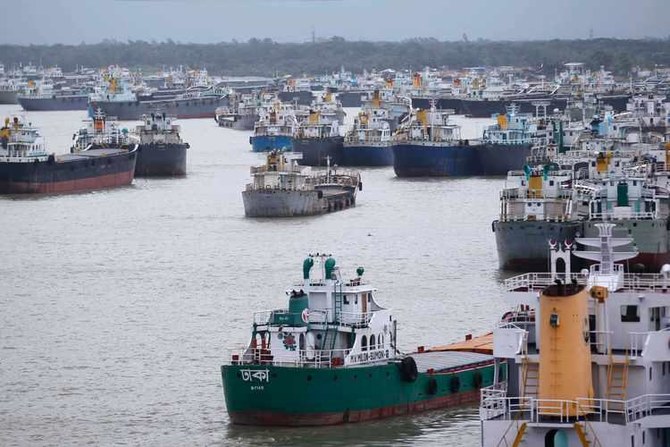
Ships lie at anchor in the River Karnafuli, near Chittagong. Several UAE-based investors have expressed interest in developing economic zones and hi-tech parks in Bangladesh. (Reuters)
Updated 17 September 2019
Follow

UAE investors to inject $10bn in Bangladesh economic zones

  • Conference aimed at strengthening the flow of trade and investment between the two countries
  • Bangladesh is on a growth overdrive and is expected to touch more than 8 percent in the next few years, making it the fastest growing economy in the world

DHAKA: UAE-based investors have lined up several new projects including five free economic zones worth $10 billion in Bangladesh, the plans for which were discussed at the Bangladesh Economic Forum in Dubai on Sunday.

Salman F. Rahman, advisor to Bangladesh’s prime minister on private industry and investment, led a 20-member government delegation comprising officials from the Bangladesh Investment Development Authority, Bangladesh Economic Zones Authority and Bangladesh Hi-Tech Park Authority for the meeting in the UAE.

This was the first time representatives from all three agencies participated in the Bangladesh Economic Forum — a private sector initiative undertaken by UAE-based, non-resident Bangladeshi professionals and entrepreneurs.

More than 300 government officials, business leaders, investors and entrepreneurs participated in the day-long international investment conference, which is aimed at strengthening the flow of trade and investment between the UAE and Bangladesh.

Several UAE-based investors expressed interest in developing economic zones and hi-tech parks in Bangladesh.

“I am pleased to see strong and genuine interest among UAE-based investors — both UAE national and foreign business groups — in investing in Bangladesh,” Rahman said.

He added that Dhaka had seen heavy investments from China, Japan and the US, urging investors from Gulf states, especially Saudi Arabia and the UAE, to “take advantage of the lower cost of investment, operations and higher return on investment in Bangladesh.”

“Investment from the GCC and the Arab world will help us achieve a higher growth rate and we are more than ready to welcome them,” Rahman said.

Kamrul Hasan, commerce secretary of Bangladesh’s mission in the UAE, told Arab News that it was a very successful discussion. “Besides, the event created a very positive branding for Bangladesh” he added.

Experts welcomed the proposal, with Dr. Shamsul Alam, member of the country’s planning commission, saying that at this moment, it was the “most desirable thing for the country.”

“To attain the target of our sustainable development goals, we need to have at least $9 billion in investment every year until 2030,” Alam told Arab News.

“At present, Bangladesh has the most congenial policy regime — foreign investors are enjoying the opportunity of a 100 percent profit repatriation policy,” he added.

However, he said that to attract investment, the country was working on building 100 economic processing zones and 28 hi-tech parks by 2030, with plans in place to get 15 ready in the next five years.

Bangladesh’s economy grew at 7.9 percent in 2018. The country is on a growth overdrive and is expected to touch more than 8 percent in the next few years, making it the fastest growing economy in the world.

In order to sustain 8 percent plus gross domestic product growth, Bangladesh needs massive foreign and domestic investment which will create employment and ensure sustainable development.

The World Bank estimates Dhaka must spend as much as $10 billion a year by 2020 to bring its power grids, roads and water supplies up to the standard in order to serve its growing population.


Trump to meet Venezuelan opposition leader Machado after praising its government

Updated 5 sec ago
Follow

Trump to meet Venezuelan opposition leader Machado after praising its government

  • Machado finds herself competing for Trump’s ear with members of Venezuela’s government
  • The lunch marks the first time the two have met in person

WASHINGTON: Venezuelan opposition leader Maria Corina Machado arrived at the White House for lunch with Donald Trump on Thursday, a meeting that could affect how the US president seeks to shape the South American country’s political future.
Machado, who fled Venezuela in a daring seaborne escape in December, finds herself competing for Trump’s ear with members of Venezuela’s government and seeking to ensure she has a role in governing the nation going forward.
The lunch marks the first time the two have met in person.

HOPES OF MOVE TO DEMOCRACY
After the US captured Venezuela’s longtime leader, Nicolas Maduro, in a snatch-and-grab operation this month, ⁠various opposition figures, members of Venezuela’s diaspora and politicians throughout the US and Latin America have expressed hope that Venezuela will begin the process of democratization.
But for now, Trump has said he is focused on economically rebuilding Venezuela and securing US access to the country’s oil. The day after the January 3 operation, he expressed doubts that Machado had the backing needed to return to the country and govern, telling reporters, “She doesn’t have the support within or the respect within the country.” Trump has on several ⁠occasions praised Delcy Rodriguez, Venezuela’s interim president, telling Reuters in an interview on Wednesday, “She’s been very good to deal with.”
Machado was banned from running in Venezuela’s 2024 presidential election by a top court stacked with government allies. Maduro claimed victory, but outside observers widely believe Edmundo Gonzalez, an opposition figure backed by Machado, in fact won more votes by a substantial margin. While the current government has freed dozens of political prisoners in recent days, outside groups and advocates have said the scale of the releases has been exaggerated by Caracas.
One potential topic of conversation for Thursday’s White House meeting will be the Nobel Peace Prize, which was awarded to Machado last month, a snub to Trump, who has long sought the award. Machado has suggested she would give ⁠the prize to the US president for having deposed Maduro, though the Norwegian Nobel Institute has said the prize cannot be transferred, shared or revoked.
Asked if he wanted Machado to give him the prize, Trump told Reuters on Wednesday: “No, I didn’t say that. She won the Nobel Peace Prize.”
Pressed on what he would do if she brought the prize nonetheless, he responded: “Well, that’s what I’m hearing. I don’t know, but I shouldn’t be the one to say.”
“I think we’re just going to talk,” Trump told Reuters. “And I haven’t met her. She’s a very nice woman. I think we’re just going to talk basics.”
After her visit with Trump, Machado will meet with a bipartisan group of senior senators on Capitol Hill in the afternoon. The opposition leader has generally found more enthusiastic allies in Congress than in the White House, with some lawmakers having expressed concerns about Trump’s dismissals of her ability to govern.