

Lebanon tribunal issues new murder charges against man accused of former PM’s assassination

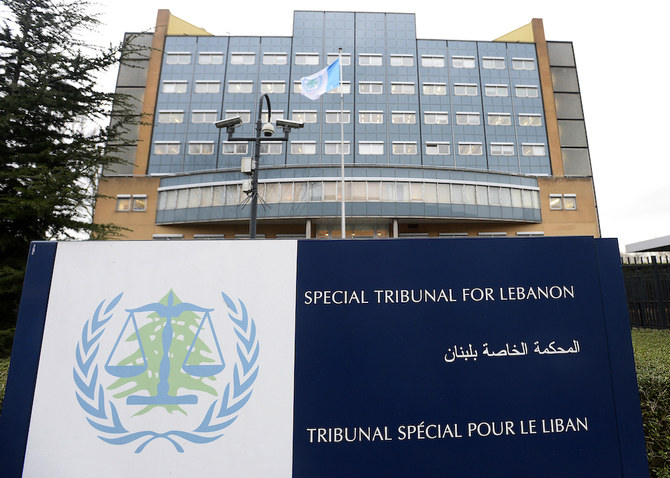
This Jan. 16, 2014, file photo, shows an exterior view of the Special Tribunal for Lebanon, in Leidschendam, Netherlands. (Reuters)
Updated 17 September 2019
Follow

Lebanon tribunal issues new murder charges against man accused of former PM’s assassination

  • Hezbollah suspect Salim Ayyash is one of four defendants accused of the assassination of former Lebanese Prime Minister Rafik Hariri in February 2005 and is on trial in absentia

BEIRUT: The Special Tribunal for Lebanon (STL) on Monday issued five new charges against Hezbollah cadre Salim Ayyash relating to the killings of three men including former secretary-general of the Lebanese Communist Party, George Hawi.

Pre-trial judge, Daniel Fransen, also sent out warrants for the arrest of court fugitive Ayyash to the Lebanese government and international police organizations.

Ayyash is one of four defendants accused of the assassination of former Lebanese Prime Minister Rafik Hariri in February 2005 and is on trial in absentia.

Fransen declassified an indictment against Ayyash, born in 1963, concerning attacks targeting Lebanese ministers Marwan Hamadeh (assassination attempt, 2004) and Elias Murr (assassination attempt, 2005), and Hawi (assassination, 2005).

The pre-trial judge’s move opens the way for a new case before the international tribunal which was set up to try the killers of Hariri and other connected terrorist crimes.

Ayyash has been charged with five counts of “conspiracy to commit terrorist acts” which include the intentional homicide with premeditation of Ghazi Abou-Karroum, Khaled Moura and Hawi, and the attempted intentional homicide with premeditation of Murr, Hamadeh and 17 other people.

According to the STL’s press office, the confirmation of the indictment means that “the pre-trial judge is satisfied, based on the supporting materials, that the prosecutor has established a prima facie case against Mr. Salim Jamil Ayyash and that there are grounds to initiate trial proceedings.

“This is not a verdict of guilt and Mr. Ayyash is presumed innocent unless his guilt is established beyond reasonable doubt at trial.”

The indictment and arrest warrant were transmitted to the Lebanese authorities, which “have the obligation to search for, arrest and transfer the accused to the STL’s custody.”

The STL said that Ayyash must now be formally notified of the charges against him. “If the accused cannot be found, the trial chamber may decide to try him in absentia.”

The press office said that following “reasonable attempts” to locate the accused and serve the indictment, the tribunal president could, after consulting the pre-trial judge, advertise the indictment in an effort to alert Ayyash of the need to appear before the tribunal and encourage anyone with information about his whereabouts to inform the tribunal.

It added: “If within 30 calendar days following such an advertisement, the accused is not under the tribunal’s authority, the pre-trial judge shall ask the trial chamber to initiate proceedings in absentia.”

In February, the STL concluded trials in absentia of four men accused of masterminding and executing the assassination of Hariri and is expected to rule on the defendants Assad Hassan Sabra (born 1976), Hussein Hassan Enissi (born 1974), Hassan Habib Merhi (born 1965), and Ayyash.

The STL overturned the prosecution of a fifth defendant, Mustafa Badreddine, who was killed in a mysterious operation in the Syrian capital Damascus in 2016.

The STL has more than 6 million papers and documents relating to the case.


Israel says it launched pre-emptive attacks against Iran

Updated 5 min 49 sec ago
Follow

Israel says it launched pre-emptive attacks against Iran

  • An Israeli defense official said the operation had been planned for months in coordination with Washington

Israel said it launched a pre-emptive attack against Iran on Saturday, pushing the Middle East into a renewed military confrontation and further ​dimming hopes for a diplomatic solution to Tehran’s long-running nuclear dispute with the West.

The New York Times, citing a US official, reported that US strikes on Iran were underway. A source said that Iran’s supreme leader, Ayatollah Ali Khamenei, was not in Tehran and had been transferred to a secure location.

An apparent strike in Iran’s capital Saturday happened near the offices of Khamenei. State television acknowledged an explosion in the area of the offices.

Israeli media reported attempts to assassinate Iranian President Masoud Pezeshkian during the attacks, and have not ruled out Khamenei being targeted.

People watch as smoke rises on the skyline after an explosion in Tehran on Feb. 28, 2026. (AP)

Several missiles have struck University Street and the Jomhouri area in Tehran, while explosion likely occurred in the northern Seyyed Khandan area of Tehran, state media reported. Thick smoke was also rising from the vicinity of Pasteur Street in downtown Tehran, ISNA said.

The attack, coming after Israel and Iran engaged in a 12-day air war in June, follows repeated US-Israeli warnings that they would strike again if ‌Iran pressed ‌ahead with its nuclear and ballistic missile programs.

“The State ​of ‌Israel ⁠launched ​a pre-emptive ⁠attack against Iran to remove threats to the State of Israel,” Defense Minister Israel Katz said.

An Israeli defense official said the operation had been planned for months in coordination with Washington, and that the launch date was decided weeks ago.

The US military declined to immediately comment on the attack.

Explosions were heard in Tehran on Saturday, Iranian media reported, and sirens sounded across Israel around 08:15 local time in what the military said was a proactive ⁠alert to prepare the public for the possibility of an ‌incoming missile strike.

People run for cover following an explosion in Tehran on Feb. 28, 2026. (WANA via Reuters)

The Israeli military announced ‌the closure of schools and workplaces, with exceptions for ​essential sectors, and a ban on public ‌airspace. Israel closed its airspace to civilian flights, and the airports authority ‌asked the public not to go to any of the country’s airports.

The country’s airspace will reopen and flights to and from Israel to resume ‘as soon as the security situation allows,’ the airport authority said.

Iran’s airspace has been closed, Tasnim news agency reported.

The US and Iran renewed negotiations in February in a bid to resolve the decades-long dispute through diplomacy and avert the threat of a military confrontation that could destabilize the region.

Israel, however, ‌insisted that any US deal with Iran must include the dismantling of Tehran’s nuclear infrastructure, not just stopping the ⁠enrichment process, and ⁠lobbied Washington to include restrictions on Iran’s missile program in the talks.

Iran said it was prepared to discuss curbs on its nuclear program in exchange for lifting sanctions but ruled out linking the issue to missiles.

Tehran also said it would defend itself against any attack.

It warned neighboring countries hosting US troops that it would retaliate against American bases if Washington struck Iran.

In June, the US joined an Israeli military campaign against Iranian nuclear installations, in the most direct American military action ever against the Islamic Republic.

Tehran retaliated then by launching missiles toward the US Al Udeid air base in Qatar, ​the largest in the Middle ​East.

Western powers have warned that Iran’s ballistic missile project threatens regional stability and could deliver nuclear weapons if developed. Tehran denies seeking atomic bombs.