HONG KONG: Oil prices saw a record surge Monday after attacks on two Saudi facilities slashed output in the world’s top producer by half, fueling fresh geopolitical fears as Donald Trump blamed Iran and raised the possibility of a military strike on the country.
Brent futures surged $12 in the first few minutes of business — the most in dollar terms since they were launched in 1988 and representing a jump of nearly 20 percent — while WTI jumped more than $8, or 15 percent.
Both contracts pared the gains but were both still more than 10 percent up.
The attack by Tehran-backed Houthi militia in neighboring Yemen, where a Saudi-led coalition is bogged down in a five-year war, hit two sites owned by state-run giant Aramco and effectively shut down six percent of the global oil supply.
Trump said Sunday the US was “locked and loaded” to respond to the attack, while Secretary of State Mike Pompeo said: “The United States will work with our partners and allies to ensure that energy markets remain well supplied and Iran is held accountable for its aggression.”
Tehran denies the accusations but the news revived fears of a conflict in the tinderbox Middle East after a series of attacks on oil tankers earlier this year that were also blamed on Iran.
“Tensions in the Middle East are rising quickly, meaning this story will continue to reverberate this week even after the knee-jerk panic in oil markets this morning,” said Jeffrey Halley, senior market analyst at OANDA.
Trump authorized the release of US supplies from its Strategic Petroleum Reserve, while Aramco said more than half of the five million barrels of production lost will be restored by tomorrow.
But the strikes raise concerns about the security of supplies from the world’s biggest producer.
Oil prices had dropped last week after news that Trump had fired his anti-Iran hawkish national security adviser John Bolton, which was seen as paving the way for an easing of tensions in the region.
“One thing we can say with confidence is that if part of the reason for last week’s fall in oil and improvement in geopolitical risk sentiment was the news of John Bolton’s sacking ... and thoughts this was a precursor to some form of rapprochement between Trump and Iran, then it is no longer valid,” said Ray Attrill at National Australia Bank.


Oil prices surge after attacks hit Saudi output
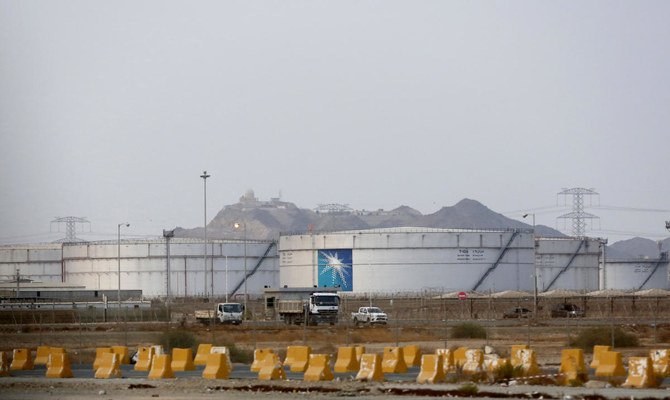
Oil prices surge after attacks hit Saudi output

- The Houthi attacks hit two Aramco sites and effectively shut down six percent of the global oil supply
- President Donald Trump said Sunday the US was ‘locked and loaded’ to respond to the attacks

Islamic military coalition, Pakistan to deepen cooperation to combat ‘terrorism’ — Pakistani military
- Islamic Military Counter Terrorism Coalition is a 43-member alliance that includes Pakistan, Saudi Arabia, Egypt, Jordan, UAE and other nations
- The Pakistani military statement comes after a meeting between IMCTC secretary-general and the chief of Pakistani defense forces in Rawalpindi
ISLAMABAD: Pakistan and the Islamic Military Counter Terrorism Coalition (IMCTC) have reaffirmed their commitment to deepening cooperation, including intelligence sharing and capacity building, to jointly combat “terrorism” and “extremism,” the Pakistani military said on Monday.
The IMCTC is a 43-member military alliance that was formed on Saudi Arabia’s initiative in Dec. 2015 to consolidate Muslim countries’ efforts in countering “terrorism.”
A 17-member IMCTC delegation is visiting Pakistan from Feb. 2-6 to conduct a training at National University of Sciences and Technology on “Re-integration and Rehabilitation of Extremist Elements,” according to the Pakistani military.
On Monday, IMCTC Secretary-General Maj. Gen. Mohammed bin Saeed Al-Moghedi held a meeting with Chief of Pakistani Defense Forces Field Marshal Asim Munir to discuss cooperation among IMCTC member states.
“During the meeting, matters of mutual interest were discussed, with particular emphasis on regional security dynamics and enhanced cooperation in counter-terrorism efforts,” the Inter-Services Public Relations (ISPR), the Pakistani military’s media wing, said in a statement.
“Both sides reaffirmed their shared commitment to combating terrorism and extremism through collaborative strategies, intelligence sharing, and capacity building among member states.”
The IMCTC features Pakistan, Saudi Arabia, Türkiye, Afghanistan, Egypt, Jordan, Qatar, Palestine, UAE, Bangladesh and other nations. In 2017, Pakistan’s former army chief Gen. (retd) Raheel Sharif was appointed as the IMCTC commander-in-chief.
During discussions with Major General Al-Moghedi, Field Marshal Munir appreciated the role of IMCTC in fostering stability and promoting coordinated counterterrorism initiatives across the Islamic world, according to the ISPR.
The IMCTC secretary-general acknowledged Pakistan’s significant contributions and sacrifices in the fight against militancy and lauded the professionalism of Pakistan’s armed forces.
“The meeting underscored the resolve of both sides to further strengthen institutional collaboration for peace, stability, and security in the region,” the ISPR added.
Pakistan enjoys cordial ties with most Muslim countries around the world, particularly Gulf Cooperation Council countries. In Sept. 2025, Pakistan signed a landmark defense pact with Saudi Arabia according to which an act of aggression against one country will be treated as an act of aggression against both.


