

Trump calls Crown Prince Mohammed bin Salman after drones attack Saudi Aramco plants

Smoke is seen following a fire at an Aramco plant in Abqaiq. (Reuters)
Updated 15 September 2019
Follow

Trump calls Crown Prince Mohammed bin Salman after drones attack Saudi Aramco plants

  • Drones hit oil processing plant at Abqaiq in Eastern Province and the country’s second largest oilfield at Khurais
  • Arab coalition says it is investigating who was responsible amid global condemnation

RIYADH: Drone attacks caused fires in two major Saudi Aramco facilities in the kingdom, the Saudi interior ministry said on Saturday.

The attacks hit the world’s largest oil processing plant at Abqaiq near Damman in Eastern Province and the country’s second largest oilfield at Khurais, about 200 kilometers away.

Aramco’s industrial security teams have controlled the blazes and their spread in Aramco’s two facilities were limited, the ministry added, and further investigations were being undertaken regarding the incidents.

Yemen’s Iran-backed Houthi group said it had carried out the attacks.

Al-Masirah TV said the Houthis had deployed 10 drones against the sites, and the group pledged to widen the range of its attacks on Saudi Arabia, which is a key member of an Arab coalition fighting them in Yemen.

Donald Trump called Crown Prince Mohammed bin Salman Saturday evening to reassert his country's "readiness to cooperate with the Kingdom, by all means conducive to maintain its security and stability," Saudi Press Agency reported.

The US president said the negative effects of the attacks would be felt on the American economy as well as the world economy.
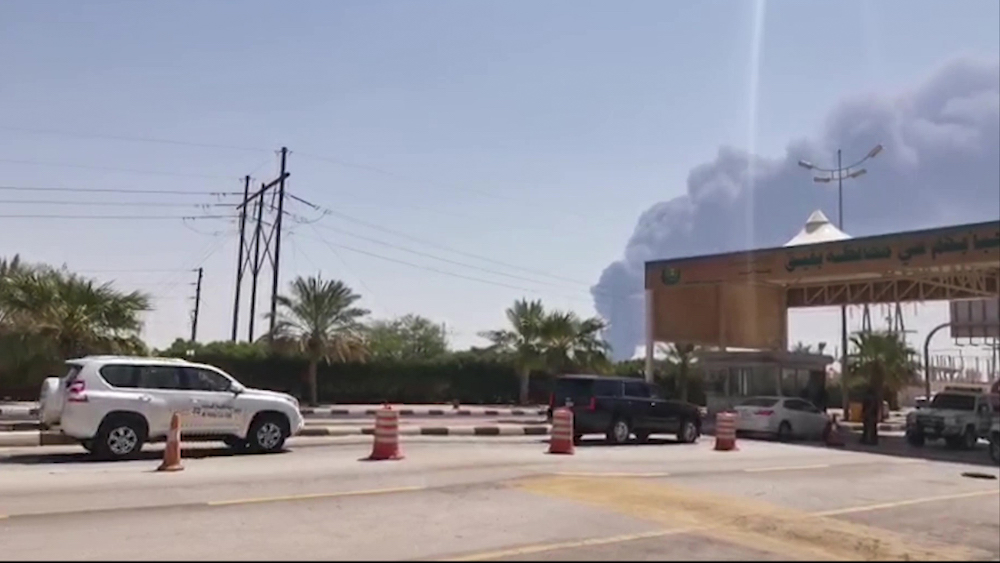


An AFPTV screengrab from a video shows smoke billowing from the Aramco oil facility in Abqaiq. (AFP)

The Crown Prince "underscored the Kingdom willingness and strength to thwart such a terrorist aggression and deal with its consequences."

The Arab coalition, which supports the internationally-recognized Yemeni government, said investigations were ongoing to determine those responsible for "planning and executing these terrorist attacks."

"The Coalition continues to adopt and implement necessary procedures to deal with such terrorist threats in order to safeguard national assets, international energy security and ensure stability of world economy," spokesman Col. Turki Al-Maliki said. 

The US Ambassador to Saudi Arabia John Abizaid said the US “strongly condemns” the drone attacks on Aramco facilities in Abqaiq and Kurais. He added that the attacks “endanger civilians” and “are unacceptable.”

The UAE, another member of the coalition, also condemned the attack calling it an “act of terrorism and sabotage” and new evidence of terrorist groups attempting to undermine security and stability in the region.

The Emirates’ foreign ministry said the UAE stands with Saudi Arabia and supports any steps that it takes to protect the security and stability of its civilians.

The security of the UAE and Saudi Arabia are indivisible, the statement said, and any threat to the Kingdom is considered a threat to the UAE.
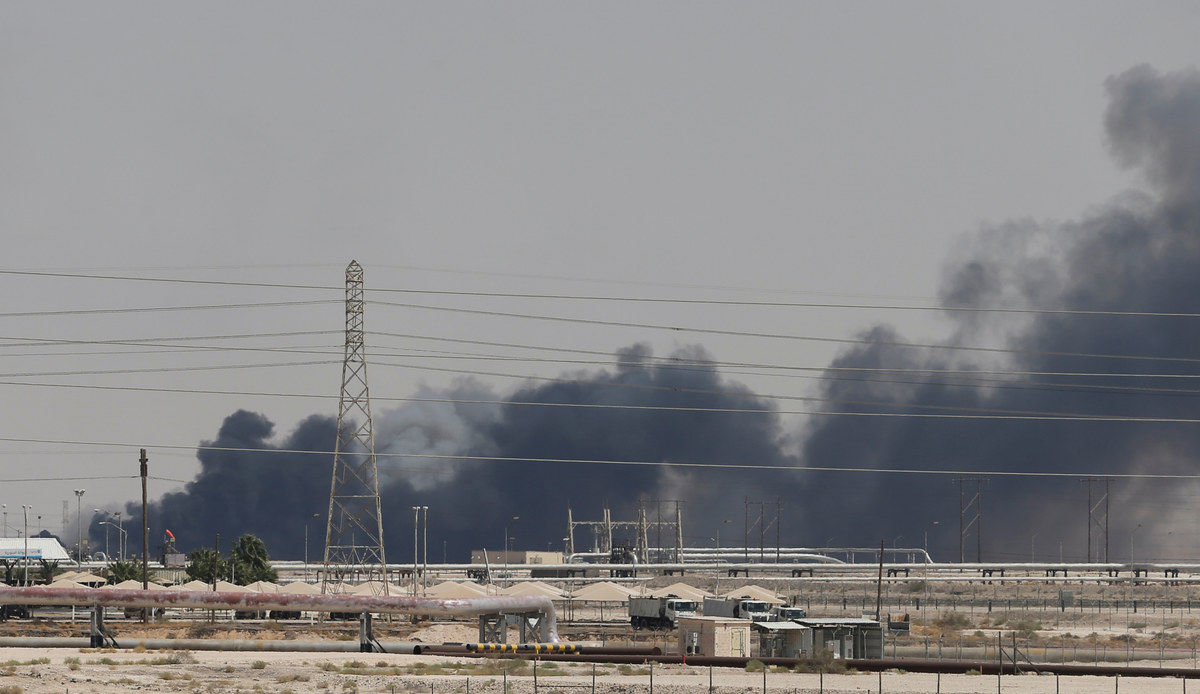


Smoke billows following a fire at the Aramco facility in the eastern city of Abqaiq, Saudi Arabia on Saturday, September 14, 2019. (Reuters)

Abqaiq is located 60 kilometers southwest of Aramco’s Dhahran headquarters. It contains the world’s largest oil processing plant, handling crude from the giant Ghawar field and for export to terminals Ras Tanura — the world’s biggest offshore oil loading facility — and Juaymah. It also pumps westwards across the kingdom to Red Sea export terminals.
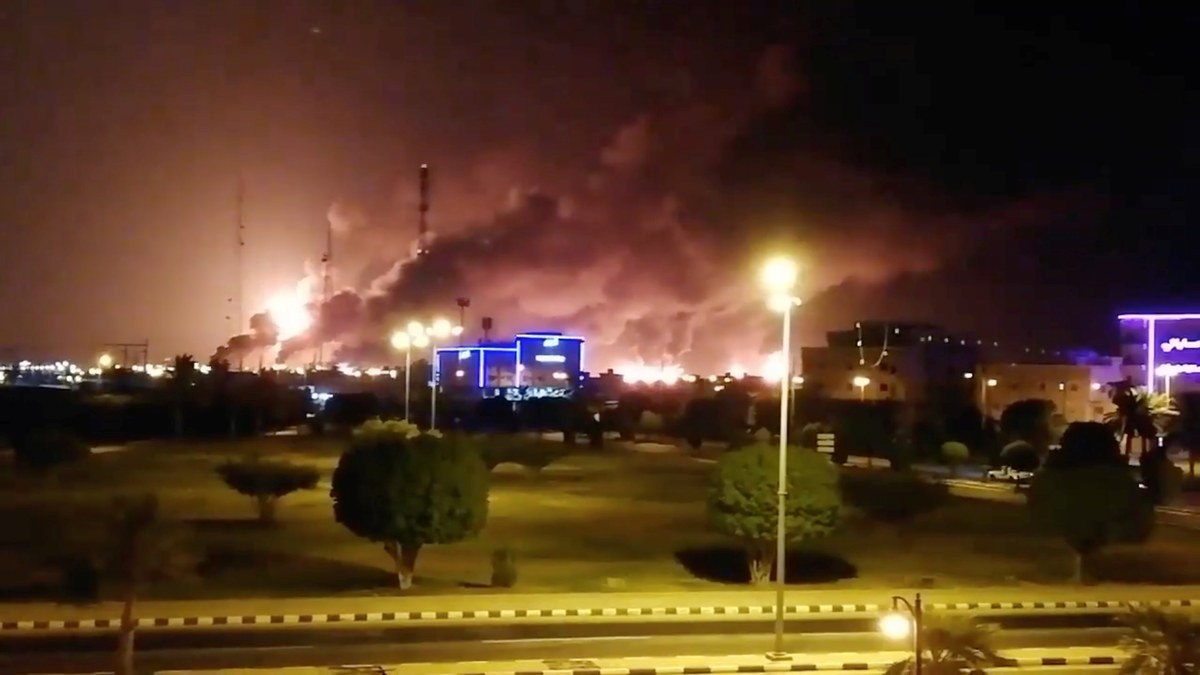


A screengrab of a video from social media shows smoke following a fire at the Aramco factory in Abqaiq, Saudi Arabia. (Reuters)

Khurais, 190 kilometers further southwest, is believed to produce over 1 million barrels of crude oil a day. It has estimated reserves of over 20 billion barrels of oil, according to Aramco.

Bahrain, Kuwait, Pakistan, Egypt, Jordan, the GCC and the Palestinian foreign ministry also reaffirmed their support for Saudi Arabia and strongly condemned the attack.

The UK condemned “the reckless drone attack” on Saudi Aramco oil facilities and called “upon the Houthis to immediately cease such attacks.”

The UN special envoy for Yemen says he is "extremely concerned" about the drone attack.

Martin Griffiths urged all parties to "prevent such further incidents, which pose a serious threat to regional security, complicate the already fragile situation and jeopardize UN-led political process.”

The Arab League and the Organization for Islamic Cooperation both added their voices to the widespread condemnation.

King Salman received a telephone call from Jordan’s King Abdullah II during which he condemned the attacks.

Prince Abdullah bin Khalid, director of research, and head of the Security Studies Research Unit at King Faisal Center for Research and Islamic Studies, said Iran will continue its escalation in the region whether "north or south" through its proxies.

"The attacks on an Aramco oil refinery in Abqaiq are the last ring in this interconnected chain, which should be considered and dealt with once and for all," he said on Twitter.
“The international community must take a decisive stance toward Iranian excesses in the region, and its continued threats to the freedom of navigation, energy security and global economy. Most important, the mistakes of the past should not be repeated with regards to the issue of nuclear weapons and dealing with it separately from other issues and threats.”

Salman Al-Ansari, a political analyst and president of the Saudi American Public Relations Affairs Committee (SAPRAC), said the incident “is another proof that Houthis are nothing but an Iranian-backed terrorist militia.

“Targeting the world’s biggest oil field is an Iranian terrorist attempt to project influence in the region since it is under sanctions and prevented globally from selling its oil,” he told Arab News. “It’s puzzling that the international community and the world’s media is not outraged by such terrorist actions. It seems they only get outraged when Saudi (Arabia) hits terrorists in Yemen,” he said.

Al-Ansari said the US should seriously consider declaring the Houthis terrorists, which would not necessarily undermine a possibility for the US-Houthi talks in the future as some US officials may think.

“It’s insanity to not consider listing the Iranian-backed terrorist militia. The Houthis proclaimed the slogan of ‘death to America’ and killed thousands of civilians and targeted the US navy multiple times and disturbed peace in the region. What else can qualify for getting listed as a terror group?”


How Saudi Arabia’s five Founding Day symbols tell a 299-year story

Updated 25 min 14 sec ago
Follow

How Saudi Arabia’s five Founding Day symbols tell a 299-year story

  • The flag, the palm, the Arabian horse, the souq and the falcon are symbols that connect Saudi Arabia to its roots
  • Researcher Ismail Abdullah Hejles explains how the Kingdom’s symbols anchor identity, heritage and continuity

RIYADH: As Saudi Arabia prepares to mark its 299th anniversary this Founding Day — commemorating the establishment of the First Saudi State by Imam Muhammed bin Saud in 1727 CE — the moment invites reflection not only on history, but on the symbols that distill that history into enduring meaning.

Beyond ceremony and celebration, the Kingdom’s official Founding Day emblems tell a deeper story: of survival in a harsh landscape, of state-building against the odds, and of values carried forward across nearly three centuries. Together, they form a visual language that binds past to present and projects confidence into the future.

The five Founding Day symbols — the green flag, the palm tree, the Arabian horse, the souq, and the falcon — do not serve a purely celebratory function, Ismail Abdullah Hejles, a Saudi researcher in traditional architecture, told Arab News. Rather, they carry an intellectual and cultural role that connects society to its roots.

“Nations that understand their symbols and identity understand themselves and are better equipped to continue their journey with confidence and balance,” he said.

The Saudi flag. (SPA)

The Saudi flag, a representation of unity and sovereignty, embodies the values upon which the state was founded and reflects the continuity of the nation, linking its past to its present. The current design was adopted in 1937, refining historical banners from the first and second Saudi states.

The Shahada, the Islamic declaration of faith, symbolizes the Kingdom’s foundation on Islamic values, while justice and safety are echoed through the sword, which represents the unification of the Kingdom during the reign of the late King Abdulaziz Al-Saud.

The flag’s green color is traditionally associated with Islam, reflecting continuity and faith as central pillars of the Saudi state.

Additionally, the palm tree and the crossed swords — now synonymous with Saudi Arabia — officially appeared in the Kingdom’s emblem around 1950 following unification. Together, they express strength, justice, and the protection of unity.

The Saudi emblem

“The choice was not arbitrary,” Hejles said. “It brought together strength (the sword) and life and sustainability (the palm). It reflects a careful balance of firmness and generosity.”

The palm tree’s symbolic presence, however, predates the modern state, stretching back to the ancient civilizations of the Arabian Peninsula.

“In the simple oases, the palm tree was life, and the swords were dignity. The palm offered shade and sustenance, the swords protected the land and the name. Between the shade of the palm and the edge of the sword, the story of a nation takes place.”

The palm tree served numerous functions essential to the sustainability of civilizations. Its dates were a nutritious food; its fronds were used for roofing; its trunk built walls; its fiber made ropes; and it provided fuel and shade for communities.

In places such as Qatif and Al-Ahsa, the palm tree formed a complete life system with almost no waste. (SPA)

In places such as Qatif and Al-Ahsa, the palm formed a complete life system with almost no waste. It was not merely an agricultural symbol, but a genuine model of sustainability long before the term itself was coined, Hejles said.

Mentioned in the Qur’an more than 20 times, always associated with generosity and abundance, the palm formed the backbone of the agricultural economy in eastern Arabia.

“The souq (traditional market) was not merely a place of trade but a space for social interaction, knowledge exchange, and solidarity,” Hejles said. Through it, economic activity flourished and relationships between communities were strengthened.

A civilizational concept that emerged centuries before Islam, the souq arose from a simple human need: exchange. (Supplied)

“Nomads and desert dwellers possessed surplus goods and sought what they lacked through barter.”

A civilizational concept that emerged centuries before Islam, the souq arose from a simple human need: exchange. That exchange generated social mobility and fostered a culture of openness, which later contributed to the rise of cities.

A civilizational concept that emerged centuries before Islam, the souq arose from a simple human need: exchange. (Supplied)

In the pre-Islamic era, seasonal markets such as Souq ‘Ukaz, Souq Majanna, and Souq Dhu Al-Majaz were not only commercial hubs, but also literary forums, political arenas, and spaces for reconciliation and arbitration.

Once Islam was adopted, Souq Al-Madinah was established on principles prohibiting monopoly, forbidding fraud, and ensuring justice.

In the Saudi state, the souq evolved from traditional mud-and-wood covered bazaars into modern shopping centers and large commercial complexes. “Yet, the concept remained the same: a place of encounter before it is a place of sale,” Hejles said.

A civilizational concept that emerged centuries before Islam, the souq arose from a simple human need: exchange. (Supplied)

The Arabian horse, another Founding Day symbol, is associated with authenticity and courage. It accompanied the early stages of state-building, travel, and defense, becoming a symbol of strength and pride in Arab heritage.

The Arabs’ oldest companion, the Arabian horse is one of the oldest and purest breeds in the world. It was bred on the Arabian Peninsula for extreme endurance, speed, and agility.

Thanks to their lung capacity, endurance, and strong feet and bones, these horses could cover long distances in harsh desert conditions and survive on minimal resources, sometimes fed only dates and camel’s milk.

To protect them against theft and harsh weather, they were sometimes brought inside family tents, which led to the development of intense bonds with their owners. Arabian horses are known to be fearless and loyal, capable of protecting their masters in battle.

The Arabs’ companion, the Arabian horse is one of the oldest and purest breeds in the world. It was bred on the Arabian Peninsula for extreme endurance, speed, and agility. (SPA photo)

They also possessed a “war-sense,” allowing them to act intelligently in combat, known as well to have a high spirit in battle.

In Saudi Arabia, Arabian horses were vital in travel, trade, and warfare. Today, they symbolize nobility, pride, courage, and honor — reflecting and continuing the Kingdom’s equestrian legacy.

And finally, vigilance, insight, and high ambition are represented by the falcon. “It is tied to the practice of falconry, which requires patience and skill, and today symbolizes the continuity of heritage and elevated aspirations,” Hejles said.

The falcon was not merely a hobby but a hunting tool in a harsh desert environment, a companion to the Bedouin, and a symbol of strength, precision, and patience. (AN photo/AN Huda Bashatah)

Falconry was not merely a hobby, but a hunting tool in a harsh desert environment — a companion to the Bedouin and a symbol of strength, precision, and patience. The long training required to master falconry fostered discipline and strong leadership in its practitioners.

Over time, the falcon became associated with prestige and courage, linked to Bedouin identity and nobility, and embedded in poetry and storytelling.

A heritage passed through generations, falconry is now inscribed on UNESCO’s Representative List of the Intangible Cultural Heritage of Humanity, with Saudi Arabia and other participating countries, reinforcing its global cultural significance.

The falcon was not merely a hobby but a hunting tool in a harsh desert environment, a companion to the Bedouin, and a symbol of strength, precision, and patience. (SPA)

“These symbols were not chosen for their visual appeal,” Hejles said. “They were chosen because they were tested across centuries of lived experience.”

Representing more than their individual images, they are collectively an expression of the Saudi citizen’s relationship with land, environment, dignity, and continuity.