ISLAMABAD: An Afghan Taliban delegation is currently visiting Moscow to interact with Russian officials after United States President Donald Trump announced his decision to call off peace negotiations with the insurgent group last Saturday, said a senior Taliban official on condition of anonymity while talking to Arab News on Friday.
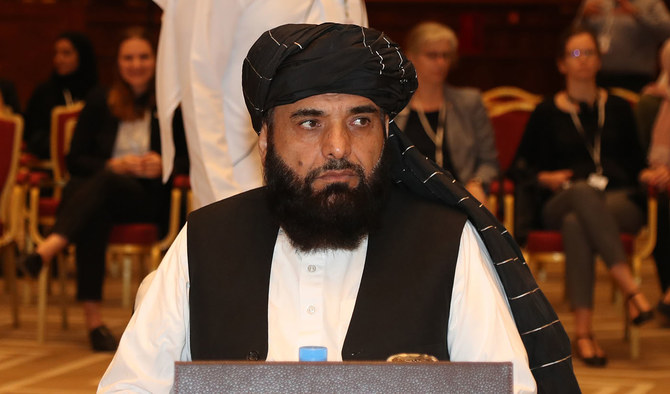
The three-member delegation is headed by Taliban chief negotiator, Sher Abbas Stanekzai, and includes the group’s political spokesman in Doha, Suhail Shaheen, and another senior Taliban member, Qari Din Muhammad.
This is the first Taliban foreign trip after Trump blocked the peace deal on Saturday, citing a Taliban-claimed attack that killed an American soldier along with 10 other people.
Earlier in the day, Shaheen told Arab News the insurgent group would explain its position to “friends and allies about the unexpected, abrupt and unjustified” cancellation of peace talks by the US president after the two negotiating teams had finalized the draft of a peace agreement.
He added that the Taliban could meet officials of several countries “who were also astonished by Trump’s decision” since the agreement was achieved after nearly one year of negotiations.
Last Saturday, the US president unexpectedly announced in a series of Twitter posts that he had canceled a secret summit with major Taliban leaders at Camp David due to an attack in Kabul that killed 12 people, including an American soldier.
Shaheen told Arab News from Qatar that the Taliban stood by their commitments in the draft agreement and would not allow the Afghan soil to be used against the US, its allies or any other country, adding that Washington should also honor its commitment to end its invasion and withdraw all troops.
The Taliban spokesman ruled out direct talks with the Afghan government, though he said the insurgent group favored unofficial intra-Afghan dialogue while referring to the three sessions of Taliban meetings with Afghan political leaders and civil society members in Moscow and Doha this year.
A day after President Trump called off the talks, the Afghan government urged the Taliban to stop fighting and start direct talks with Kabul.
“Why should we sit with the Kabul administration when the country is still under occupation? The formal intra-Afghan talks were linked to the signing of the Taliban-US deal which the US has blocked. Official intra-Afghan dialogue was planned within three weeks after the date of the formal announcement of the peace agreement. The US disrupted that process,” Shaheen said.
Speaking at a ceremony to honor the victims of the September 11 attacks on Wednesday, President Trump said the Taliban were hit “harder than they have ever been hit before.”
Secretary of State Mike Pompeo claimed on Sunday that the US and its NATO allies had killed a thousand Taliban militants in 10 days.
On Friday, Afghan President Ashraf Ghani also claimed that attacks had intensified against the Taliban and over 1,000 insurgent fighters had been killed in a week.
However, another Taliban spokesman, Zabihullah Mujahid, dismissed Ghani’s statement as baseless and a “figment of his imagination,” adding that Afghan forces did not possess such capability.
Shaheen said the US and its allies would fail to achieve anything through use of force and ultimately return to the negotiating table.
“If they [the Americans] want to make Afghanistan subservient through use of force, they should remember that they could not do that in 18 years. Cancellation of the peace negotiations by the US will prolong the war that will harm the country. The US will again return to the negotiating table even after 10 or 20 years as there is no other way out but a political solution. Trump is choosing a way which is not the way of success,” he said.
Shaheen claimed the US president had also discredited his own negotiating team.
“I think the US negotiating team was also surprised. The Trump administration had given authority to its members. The team will understand that whatever has happened is not good for them,” he said.
Asked why the Taliban were reluctant to agree to a cease-fire despite repeated demands from the US side, he said the cease-fire came under discussions during the talks and the understanding was that it would be on the agenda of the intra-Afghan dialogue.
“It was a comprehensive peace agreement that we had reached. But the US blocked the deal and they should accept the blame as they have violated their commitment. We are still committed to honor whatever has been decided and written in the draft agreement,” Shaheen added.


![]()
![]()

Taliban delegation arrives in Moscow after US declared peace process dead

Taliban delegation arrives in Moscow after US declared peace process dead
- The insurgent group’s spokesman tells Arab News Taliban stand by their commitments in the draft agreement
- Says the US will have to return to the negotiating table since use of force will not resolve anything
Latest updates


© 2026 SAUDI RESEARCH & PUBLISHING COMPANY, All Rights Reserved And subject to Terms of Use Agreement.