NEW YORK: Americans are commemorating 9/11 with mournful ceremonies, volunteering, appeals to “never forget” and rising attention to the terror attacks’ extended toll on responders.
A crowd of victims’ relatives is expected at ground zero Wednesday, while President Donald Trump is scheduled to join an observance at the Pentagon. Vice President Mike Pence is to speak at the third attack site, near Shanksville, Pennsylvania.
Former President George W. Bush, the commander-in-chief at the time of the 2001 attacks, is due at an afternoon wreath-laying at the Pentagon.
Eighteen years after the deadliest terrorist attack on American soil, the nation is still grappling with the aftermath at ground zero, in Congress and beyond. The attacks’ aftermath is visible from airport security checkpoints to Afghanistan. A rocket exploded at the US embassy as the anniversary began in Afghanistan, where a post-9/11 invasion has become America’s longest war.
“People say, ‘Why do you stand here, year after year?’” Chundera Epps, a sister of Sept. 11 victim Christopher Epps, said at last year’s ceremony at the World Trade Center. “Because soldiers are still dying for our freedom. First responders are still dying and being ill.”
“We can’t forget. Life won’t let us forget,” she added.
The anniversary ceremonies center on remembering the nearly 3,000 people killed when hijacked planes rammed into the trade center, the Pentagon and a field near Shanksville on Sept. 11, 2001. All those victims’ names are read aloud at the ground zero ceremony, where moments of silence and tolling bells mark the moments when the aircraft crashed and the trade center’s twin towers fell.
But there has been growing awareness in recent years of the suffering of another group of people tied to the tragedy: firefighters, police and others who died or fell ill after exposure to the wreckage and the toxins unleashed in it.
While research continues into whether those illnesses are tied to 9/11 toxins, a victims compensation fund for people with potentially Sept. 11-related health problems has awarded more than $5.5 billion so far. Over 51,000 people have applied.
After years of legislative gridlock, dwindling money in the fund and fervent activism by ailing first responders and their advocates, Congress this summer made sure the fund won’t run dry . Trump, a Republican and a New Yorker who was in the city on 9/11, signed the measure in July.
The sick gained new recognition this year at the memorial plaza at ground zero, where the new 9/11 Memorial Glade was dedicated this spring.
The tribute features six large stacks of granite inlaid with salvaged trade center steel, with a dedication “to those whose actions in our time of need led to their injury, sickness, and death.” No one is named specifically.
Some 9/11 memorials elsewhere already included sickened rescue, recovery and cleanup workers, and there is a remembrance wall entirely focused on them in Nesconset, on Long Island. But those who fell ill or were injured, and their families, say having a tribute at ground zero carries special significance.
Meanwhile, the Pentagon announced Monday that its 9/11 memorial will close next week for electrical and lighting work. The project, expected to take until late May, includes repairs to lighting glitches in the shallow reflecting pools under the memorial benches.
Sept. 11 is known not only as a day for remembrance and patriotism, but also as a day of service. People around the country continue to volunteer at food banks, schools, home-building projects, park cleanups and other charitable endeavors on and near the anniversary.


![]()

US to commemorate 9/11 as its aftermath extends and evolves
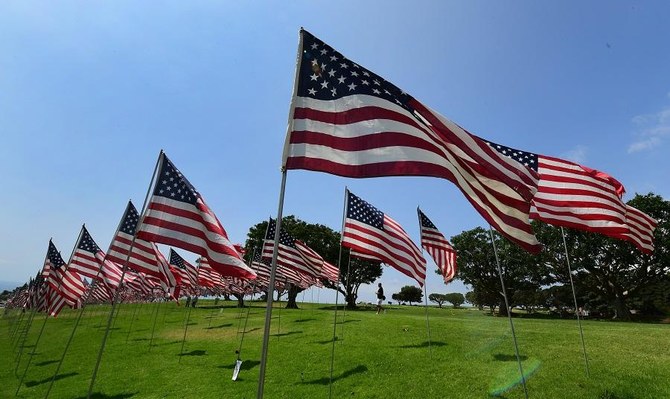
US to commemorate 9/11 as its aftermath extends and evolves
- President Donald Trump is scheduled to join an observance at the Pentagon
- Eighteen years after the deadliest terrorist attack on American soil, the nation is still grappling with the aftermath at ground zero, in Congress and beyond


Latest updates


© 2026 SAUDI RESEARCH & PUBLISHING COMPANY, All Rights Reserved And subject to Terms of Use Agreement.