Trump fires national security adviser John Bolton

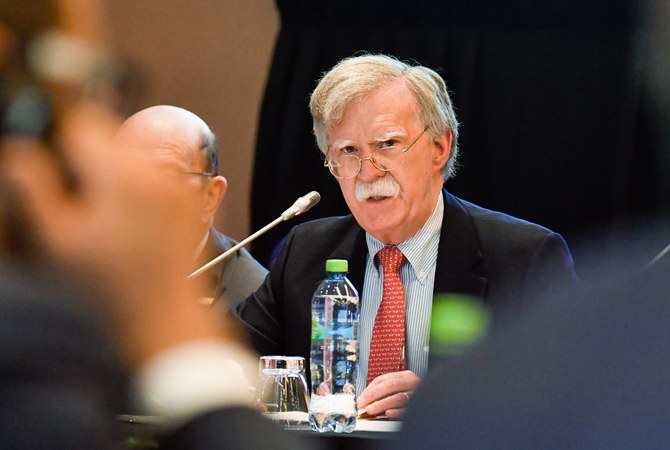
Trump said he strongly disagreed with John Bolton on several issues. (AFP/File photo)
Updated 11 September 2019
Follow

Trump fires national security adviser John Bolton

  • Trump tweeted that he told Bolton Monday night his services were no longer needed at the White House and said Bolton submitted his resignation on Tuesday morning
  • Bolton espoused hawkish foreign policy views dating back to the Reagan administration and became a household name over his vociferous support for the Iraq War

WASHINGTON: President Donald Trump said Tuesday he fired national security adviser John Bolton, citing strong disagreements on a number of policy issues.
Trump tweeted that he told Bolton Monday night his services were no longer needed at the White House and said Bolton submitted his resignation on Tuesday morning. Trump said that he “disagreed strongly” with many of Bolton’s suggestions, “as did others in the administration.”

Bolton responded in a tweet of his own that he offered to resign Monday “and President Trump said, ‘Let’s talk about it tomorrow.’“
Bolton’s ouster came as a surprise to many in the White House. Just an hour before Trump’s tweet, the press office announced that Bolton would join Secretary of State Mike Pompeo and Treasury Secretary Steven Mnuchin in a briefing.

Bolton was always an unlikely pick to be Trump’s third national security adviser, with a world view seemingly ill-fit to the president’s isolationist “America First” pronouncements.
He’s espoused hawkish foreign policy views dating back to the Reagan administration and became a household name over his vociferous support for the Iraq War as the US ambassador to the UN under George W. Bush. Bolton even briefly considered running for president in 2016, in part to make the case against the isolationism that Trump would come to embody.
Inside the administration he advocated caution on the president’s whirlwind rapprochement with North Korea and against Trump’s decision last year to pull US troops out of Syria. He masterminded a quiet campaign inside the administration and with allies abroad to convince Trump to keep US forces in Syria to counter the remnants of the Islamic State and Iranian influence in the region.
Bolton was named Trump’s third national security adviser in April 2018 after the departure of Army Gen. H.R. McMaster.


In Ethiopia, Tigrayans fear return to ‘full-scale war’

Updated 02 February 2026
Follow

In Ethiopia, Tigrayans fear return to ‘full-scale war’

  • Flights have been suspended into Tigray since Thursday and local authorities reported drone strikes on goods lorries
  • The international community fears the fighting could turn into an international conflict between Ethiopia and Eritrea

ADDIS ABABA: Tigrayans in northern Ethiopia fear a return to all-out war amid reports that clashes were continuing between local and federal forces on Monday, barely three years after the last devastating conflict in the region.
The civil war of 2020-2022 between the Ethiopian government and Tigray forces killed more than 600,000 people and a peace deal known as the Pretoria Agreement has never fully resolved the tensions.
Fighting broke out again last week in a disputed area of western Tigray called Tselemt and the Afar region to the east of Tigray.
Abel, 38, a teacher in Tigray’s second city Adigrat, said he still hadn’t recovered from the trauma of the last war and had now “entered into another round of high anxiety.”
“If war breaks out now... it could lead to an endless conflict that can even be dangerous to the larger east African region,” added Abel, whose name has been changed along with other interviewees to protect their identity.
Flights have been suspended into Tigray since Thursday and local authorities reported drone strikes on goods lorries on Saturday that killed at least one driver.
In Afar, a humanitarian worker, speaking to AFP on condition of anonymity, said there had been air strikes on Tigrayan forces and that clashes were ongoing on Monday, with tens of thousands of people displaced.
AFP could not independently verify the claims and the government has yet to give any comment on the clashes.
In the regional capital Mekele, Nahom, 35, said many people were booking bus tickets this weekend to leave, fearing that land transport would also be restricted soon.
“My greatest fear is the latest clashes turning into full-scale war and complete siege like what happened before,” he told AFP by phone, adding that he, too, would leave if he could afford it.
Gebremedhin, a 40-year-old civil servant in the city of Axum, said banks had stopped distributing cash and there were shortages in grocery stores.
“This isn’t only a problem of lack of supplies but also hoarding by traders who fear return of conflict and siege,” he said.
The region was placed under a strict lockdown during the last war, with flights suspended, and banking and communications cut off.
The international community fears the fighting could turn into an international conflict between Ethiopia and Eritrea, whose relations have been increasingly tense in recent months.
The Ethiopian government accuses the Tigrayan authorities and Eritrea of forging closer ties.
United Nations Secretary-General Antonio Guterres is “deeply concerned about... the risk of a return to a wider conflict in a region still working to rebuild and recover,” his spokesman said.
The EU said that an “immediate de-escalation is imperative to prevent a renewed conflict.”