Britain summons Iranian ambassador after oil tanker offloads in Syria

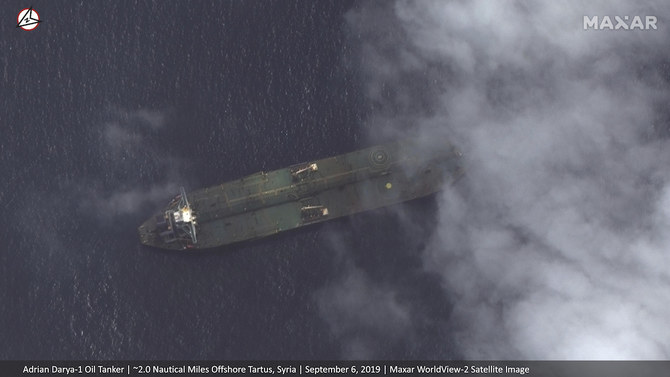
The Adrian Darya-1 unloaded its oil in Syria despite Iran giving reassurances that the vessel would not. (Satellite image Maxar Technologies via AP)
Updated 10 September 2019
Follow

Britain summons Iranian ambassador after oil tanker offloads in Syria

  • Britain said Iran had unloaded in Syria despite giving reassurances that it would not
  • The vessel, formerly named Grace 1, was seized by British Royal Marine commandos on July 4

LONDON: Britain said Iran had sold the oil cargo of tanker Adrian Darya 1 to Syria, breaking assurances it had given over the vessel which had been detained in Gibraltar for a suspected breach of European Union sanctions.
The vessel, formerly named Grace 1, was seized by British Royal Marine commandos on July 4 on suspicion of being en route to Syria.
Gibraltar released it on Aug. 15 after receiving formal written assurances from Tehran that the ship would not discharge its 2.1 million barrels of oil in Syria.
But Britain's foreign office said in a statement on Tuesday it was clear Iran had breached those assurances and that the oil had been transferred to Syria.
"Iran has shown complete disregard for its own assurances over Adrian Darya 1," foreign minister Dominic Raab said in the statement.
"This sale of oil to (Syrian President Bashar al-Assad's) brutal regime is part of a pattern of behaviour by the Government of Iran designed to disrupt regional security."
Britain said it had summoned the Iranian Ambassador to condemn Iran’s actions and would raise the issue at the United Nations later this month.
"Iran’s actions represent an unacceptable violation of international norms," the statement said


Iran open to compromises to reach nuclear deal with US, minister tells BBC

Updated 15 sec ago
Follow

Iran open to compromises to reach nuclear deal with US, minister tells BBC

  • A US delegation, including envoys Steve Witkoff and Jared Kushner, will meet with the ⁠Iranians on Tuesday morning
LONDON: Iran is ready to consider compromises to reach a nuclear deal with the United States ​if Washington is willing to discuss lifting sanctions, Iran’s Deputy Foreign Minister Majid Takht-Ravanchi told the BBC in an interview published on Sunday.
Iran has said it is prepared to discuss curbs on its nuclear program in return for the lifting of sanctions, but has repeatedly ruled out linking the issue to other questions including ‌missiles.
Takht-Ravanchi confirmed ‌that a second round of ​nuclear talks ‌would ⁠take place ​on ⁠Tuesday in Geneva, after Tehran and Washington resumed discussions in Oman earlier this month.
“(Initial talks went) more or less in a positive direction, but it is too early to judge,” Takht-Ravanchi told the BBC.
A US delegation, including envoys Steve Witkoff and Jared Kushner, will meet with the ⁠Iranians on Tuesday morning, a source ‌had told Reuters on Friday, ‌with Omani representatives mediating the US-Iran contacts.
Iran’s ​atomic chief said on ‌Monday the country could agree to dilute its most ‌highly enriched uranium in exchange for all financial sanctions being lifted. Takht-Ravanchi used this example in the BBC interview to highlight Iran’s flexibility.
The senior diplomat reiterated Tehran’s stance that ‌it would not accept zero uranium enrichment, which had been a key impediment to reaching ⁠a deal ⁠last year, with the US viewing enrichment inside Iran as a pathway to nuclear weapons.
Iran denies seeking such nuclear weapons.
During his first term in office, Trump pulled the US out of a 2015 Iran nuclear agreement, known as the Joint Comprehensive Plan of Action, the signature foreign policy achievement of former Democratic President Barack Obama.
The deal eased sanctions on Iran in exchange for Tehran limiting its nuclear program to ​prevent it from being ​able to make an atomic bomb.