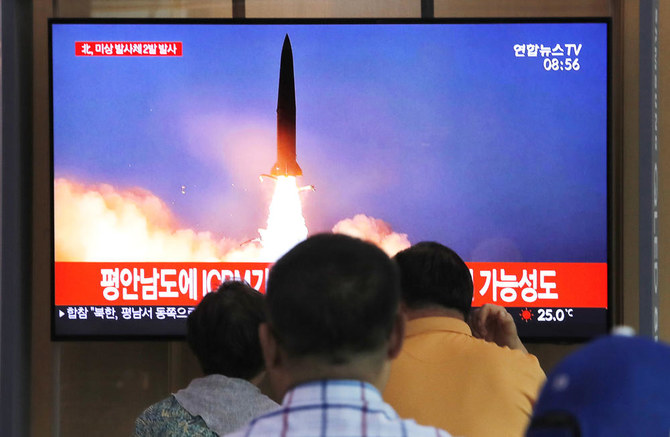
SEOUL, South Korea: North Korea launched at least two unidentified projectiles toward the sea on Tuesday, South Korea’s military said, hours after the North offered to resume nuclear diplomacy with the United States but warned its dealings with Washington may end without new US proposals.
The North’s projectile launches and demand for new proposals were apparently aimed at pressuring the United States to make concessions when the North Korea-US talks restart. North Korea is widely believed to want the United States to provide it with security guarantees and extensive relief from US-led sanctions in return for limited denuclearization steps.
The North Korean projectiles fired from its South Phyongan province, which surrounds its capital city of Pyongyang, flew across the country and in the direction of the waters off its east coast, according to South Korea’s Joint Chiefs of Staff and Defense Ministry.
The military said South Korea will monitor possible additional launches by North Korea but gave no further details like exactly what projectile North Korea fired.
Tuesday’s launches were the eighth such launches since late July and the first since Aug. 24. The previous seven launches have revealed short-range missile and rocket artillery systems that experts say would potentially expand its capabilities to strike targets throughout South Korea, including US military bases there.
On Monday night, the North’s first vice foreign minister, Choe Son Hui, said North Korea is willing to resume nuclear diplomacy with the United States in late September but that Washington must come to the negotiating table with acceptable new proposals. She said if the proposals don’t satisfy North Korea, dealings between the two countries may come to an end.
President Donald Trump called North Korea’s announcement “interesting.”
“We’ll see what happens,” Trump said. “In the meantime, we have our hostages back, we’re getting the remains of our great heroes back and we’ve had no nuclear testing for a long time.”
There was no immediate comment from the White House following reports of the launches.
South Korea’s presidential office said national security adviser Chung Eui-yong presided over an emergency National Security Council meeting where officials expressed “strong concern” over the continuing short-range launches by the North.
In the late-night statement carried by state media, Choe said North Korea is willing to sit down with the United States “for comprehensive discussions in late September of the issues we have so far taken up, at a time and place to be agreed.”
Choe said she hopes the United States will bring “a proposal geared to the interests of the DPRK and the US and based on decision methods acceptable to us.” DPRK stands for the Democratic People’s Republic of Korea, the North’s official name.
She warned that “if the US side fingers again the worn-out scenario which has nothing to do with new decision methods at the DPRK-US working negotiation to be held with so much effort, the DPRK-US dealings may come to an end.”
Talks on North Korea’s nuclear disarmament fell apart in February when Trump rejected North Korean leader Kim Jong Un’s demand for sweeping sanctions relief in return for partial disarmament at their second summit in Vietnam.
It was a huge embarrassment for the young North Korean leader, who made a dayslong train trip to the Vietnamese capital to obtain the sanctions relief he needs to revitalize his country’s troubled economy.
In April, Kim said he was open to another summit with Trump but set the end of the year as a deadline for the US to offer improved terms for an agreement to revive the nuclear diplomacy.
Kim and Trump met again at the Korean border in late June and agreed to restart diplomacy, but there have no public meetings between the sides since then.
In recent months, North Korea has carried out a slew of missile and rocket tests to protest joint military drills between the US and South Korea that North Korea views as an invasion rehearsal. Some experts said the North Korean weapons tests were also a demonstration of its expanding weapons arsenal aimed at boosting its leverage ahead of new talks with the United States.
Most of the North Korean weapons tested in July and August have been short range. This suggests that North Korea hasn’t wanted to lift its self-imposed moratorium on nuclear and long-range missile tests, which would certainly derail negotiations with Washington.
Trump has downplayed the latest North Korean weapons tests, saying the US never restricted short-range tests.
Some experts said Trump’s repeated downplaying of North Korea’s recent launches allowed the country to speed up its weapons development while it seeks to build leverage ahead of negotiations with Washington.
By repeatedly firing the short-range weapons system that directly threaten South Korea but not the US mainland or its Pacific territories, Pyongyang is also seen as pressuring Seoul to coax major concessions from Washington on its behalf. The North, while recently ignoring the South’s pleas for talks, has also demanded that Seoul turn away from Washington and restart inter-Korean economic projects currently held back by US-led sanctions against the North.


![]()

North Korea fires projectiles after offering talks with US
North Korea fires projectiles after offering talks with US
Latest updates




© 2026 SAUDI RESEARCH & PUBLISHING COMPANY, All Rights Reserved And subject to Terms of Use Agreement.