

Saudi Arabia’s Nazaha chief urges cooperation among Gulf anti-corruption agencies

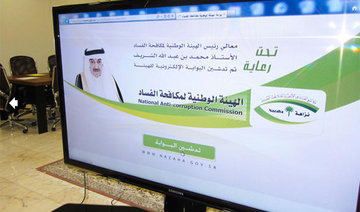
The headquarters of the National Anti-Corruption Commission (Nazaha) in Riyadh. (Courtesy of Nazaha website)
Updated 10 September 2019
Follow

Saudi Arabia’s Nazaha chief urges cooperation among Gulf anti-corruption agencies

RIYADH: The president of the National Anti-Corruption Commission (Nazaha) stressed the importance of continuing and enhancing cooperation and exchanging expertise among anti-corruption agencies in the Gulf to achieve regional security, stability, development and prosperity.

Mazen bin Ibrahim Al-Kahmous was speaking at a meeting of Gulf Cooperation Council (GCC) anti-corruption agencies, which was held in Oman.

He thanked the sultanate and the council’s general secretariat for organizing the meeting, and expressed hope that the aspirations of the leaders of GCC countries will be achieved.

Nazaha aims to create a work environment of integrity, transparency, honesty, justice and equality in the bodies that fall within its jurisdiction or specialization.

According to official statistics, Nazaha received 15,591 reports in 2018 compared with 10,402 the previous year. Financial and administrative corruption cases made up the bulk of the reports.

Decoder


First Saudi State’s economy laid foundation for modern stability

Updated 23 February 2026
Follow

First Saudi State’s economy laid foundation for modern stability

  • Revived commerce in Arabian Peninsula, according to historian
  • Diriyah highlighted as premier political and commercial center

RIYADH: The economy of the First Saudi State served as a fundamental pillar in building the nation, consolidating its influence, and ensuring its stability, the Saudi Press Agency reported recently.

The main features of this economy is outlined in the book “Diriyah: Origins and Development during the First Saudi State,” by Dr. Abdullah Al-Saleh Al-Othaimeen, the SPA reported.

The measures taken in those early days helped to ensure security, unify regions, and organize society. This assisted in stimulating trade, stabilizing markets, and enhancing life in Diriyah and surrounding areas.


Beyond its political and intellectual prominence, Diriyah emerged as a vibrant economic hub. (SPA)

The book, published by the King Abdulaziz Foundation for Research and Archives, outlines how these actions facilitated the arrival of caravans, secured vast trade routes, and revived commerce across the Arabian Peninsula.

Beyond its political and intellectual prominence, Diriyah emerged as a vibrant economic hub. Its markets attracted merchants and students from across the region.

The local community relied on diverse activities including trade, agriculture, and livestock breeding, with horses and camels playing crucial roles in transportation, commerce, and securing roads.

Economic growth during this founding phase “solidified Diriyah’s position as a premier political and commercial center in the Arabian Peninsula,” the SPA reported