

Strong typhoon makes landfall near Tokyo, snarling transport

1 / 3
Workers remove a fallen signboard hit by typhoon Faxai in Kamakura, Kanagawa prefecture on September 9, 2019. (AFP / JIJI PRESS)
2 / 3
A truck turned over by high winds lies on a highway in Tomisato on September 9, 2019. (AFP / JIJI PRESS)
3 / 3
A crowd of passengers is seen as they wait for operations of train services to resume in a snarl caused by Typhoon Faxai at Urawa station in Saitama, north of Tokyo, on September 9, 2019. (Kyodo/via REUTERS)
Updated 09 September 2019
Follow

Strong typhoon makes landfall near Tokyo, snarling transport

  • Scores of train lines were stopped, snarling the morning commute for millions in the greater Tokyo area
  • Around four to five typhoons make landfall in Japan every year, but it is unusual for them to do so near Tokyo

TOKYO: A powerful typhoon that battered Tokyo overnight with ferocious winds and driving rain caused commuter chaos on Monday morning, with trains halted and more than 100 flights cancelled.
Typhoon Faxai, packing winds of up to 216 kilometres (134 miles) per hour, made landfall in Chiba just east of the capital before dawn, after barrelling through Tokyo Bay.
The transport disruptions unleashed by the storm came less than two weeks before the start of the Rugby World Cup, and delayed the arrival of the Australian team -- a reminder that Japan's typhoon season could present challenges for organisers.
Forecasters had warned of potential record wind speeds for a typhoon in the region, and non-mandatory evacuation orders were still in place at 8:00 am (2300 GMT) for nearly 340,000 people.
Authorities said more than 2,000 people had taken refuge in shelters opened to accommodate those complying with the evacuation advisories.
More than 30 people were injured in the storm, the Kyodo news agency said, including a woman who sustained serious injuries after pillars at a golf range were toppled by high winds and hit a house.
And on Sunday night, eight surfers were rescued after being swept out to sea in high waves off Shizuoka in central Japan.
Authorities said two of the surfers were sent to hospital but none of those rescued were in serious condition.
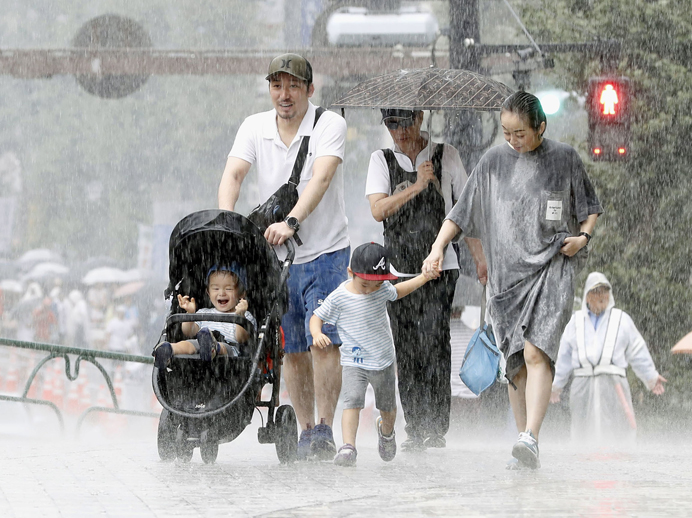


People walk through heavy rain caused by a typhoon in Tokyo on Sept. 8, 2019. (Kyodo News via AP)

The strong winds downed trees and power lines, with left 910,000 people without electricity in the Tokyo area on Monday morning, NHK said.
And at least 10 homes were damaged in Shizuoka, with windows shattered and cars flipped on their sides, local media reported.
Television footage showed a huge roof collapsing at a gasoline station in Tateyama, south of Tokyo, with pumps crushed underneath.
Elsewhere, scaffolding was torn from buildings and protective sheeting hung to keep construction debris off the streets was crumpled and torn by the storm.
While the damage was relatively light given the wind speeds, it was enough to cause chaos in the capital's notoriously busy morning commute.
The overland East Japan Railway train system was largely halted in the early hours of operation while tracks were checked for fallen trees and other debris from the storm.
"We need to inspect tracks and check if there is any damage," a train company spokesman told AFP earlier.
The storm also caused delays and stoppages on subway lines, leading to massive crowds at some stations in the busy metropolitan area that is home to 36 million people.
Bullet train services that were suspended during the storm were largely resumed, though some were operating on a reduced schedule. Some roads were blocked by downed trees.
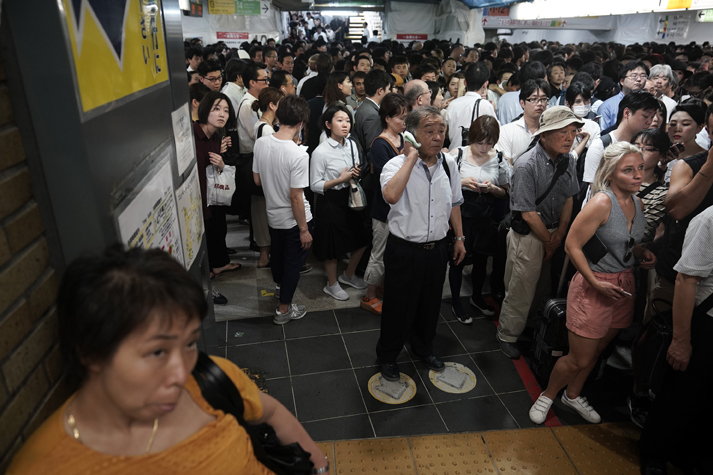


Commuters line up at Shinjuku Station, waiting for train platforms to open on Sept. 9, 2019, in Tokyo. (AP Photo/Jae C. Hong)

And at least 138 domestic flights were cancelled, with the weather even delaying the arrival of the Australian rugby team due to arrive in Tokyo Monday ahead of the World Cup that kicks off on September 20.
The French team managed to sneak in just ahead of the typhoon and reach their training camp near Mount Fuji.
However, the Wallabies squad found their preparations disrupted by Faxai's arrival.
By mid-Monday morning, the storm had moved back offshore and was headed northeast away from Japan, back into the Pacific.
The weather agency warned that landslides were still possible in China as well as the northern Fukushima region as the storm headed away from land.
Japan is used to severe tropical storms and typhoons during late summer and autumn.
Strong typhoon Krosa lashed western Japan in mid-August, bringing strong winds and torrential rain that claimed one life.
And in late August, heavy rains left three people dead when massive floods also hit western Japan.
But this year, the typhoon season coincides with the Rugby World Cup, presenting a possible headache for teams and organisers.
Tournament rules say that if a pool match has to be scrapped due to extreme weather, it is classed as a draw, which could have a major impact on what is set to be a very close competition.


Congressional Black Caucus and civil rights leaders unite to counter Trump administration’s agenda

Updated 4 sec ago
Follow

Congressional Black Caucus and civil rights leaders unite to counter Trump administration’s agenda

  • Rep. Yvette Clarke of New York, caucus chair, lamented the concerted effort to roll back civil rights underlying voting access and dismantling of social programs 
  • Civil rights leaders and Democratic lawmakers have already filed dozens of lawsuits against the administration’s anti-DEI policies

WASHINGTON: The Congressional Black Caucus and major civil rights groups on Tuesday marked Black History Month by relaunching a national plan to mobilize against what they say are the Trump administration’s efforts to weaken legal protections for minority communities.
The assembled leaders voiced outrage over the series of policy actions President Donald Trump has implemented since his return to the White House, as well as the president’s personal conduct, but offered few concrete details about what they’re prepared to do in response to the administration.
“Over the past year, we have seen a concerted effort to roll back civil rights underlying voting access, dismantle social programs and concentrate power in the hands of the wealthy and well-connected, at the expense of our community,” said Rep. Yvette Clarke, D-N.Y., chair of the Congressional Black Caucus.
Clarke, who spoke in front of leaders from major civil rights organizations and her Democratic colleagues, promised the caucus would “legislate, organize, mobilize our communities.” The coalition, which spoke privately before the press conference, discussed how to protect voters ahead of the fall midterms and how to build a policy agenda for Democrats should the party win back power in either chamber of Congress next year.
“It’s an all-hands-on-deck moment, and every tool available to the leadership collectively has got to be deployed to get this thing turned around,” House Minority Leader Hakeem Jeffries, D-N.Y., told The Associated Press after the press conference.
Jeffries did not rule out mass protests, organizing boycotts and further legal action as potential steps organizers may take.
The leaders’ warnings come at a moment when the Trump administration has continued its crusade against diversity, equity and inclusion across the US government, in higher education and the private sector.
At the start of his second term, Trump signed multiple executive orders banning the use of “illegal DEI” in government agencies, as well as organizations that interact with the federal government. Trump has threatened to withhold funds from major companies, non-profit groups and state governments as part of the administration’s efforts to upend DEI.
The administration has also sought to redefine the nation’s culture and how history is taught in museums, classrooms and other educational settings. It also prioritized investigating and prosecuting civil rights cases of potential discrimination against white people through both the Justice Department’s civil rights division and the Equal Employment Opportunity Commission, among other agencies.
Civil rights leaders and Democratic lawmakers have already filed dozens of lawsuits against the administration’s anti-DEI policies.
Locked out of power in both chambers of Congress, Democrats have fewer ways to conduct oversight or limit the actions of the Trump administration. And civil rights leaders, who were largely knocked on the back foot by a deluge of policy changes over the last year, are attempting to regroup ahead of this year’s midterm elections.
Progressive civil rights leaders, who are broadly unhappy with the administration’s entire agenda, have argued that the president’s agenda on immigration, voting rights, the economy and other issues is exploiting hard-won policies that civil rights leaders had, for decades, used to ensure anti-discrimination and economic advancement for Black communities.
“This is about how this administration is using the tools we built as a Black community to ensure that all of our people are protected,” said Maya Wiley, president and CEO of the Leadership Conference on Civil and Human Rights.
Progressive state leaders and civil rights groups have also stepped up their efforts elsewhere. A coalition of state attorneys general and civil rights groups this month launched a coalition to promote DEI and accessibility policies through more aggressive legal action.
“State attorneys general are in a unique position to defend these fundamental rights, and this campaign will ensure everyone is heard and shielded from those who aim to weaken civil rights,” Illinois Attorney General Kwame Raoul said in a statement on Monday announcing the initiative.
The initiative includes Democratic attorneys general from fourteen states District of Columbia, as well as over a dozen civil rights groups from across the country. The group intends to launch inquiries and file lawsuits across the country into instances where, the leaders argue, organizations may be violating anti-discrimination laws in response to the rollback of DEI policies by major companies and the Trump administration.
The effort faces an uncertain and shifting legal landscape.
Federal courts remain divided over the use of race in hiring and anti-discrimination in the workplace. And the conservative-majority on the Supreme Court has ruled against the use of race in college admissions. Several justices have voiced skepticism about how race and other characteristics can be used by government agencies and private institutions, even if a policy was meant to combat discrimination.
On Tuesday, the assembled civil rights leaders repeatedly acknowledged the uphill battle that their movement faced on multiple fronts. Some said that the administration’s policy decisions may set up stark political battles in the coming years.
Marc Morial, president of the National Urban League, said: “We commit today to fight and fight and fight until hell freezes over, and then, I can assure you, we will fight on the ice.”