LONDON: Britain should delay Brexit beyond Oct. 31 rather than leave the European Union without a deal which is a particular threat to large automakers, the head of the sector’s industry body told Reuters on Friday.
As the United Kingdom spins toward an election, Brexit remains up in the air more than three years after Britons voted to leave the bloc in a 2016 referendum. Options range from a turbulent ‘no-deal’ exit to abandoning the whole endeavor.
The autos sector, the country’s biggest exporter of goods, has been one of the most vocal opponents of a no-deal Brexit, warning that production would be hit with tariffs, border delays and new bureaucracy, ruining the viability of many plants.
“Leaving without a deal would be the worst outcome,” the Chief Executive of the Society of Motor Manufacturers of Traders (SMMT) Mike Hawes told Reuters.
“If it takes an extra couple of months to get that deal, I think the industry would put up with that,” he said.
Figures published by the SMMT in July showed investment in Britain’s car sector fell by more than 70 percent in the first half of the year to £90 million ($111 million), although a major investment by Jaguar Land Rover will boost the full-year figure.
“Investment in the UK has effectively stopped,” said Hawes.
“It has, because they (investors) fear no-deal. That will make it very, very difficult to continue to have the certainty and confidence to invest in the UK.”

UK carmakers urge Brexit delay rather than no-deal exit
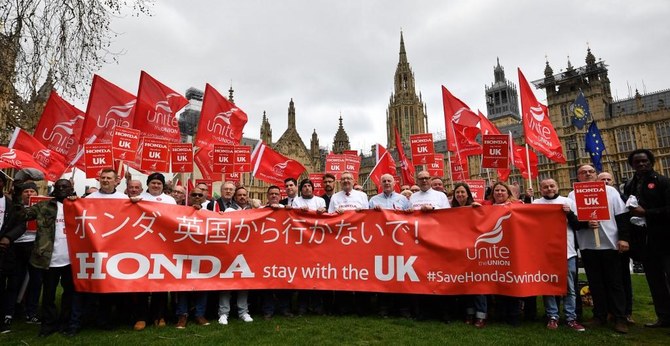
- Brexit remains up in the air more than three years after Britons voted to leave the bloc in a 2016 referendum
Saudi Arabia’s net FDI inflows jump 34.5% in Q3: GASTAT
RIYADH: Saudi Arabia’s foreign direct investment net inflows reached SR24.9 billion ($6.64 billion) in the third quarter of this year, marking a 34.5 percent increase from the same period in 2024, official data showed.
According to a report by the General Authority for Statistics, net inflows also rose 5.2 percent in the third quarter compared with the previous three months.
The increase reflects Saudi Arabia’s broader efforts to attract long-term foreign capital under its Vision 2030 strategy, which aims to diversify the economy beyond oil revenues. Under the program, the Kingdom is targeting $100 billion in annual FDI by 2030.
In its latest by GASTAT stated: “The value of FDI inflows amounted to about SR27.7 billion during the third quarter of this year. It achieved an increase of 4.4 percent compared to the third quarter of 2024, which was approximately SR26.5 billion.”
The report added that FDI inflows rose 3.3 percent in the third quarter compared with the previous three months.
Saudi Arabia has been implementing regulatory reforms, opening up sectors such as tourism, renewable energy, and technology to international investors, while launching initiatives through the Ministry of Investment to attract foreign capital.
According to GASTAT, FDI outflows amounted to about SR2.7 billion in the third quarter, representing a 65.7 percent decline from the same period in 2024. Compared with the second quarter, outflows fell 11.4 percent.
In a separate release in September, GASTAT said FDI inflows rose 24 percent in 2024 to SR119 billion, even as global investment flows slowed. At the time, the Ministry of Investment said inflows had exceeded the National Investment Strategy’s annual target of SR109 billion.
The ministry added that Saudi Arabia has surpassed its FDI goals for four consecutive years, with annual targets set to rise from SR140 billion in 2025 to SR388 billion by 2030.
Commenting earlier on the 2024 performance, Investment Minister Khalid Al-Falih said the steady flow of foreign investment, despite global challenges, reflects the Kingdom’s ability to navigate economic headwinds.


