Bangladesh bans two aid agencies from Rohingya refugee camps

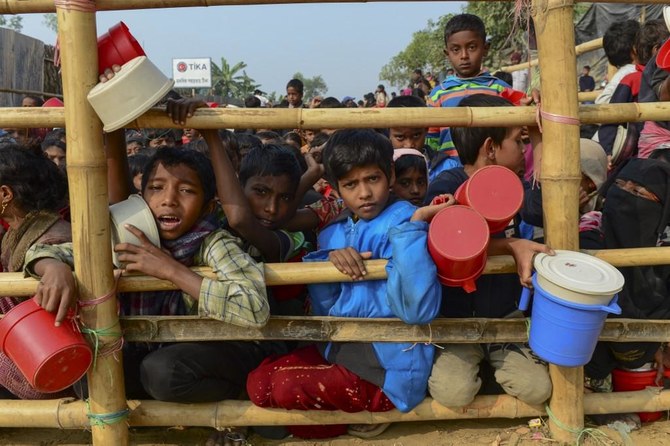
Some 740,000 Rohingyas were driven over the border to Bangladesh by a Myanmar military crackdown on the Muslim minority. (AFP)
Updated 05 September 2019
Follow

Bangladesh bans two aid agencies from Rohingya refugee camps

  • Move comes amid growing impatience from Dhaka about the presence of the refugees in the country
  • About 740,000 Rohingyas were driven over the border by a military crackdown on the Muslim minority

COX’S BAZAR, Bangladesh: Bangladesh on Thursday said it has banned two aid agencies from Rohingya camps in the country’s southeast, alleging they were telling refugees to reject repatriation to their homeland in Myanmar.
The move came amid growing impatience from Dhaka about the presence of the refugees in the country, two years after some 740,000 were driven over the border by a military crackdown on the Muslim minority.
The latest repatriation attempt by Bangladesh and Myanmar two weeks ago, the second in less than a year, failed with not a single refugee volunteering to cross the border back home.
US-based Adventist Development and Relief Agency (ADRA) and local organization Al-Markazul Islami were accused by the government’s NGO Affairs Bureau of “instigating” the stateless minority against the recent repatriation attempt.
Kamal Hossain, the government administrator of Cox’s Bazar district where the refugee camps are located, said Dhaka had issued a notice for the NGOs to immediately stop their activities across the country.
“The administration is taking action accordingly to the issued order,” he said, adding that the NGO Affairs Bureau also ordered bank transactions by the two agencies to be halted.
More than 130 aid agencies work in the three dozen squalid camps in Cox’s Bazar, where the 740,000 Rohingya fled to, joining some 200,000 others already living here.
Foreign Minister A.K. Abdul Momen last week said Dhaka would crack down on aid agencies if they “do something going beyond their terms and references.”
The Rohingya have refused to go home until Myanmar gives them guarantees of safety and citizenship status.
Tensions have ratcheted up in the camps in recent weeks as refugees marked the two-year anniversary of the 2017 exodus.
Four refugees have also been killed in the fallout over the murder of local ruling party official Omar Faruk, which police blame on Rohingya hitmen.
Bangladeshi authorities on Monday also ordered operators to shut down mobile phone services in the camps amid the outbreak of violence.


Kyiv mayor calls for temporary evacuation over heating outages

Updated 4 sec ago
Follow

Kyiv mayor calls for temporary evacuation over heating outages

  • “Moscow is trying to use cold weather as a tool of terror,” Zelensky said
  • He said 20 residential buildings in Kyiv had been damaged, including the Qatari embassy

KYIV: Mass heating outages caused by Russian strikes on Kyiv are set to last into the weekend, as the capital’s mayor called on residents to temporarily leave the city with sub-zero temperatures expected to fall even lower.
A massive missile and drone attack on Kyiv killed four and ripped open apartment blocks. Moscow also fired its feared Oreshnik ballistic missile at western Ukraine, drawing condemnation from Europe.
The barrage came hours after Moscow rejected a plan by Kyiv and its Western allies to deploy peacekeeping forces to Ukraine should a ceasefire be reached.
AFP journalists in Kyiv saw residents running for shelter late Thursday night as the air raid siren echoed, and heard Russian drones exploding into residential buildings and missiles whistling over the capital.
“Moscow is trying to use cold weather as a tool of terror,” Ukrainian President Volodymyr Zelensky said at a meeting in Kyiv with British Defense Secretary John Healy.
He said 20 residential buildings in Kyiv had been damaged, including the Qatari embassy, in one of the largest attacks on the capital for months.
Qatar expressed “deep regret” over the embassy hit and said that none of its staff there had been harmed.

- ‘Very difficult’ situation -

The Russian barrage left around half of all apartment blocks in the capital, some 6,000 buildings, without heating, Mayor Vitaliy Klitschko said.
Temperatures are set to fall to -15C on Saturday.
Officials said they were hopeful some heating could be restored on Friday night.
“In some areas where the damage is more complex, additional time is needed,” Ukraine’s Restoration Minister Oleksiy Kuleba said.
Klitschko said the situation was “very difficult” and called on “residents of the capital who have the opportunity to temporarily leave the city for places with alternative sources of power and heat to do so.”
City authorities said they had set up 1,200 warming centers.

- Russia fires rarely-used missile -

A medic who died at a building that was struck in a repeat attack was among the four killed, officials said. Another 26 were wounded.
Nina, 70, who lives in one of the buildings hit, told AFP she was angry that the world was talking about a possible deal to end the conflict at a time when Russia was launching such deadly barrages.
“Where is Europe, where is America? It doesn’t hurt them the same way,” she said.
Her neighbor, 58-year-old Kostiantyn Kondratchenko fought the second-floor blaze from a drone hit with a hose used to water flowers, he told AFP.
The barrage is just the latest to batter Ukraine as diplomats wrangle for a breakthrough in what has been Europe’s deadliest conflict since World War II.
Russia has shown no sign of slowing down its ground offensive or aerial bombardments.
Moscow’s defense ministry said it had fired the Oreshnik ballistic missile on “strategic targets” — only the second time the new weapon, which the Kremlin says is impossible to stop, is known to have been used.

- ‘Escalatory and unacceptable’ -

Ukrainian authorities said a ballistic missile traveling “at about 13,000 kilometers (8,000 miles) per hour” had struck an “infrastructure facility” near the western city of Lviv.
It said Russia had attacked “civilian infrastructure,” without specifying the target or extent of any damage.
The Oreshnik is an intermediate-range ballistic missile that can be equipped with both nuclear and conventional warheads.
Lviv region officials said that radiation levels were within normal range after the attack.
France, Germany and Britain condemned Moscow’s “escalatory and unacceptable” use of Oreshnik, a UK government spokeswoman said after a call between leaders of the three countries.
Across the border in Russia’s Belgorod, the governor said more than half a million people were without power or heating after a Ukrainian attack targeted the region’s utilities.
Despite intense diplomatic efforts led by US President Donald Trump, a deal to end the fighting remains elusive.
Moscow baulked this week after European leaders and US envoys announced post-war guarantees for Ukraine would include a US-led monitoring mechanism and a multinational force.
Russia called the plan “dangerous” and “destructive.”
Key territorial issues are also unresolved as Russia insists on getting full control of Ukraine’s Donbas region, part of which is still controlled by Kyiv.
Russia occupies around 20 percent of Ukraine.
Tens of thousands have been killed since it invaded in February 2022, millions forced to flee their homes and much of eastern and southern Ukraine decimated.