Saudi delegation discusses customs cooperation with Pakistan

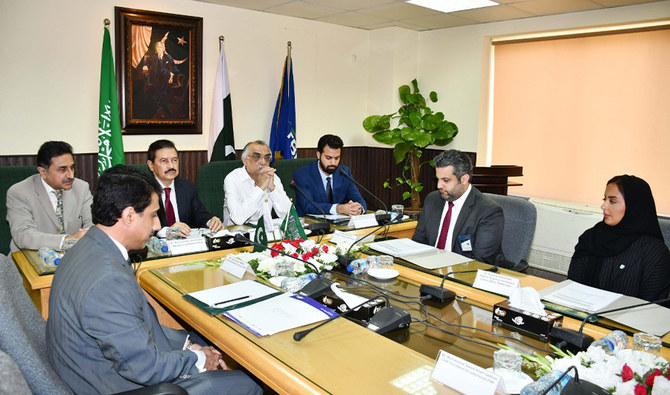
A five-member delegation from the Saudi Customs Authority visited the Federal Board of Revenue (FBR) in Islamabad on Tuesday. (FBR)
Updated 06 September 2019
Follow

Saudi delegation discusses customs cooperation with Pakistan

  • Pakistan seeks to control illicit flow of currency in an effective manner
  • The two sides emphasized exchange of information on real-time basis

ISLAMABAD: A five-member delegation of the Saudi Customs Authority visited the Federal Board of Revenue (FBR) in Islamabad on Tuesday to discuss the importance of customs cooperation between two countries, the FBR said in a statement released late yesterday.
The Saudi delegation was headed by Muhammad AlNuaim, Deputy Governor of Security Affairs while FBR Chairman Shabbar Raza Zaidi led the Pakistani side in the talks.
Both groups shared their experiences in the law enforcement domain and further explored avenues of future cooperation for the “exchange of information on a real-time basis,” in addition to discussing measures for the exchange of “intelligence-based information to effectively control illicit flow of currency.”
“Profiling of advance passenger information. Cooperation between Saudi Customs and Pakistani Customs in order to arrest the senders and recipients of drugs and [matters related] exchange of post seizure and arrest investigations [were also in the meeting],” the statement said.
It was mutually agreed that “no country can cope with these cross border challenges without ensuring international cooperation,” in addition to the fact that there was a dire need for both countries to support each other through international forums, customs cooperation and Mutual Assistance Agreements. 
“AlNuaim said that the Saudi government gives great value to its brotherly relations with the government of Pakistan,” the statement said, adding that the Kingdom had recently introduced new monetary limits on currencies which so far are not well-known to visitors from Pakistan, urging for the launch of a public awareness campaign to share this information.
Pakistani representatives, for their part, informed the visiting delegation that limiting currency smuggling was one of the prime priorities of the current government.
“Declaration of currency has now been made mandatory and the FBR has taken various legal and administrative actions to improve interdictory regime against currency smuggling,” the statement said.


At least 13 civilians killed in Pakistan strikes in Afghanistan, UN says

Updated 5 sec ago
Follow

At least 13 civilians killed in Pakistan strikes in Afghanistan, UN says

  • Pakistan said it launched the strikes after blaming recent suicide attacks on militants operating from Afghan territory
  • The reported toll adds to fears of a renewed cycle of retaliation between the neighbors, threatening a fragile ceasefire

ISLAMABAD/KABUL: At least 13 civilians ‌were killed and seven injured in Pakistani airstrikes in eastern Afghanistan, the United Nations said on Monday, as cross-border tensions escalated following a string ​of suicide bombings in Pakistan.

The reported toll adds to fears of a renewed cycle of retaliation between the neighbors, threatening a fragile ceasefire along their 2,600-km (1,600-mile) frontier and further straining ties as both sides trade blame over militant violence.

The United Nations Assistance Mission in Afghanistan (UNAMA) said it had received “credible reports” that overnight Pakistani airstrikes on February 21–22 killed at least 13 ‌civilians and injured ‌seven in the Behsud and Khogyani ​districts ‌of ⁠Nangarhar province.

Taliban ​spokesman Zabihullah ⁠Mujahid earlier reported dozens killed or wounded in the strikes, which also hit locations in Paktika province. Reuters could not independently verify the reported toll.

Pakistan said it launched the strikes after blaming recent suicide attacks, including during Ramadan, on militants operating from Afghan territory.

Pakistan’s information ministry in a post on X said ⁠the “intelligence-based” operation struck seven camps of the Pakistani Taliban ‌and Daesh (Islamic State) Khorasan Province ‌and that it had “conclusive evidence” the militant ​assaults on Pakistan were directed ‌by “Afghanistan-based leadership and handlers.”

Kabul has repeatedly denied allowing militants ‌to use Afghan territory to launch attacks in Pakistan.

The strikes took place days after Kabul released three Pakistani soldiers in a Saudi-mediated exchange aimed at easing months of tensions along the border.

Afghanistan’s defense ministry condemned ‌the strikes and called them a violation of sovereignty and international law, saying an “appropriate and measured ⁠response will ⁠be taken at a suitable time.” The Afghan foreign ministry said it had summoned Pakistan’s ambassador.

In a statement on the February 21-22 strikes, Afghanistan’s education ministry said eight school students; five boys and three girls, were killed in Behsud in Nangarhar province, and one madrasa student injured in Barmal in Paktika province, adding that dozens of other civilians were killed or wounded and educational centers destroyed. Reuters could not independently verify the information.

The latest strikes follow months of clashes and repeated border closures ​that have disrupted trade ​and movement along the rugged frontier.