

Pakistan is fifth largest recipient of KSRelief humanitarian assistance — report

1 / 2
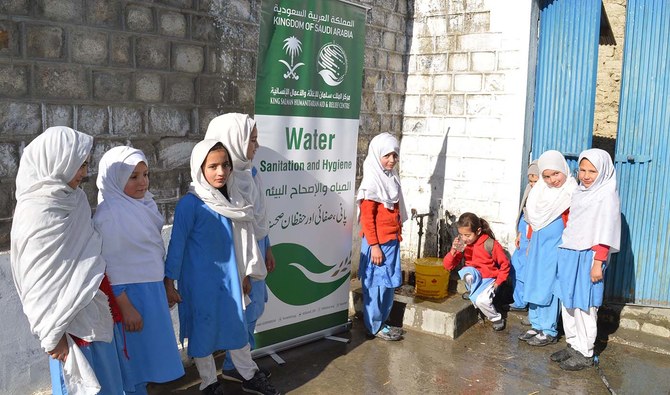
In this January 23, 2019 photo, a young schoolgirl drinks water from a hand pump, surrounded by other students. More than 350 drinking water projects have been completed by KSRelief across Pakistan in recent years. (Photo Courtesy: KSRelief)
2 / 2
Updated 04 September 2019
Follow

Pakistan is fifth largest recipient of KSRelief humanitarian assistance — report

  • The aid agency has given Pakistan $117.6 million in humanitarian and development aid since 2005
  • KSRelief has one of the largest development aid budgets in the world and is active in 44 countries

ISLAMABAD: Pakistan is the fifth-largest recipient of aid from the Saudi-based international aid agency, the King Salman Humanitarian Aid and Relief Center (KSRelief), and has received $117.6 million in aid since 2005 according to a report published by the organization. 
With one of the largest humanitarian aid budgets in the world, KSRelief has been working in 44 countries, and after Yemen, Palestine, Syria and Somalia, Pakistan is the biggest beneficiary of the organization’s aid money and humanitarian operations.
KSRelief has completed 84 projects in Pakistan in the fields of education, health care, water, sanitation, hygiene, emergency camps and community support that have cost roughly $100 million in the last 14 years, the report said. It has also completed 22 food security projects in the country during the same period.
“We have joined hands together with our Pakistani brothers by working with them in times of need and will keep on doing so in the future as well,” Dr. Khalid Mohammed Alothmani, Director for KSRelief Pakistan, told Arab News in an interview last week.
The organization has spent nearly $68 million solely on emergency disaster relief efforts in Pakistan, mainly in areas devastated by natural calamities.
But apart from relief efforts, KSRelief’s aid to Pakistan has also focused on education and school infrastructure in mostly rural establishments across the country, at a cost of $7.8 million and benefitting an estimated 13,000 students.
“KSRelief gave us furniture for 700 students,” said Ghulam Yaseen, principal of Government Middle School Village Gujji in Layyah district of southern Punjab, while talking to Arab News via telephone. 
“They constructed a new building, and none of the schools in our district has such infrastructure. Before the completion of this project...our students used to sit under the sky,” he said.
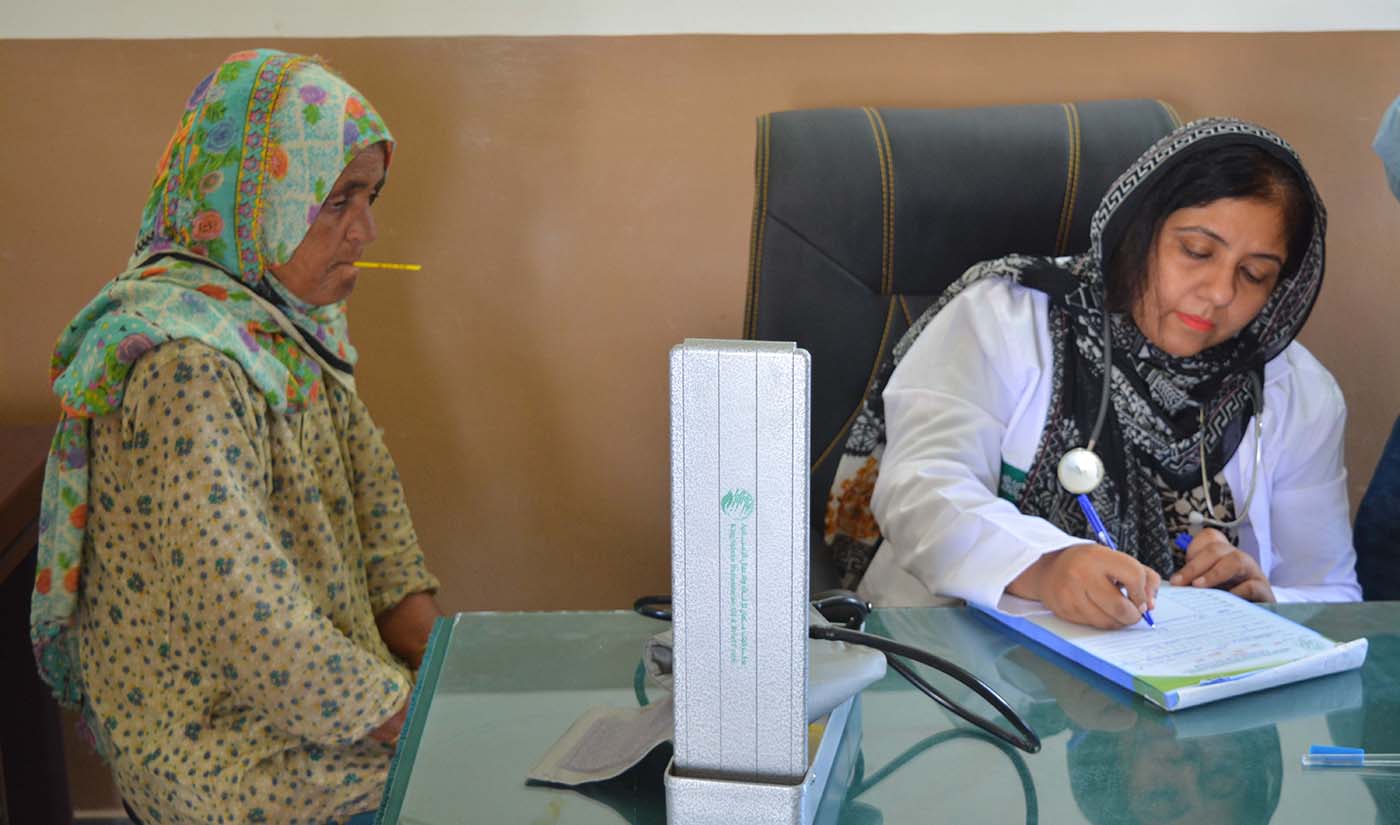


In this June 26, 2019 picture, a doctor takes notes with a patient. KSRelief has built several healthcare facilities across Pakistan, especially in rural areas. (Photo Courtesy: KSRelief)

Aid has also been given for health care, water, sanitation and hygiene improvement- projects estimated to benefit as many as 900,000 people, according to the KSRelief report.
“Our basic health unit lacked important medical equipment and beds,” said Dr. Rabia Bibi who manages a health care facility in a remote village of Dera Ghazi Khan in Pakistan’s eastern Punjab province.
“In 2017, KSRelief gave us new equipment, including ultrasound, X-ray and ECG machines...12 beds for patients, operation lights, oxygen cylinders, and other necessary equipment.”
“We were only catering to a few patients due to a lack of facilities,” Bibi said, but added that only a few serious cases were now referred to the bigger city hospitals and most were treated in-house.
Saudi Arabia and Pakistan have enjoyed historically strong ties and Riyadh has played a vital role in recent years in rebuilding and relief efforts inside Pakistan after natural calamities.
In the aftermath of the 2005 earthquake in northern Pakistan and Kashmir, where an estimated 90,000 people lost their lives and 3.5 million were rendered homeless, the Saudi government provided a grant of $10 million. 
After the 2010-11 floods, where a reported 20 million people were directly affected, the government gave a $170 million grant.


Pakistani on trial in US says Trump, Biden were possible targets in Iran-linked assassination plot

Updated 7 sec ago
Follow

Pakistani on trial in US says Trump, Biden were possible targets in Iran-linked assassination plot

  • Asif Merchant, who paid money to hitmen, tells court Iranian contact named three potential targets
  • The Pakistani national says he anticipated getting arrested, acted out of fear for his relatives in Iran

NEW YORK: The allegation sounded like the stuff of spy movies: A Pakistani businessman trying to hire hit men, even handing them $5,000 in cash, to kill a US politician on behalf of Iran ‘s powerful paramilitary Revolutionary Guard.

It was true, and potential targets of the 2024 scheme included now-President Donald Trump, then-President Joe Biden and former presidential candidate and ex-UN Ambassador Nikki Haley, the man told jurors at his attempted terrorism trial in New York on Wednesday. But he insisted his actions were driven by fear for loved ones in Iran, and he figured he’d be apprehended before anything came of the scheme.

“My family was under threat, and I had to do this,” the defendant, Asif Merchant, testified through an Urdu interpreter. “I was not wanting to do this so willingly.”

Merchant said he had anticipated getting arrested before anyone was killed, intended to cooperate with the US government and had hoped that would help him get a green card.

US authorities were, indeed, on to him — the supposed hit men he paid were actually undercover FBI agents — and he was arrested on July 12, 2024, a day before an unrelated attempt on Trump’s life in Butler, Pennsylvania. Merchant did sit for voluntary FBI interviews, but he ultimately ended up with a trial, not a cooperation deal.

“You traveled to the United States for the purpose of hiring Mafia members to kill a politician, correct?” Assistant US Attorney Nina Gupta asked during her turn questioning Merchant Wednesday in a Brooklyn federal court.

“That’s right,” Merchant replied, his demeanor as matter-of-fact as his testimony was unusual.

The trial is unfolding amid the less than week-old Iran war, which killed Iranian Supreme Leader Ayatollah Ali Khamenei in a strike that Trump summed up as “I got him before he got me.” Jurors are instructed to ignore news pertaining to the case.

The Iranian government has denied plotting to kill Trump or other US officials.

Merchant, 47, had a roughly 20-year banking career in Pakistan before getting involved in an array of businesses: clothing, car sales, banana exports, insulation imports. He openly has two families, one in Pakistan and the other in Iran — where, he said, he was introduced around the end of 2022 to a Revolutionary Guard intelligence operative. They initially spoke about getting involved in a hawala, an informal money transfer system, Merchant said.

Merchant testified that his periodic visits to the US for his garment business piqued the interest of his Revolutionary Guard contact, who trained him on countersurveillance techniques.

The US deems the Revolutionary Guard a “foreign terrorist organization.” Formally called the Islamic Revolutionary Guard Corps, the force has been prominent in Iran under Khamenei.

Merchant said the handler told him to seek US residents interested in working for Iran. Then came another assignment: Look for a criminal to arrange protests, steal things, do some money laundering, “and maybe have somebody murdered,” Merchant recalled.

“He did not tell me exactly who it is, but he told me — he named three people: Donald Trump, Joe Biden and Nikki Haley,” he added.

After US immigration agents pulled Merchant aside at the Houston airport in April 2024, searched his possessions and asked about his travels to Iran, he concluded that he was under surveillance. But still he researched Trump rally locations, sketched out a plot for a shooting at a political rally, lined up the supposed hit men and scrambled together $5,000 from a cousin to pay them a “token of appreciation.”

He even reported back to his Revolutionary Guard contact, sending observations — fake, Merchant said — tucked into a book that he shipped to Iran through a series of intermediaries.

Merchant said he “had no other option” than to play along because the handler had indicated that he knew who Merchant’s Iranian relatives were and where they lived.

In a court filing this week, prosecutors noted that Merchant didn’t seek out law enforcement to help with his purported predicament before he was arrested. He testified that he couldn’t turn to authorities because his handler had people watching him.

Prosecutors also said that in his FBI interviews, Merchant “neglected to mention any facts that could have supported” an argument that he acted under duress.

Merchant told jurors Wednesday that he didn’t think agents would believe his story, because their questions suggested “they think that I’m some type of super-spy.”

“And are you a super-spy?” defense lawyer Avraham Moskowitz asked.

“No,” Merchant said. “Absolutely not.”