
KARACHI: Pakistan’s foreign minister said on Friday US President Donald Trump had said his offer to mediate between India and Pakistan on the Kashmir conflict “still stands” despite the insistence of Indian Prime Minister Narendra Modi that the issue was bilateral.
Tensions between India and Pakistan have escalated since August 5 when India revoked the constitutional autonomy of the part of the Himalayan region of Kashmir that it administers and moved to quell objections by shutting down communications and clamping down on local leaders.
Pakistan has reacted with fury to India’s decision, cutting trade and transport ties and expelling India’s ambassador. Both countries claim Kashmir in full but rule it in part.
Trump has previously offered to mediate between India and Pakistan on Kashmir, a mountainous region which has been the source of repeated confrontations between the two nuclear-armed neighbors ever since they gained independence from British colonial rule in 1947.
This week, Trump revised his statement and said India and Pakistan could handle their dispute over Kashmir on their own.
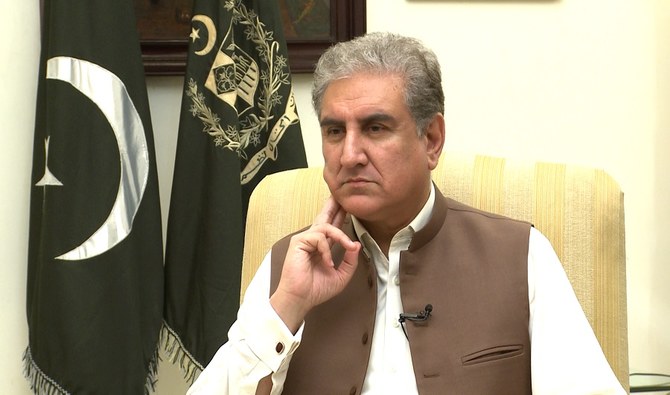
However, in an interview to Arab News, Foreign Minister Shah Mahmood Qureshi quoted the US president as saying in response to India’s insistence that the Kashmir issue was bilateral: “This has been going on for decades. Why was this not resolved? But fine, if you [India and Pakistan] can go ahead and do it yourselves, it’s okay with me. But my offer still stands.”
Qureshi did not specify if Trump had communicated this to the foreign minister directly or when and where. Arab News could not independently verify the minister's statement.
Qureshi said India had played the role of a “spoiler” in ongoing Afghan peace talks, saying New Delhi’s move to revoke the special status of Kashmir, sparking tensions with Islamabad, had “distracted” from negotiations between the United States and the Taliban over how to end the 18-year war in Afghanistan.
In the background, Zalmay Khalilzad, an Afghan-born US diplomat, has led nine rounds of talks with Taliban leaders to reach a peace deal.
“As far as Pakistan is concerned we are pushing ahead with the peace process in Afghanistan; we have facilitated the process,” Qureshi said when asked how the recent conflict in Kashmir was affecting Afghan peace talks. “But this action [of revoking Kashmir’s autonomy], this Indian action has distracted us … Now with this action obviously our attention is diverted.”
“To that extent, I think India has in my view tried to play the role of a spoiler and the West and particularly the United States should see through that,” Qureshi said.
Officially allies in fighting terrorism, Pakistan and the United States have a complicated relationship, plagued by accusations from Washington that Islamabad is playing a double game in Afghanistan, which Islamabad denies.
US officials have for years pressed Pakistan to lean on top Taliban leaders, that Washington says are based inside Pakistan, to come to the negotiating table. The US has also asked Islamabad to use its influence on the Taliban to make them agree on a permanent cease-fire and to engage in direct talks with the Afghan government.
Pakistani officials deny offering safe havens to the Afghan Taliban and say their influence on the group has waned over the years.
“Pakistan is very much in the loop [in US-Taliban peace talks],” Qureshi said to a question about Islamabad’s role in the final phase of peace talks. “Pakistan has been the facilitator. Pakistan’s role has been recognized as well as appreciated.”
The foreign minister denied that India had fared better diplomatically compared to Pakistan during the recent conflict in Kashmir, saying Islamabad had succeeded in taking the Kashmir issue to the United Nations Security Council and the conflict was now being discussed by world leaders and at major international forums.
“It [Kashmir conflict] is being recognized; it’s being talked about all over the world today,” Qureshi said. “So how can it be [our] diplomatic failure? I think it’s a diplomatic achievement.”
Qureshi said he had written a letter to the Organization of Islamic Conference Contact Group on Kashmir and would convene a meeting of the group on the sidelines of the United Nations General Assembly session next month.
“I expect not just ministerial participation, I’m expecting a ministerial communique on this issue,” he said.
Qureshi also said Pakistani Prime Minister Imran Khan would highlight the Kashmir issue during his address at the upcoming UNGA session.
“Obviously when Prime Minister Imran Khan speaks on the 27th of September, makes his statement in the General Assembly, I think the Kashmir issue will be mentioned loud and clear,” the foreign minister said. “Our message will go through to the international community loud and clear.”
Qureshi urged the Muslim world to recignize India’s human rights violations in Kashmir and speak up against them.
“Our expectation from, especially [Muslim] Ummah is that we feel that a fundamental right of religious freedom has been seriously undermined by Indian authorities,” Qureshi said. “People were not allowed to pray on Eid. They were not allowed to sacrifice their animals. Every Friday prayer is being blocked. Mosques are locked up. And this is a negation of a basic fundamental right. So the Muslim World must recognize that and speak up against it.”