

Europe to step up diplomatic efforts on Iran crisis: Germany

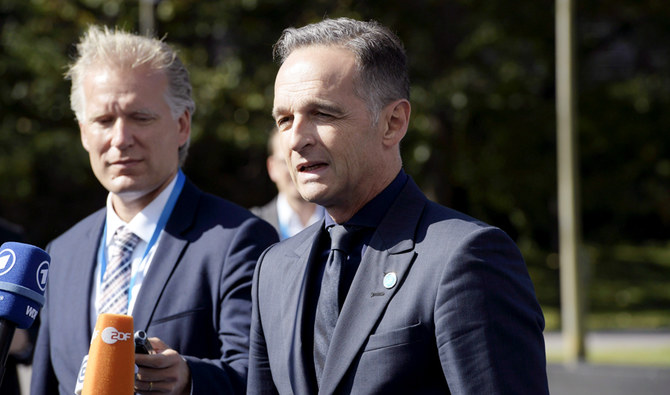
German Foreign Minister Heiko Maas speak to journalists as he arrives for the Informal Meeting of EU Foreign Ministers in Helsinki, Finland on August 29, 2019. (AFP)
Updated 31 August 2019
Follow

Europe to step up diplomatic efforts on Iran crisis: Germany

  • Germany’s Heiko Maas said the trio wanted to build on momentum from last weekend’s G7 summit, where Trump indicated willingness to talk to Iran

HELSINKI: European countries will step up diplomatic efforts to save the beleaguered Iran nuclear deal, Germany’s foreign minister said on Friday after talks with Britain and France.

Tensions have spiked recently in the Gulf, where Iran has seized Western tankers as Tehran and Washington have locked horns over the 2015 deal.

US President Donald Trump last year unilaterally pulled out of the accord that handed Iran relief from sanctions in return for curbs on its atomic program.

The move alarmed European powers, which see the deal as the best way to stop Iran acquiring nuclear weapons, and infuriated the Islamic republic.

The foreign ministers of Britain, France and Germany — the three European parties to the deal — were joined by EU diplomatic chief Federica Mogherini for talks on the sidelines of an EU meeting in Helsinki.

Germany’s Heiko Maas said the trio wanted to build on momentum from last weekend’s G7 summit, where Trump indicated willingness to talk to Iran.

“Our priority is to open the dialogue window between the US and Iran,” Maas told reporters.

“Especially after the G7 summit in Biarritz we are all of the opinion that the momentum that perhaps exists, the readiness for dialogue on both sides... must now be used.”

Mogherini said Thursday the EU would support such a move — provided the current deal was preserved. The Europeans have repeatedly said they are committed to saving the deal, but efforts to shield Iran’s economy from the reimposition of US sanctions have so far borne little fruit.

“We will be discussing further diplomatic efforts together with the French and the British — including in the region with all the countries bordering the Gulf,” Maas said.

Ahead of the meeting, British Foreign Minister Dominic Raab also said he wanted to “build on the momentum of the positive G7 talks on Iran.”

As well as mooting the summit with his Iranian counterpart Hassan Rouhani, Trump also appeared open to a French suggestion that Iran be given a line of credit to help stabilize its economy.

“The nuclear deal is the only deal on the table that prevents Iran from getting a nuclear weapon and we will continue working together to encourage Iran to uphold the agreement in full,” Raab said.

“We also need the broadest international support possible to tackle the threats to international shipping in the Strait of Hormuz.”

Britain, along with Australia and Bahrain, has joined Washington’s Operation Sentinel mission to protect commercial shipping on the crucial oil trade routes through the Gulf, in particular the Strait of Hormuz.

Other European countries have been cool on the idea, fearing greater naval presence in the region could risk escalating an already febrile situation.

The idea has been floated of a European observation mission in the Strait, a strategic choke point at the mouth of the Gulf, but a number of EU countries have voiced reservations.

Maas said there were sill “different views” and stressed nothing should be done that might imperil diplomatic efforts.

Mogherini on Thursday gave a cautious welcome to the idea of US-Iran talks but stressed “first and foremost what is existing needs to be preserved” — including the 2015 deal.

In response to the US pulling out of the deal and reimposing sanctions, Tehran has breached certain limits on its nuclear production imposed by the accord, but the EU insists it has so far not taken any irreversible steps.


US to cut roughly 200 NATO positions, sources say

Updated 4 sec ago
Follow

US to cut roughly 200 NATO positions, sources say

  • Trump famously threatened to withdraw from NATO during ⁠his first presidential term and said on the campaign trail that he would encourage Russia to attack NATO members that did not pay their fair share on defense

WASHINGTON: The United States plans to reduce the number of personnel it has stationed within several key NATO command centers, a move that could intensify concerns ​in Europe about Washington’s commitment to the alliance, three sources familiar with the matter said this week.
As part of the move, which the Trump administration has communicated to some European capitals, the US will eliminate roughly 200 positions from the NATO entities that oversee and plan the alliance’s military and intelligence operations, said the sources, who requested anonymity to discuss private diplomatic conversations.
Among the bodies that will be affected, said the sources, are the UK-based NATO Intelligence Fusion Center and the Allied Special Operations Forces Command in Brussels. Portugal-based STRIKFORNATO, which oversees some maritime operations, will also be cut, as will several other similar NATO entities, the sources said.
The sources did not specify why the US had decided to cut the number of staff dedicated to the NATO roles, but the moves broadly align with the ‌Trump administration’s stated intention to ‌shift more resources toward the Western Hemisphere.
The Washington Post first reported the decision.

TRUMP ‌RE-POSTS ⁠MESSAGE ​IDENTIFYING NATO ‌AS THREAT
The changes are small relative to the size of the US military force stationed in Europe and do not necessarily signal a broader US shift away from the continent. Around 80,000 military personnel are stationed in Europe, almost half of them in Germany. But the moves are nonetheless likely to stoke European anxiety about the future of the alliance, which is already running high given US President Donald Trump’s stepped-up campaign to wrest Greenland away from Denmark, raising the unprecedented prospect of territorial aggression within NATO.
On Tuesday morning, the US president, who is scheduled to fly to the World Economic Forum in Switzerland in the evening, shared another user’s post on social media that identified NATO as a threat to the ⁠United States. The post described China and Russia as merely “boogeymen.”
Asked for comment, a NATO official said changes to US staffing are not unusual and that the US presence in ‌Europe is larger than it has been in years.
“NATO and US authorities are in ‍close contact about our overall posture – to ensure NATO retains our ‍robust capacity to deter and defend,” the NATO official said.
The White House and the Pentagon did not respond to requests for ‍comment.

MILITARY IMPACT UNCLEAR, SYMBOLIC IMPACT OBVIOUS
Reuters could not obtain a full list of NATO entities that will be affected by the new policy. About 400 US personnel are stationed within the entities that will see cuts, one of the sources said, meaning the total number of Americans at the affected NATO bodies will be reduced by roughly half.
Rather than recalling servicemembers from their current posts, the US will for the most part decline to ​backfill them as they move on from their positions, the sources said.
The drawdown comes as the alliance traverses one of the most diplomatically fraught moments in its 77-year history. Trump famously threatened to withdraw from NATO during ⁠his first presidential term and said on the campaign trail that he would encourage Russian President Vladimir Putin to attack NATO members that did not pay their fair share on defense. But he appeared to warm to NATO over the first half of 2025, effusively praising NATO Secretary-General Mark Rutte and other European leaders after they agreed to boost defense spending at a June summit.
In recent weeks, however, his administration has again provoked alarm across Europe. In early December, Pentagon officials told diplomats that the US wants Europe to take over the majority of NATO’s conventional defense capabilities, from intelligence to missiles, by 2027, a deadline that struck European officials as unrealistic. A key US national security document released shortly after called for the US to dedicate more of its military resources to the Western Hemisphere, calling into question whether Europe will continue to be a priority theater for the US
In the first weeks of 2026, Trump has revived his longstanding campaign to acquire Greenland, an overseas territory of Denmark, enraging officials in Copenhagen and throughout Europe, many of whom believe any territorial aggression within the alliance would mark the end of NATO. Over the weekend, ‌Trump said he would slap several NATO countries with tariffs starting February 1 due to their support for Denmark’s sovereignty over the island. That has caused European Union officials to mull retaliatory tariffs of their own.