HONG KONG: Hundreds of people protested in Hong Kong on Wednesday to denounce Cathay Pacific Airways for dismissing crew taking part in or supporting anti-government rallies that have swept the Chinese-ruled city for weeks.
The Hong Kong Confederation of Trade Unions (HKCTU) switched the protest venue, originally planned to be outside the airline’s airport headquarters, Cathay City, to the central financial district after police refused permission.
The airport was forced to close two weeks ago after protesters thronged the arrivals hall for days, grounding about 1,000 flights and occasionally clashing with police.
Cathay was targeted for sacking 20 pilots and cabin crew and what staff have described as “white terror,” a phrase used to describe anonymous acts that create a climate of fear.
“Revoke termination, stop terrorizing CX staff,” proclaimed a black banner in English at the protest site where at least 2,000 gathered peacefully. “Uphold our freedom of speech.”
CX is airline code for Cathay.
The airline has been caught in the crosswinds between authorities in Beijing and protesters who have staged sometimes violent demonstrations since June that have grown into the biggest challenge for authorities in the former British colony since it returned to Chinese rule in 1997.
China has denounced the protests and accused the United States and Britain of interfering in its affairs in Hong Kong. It has sent a clear warning that forceful intervention is possible.
Rebecca Sy, former head of a flight attendants’ association, said she was fired without explanation after managers saw her Facebook account.
“We never faced any disciplinary action from the company before. How come now they just terminate me without any valid reason? By simply showing me those printouts of my own private Facebook account?“
’NO GROUND FOR COMPROMISE’
China’s aviation regulator demanded Cathay suspend staff from flying over its airspace if they were involved in, or supported, the demonstrations. At least 20 pilots and cabin crew have since been fired, the HKCTU said.
Cathay’s director for corporate affairs, James Tong, said the Civil Aviation Administration of China had issued a directive “with regards to new safety and security measures” with which the airline was bound to comply.
“We fully support the upholding of the Basic Law and all the rights and freedoms afforded by it. At the same time, we are also required to adhere to all of our regulatory duties, including those prescribed by the authorities in mainland China. The airline must do this; there is no ground for compromise.”
The Basic Law is the mini-constitution under which Hong Kong is ruled.
The protests in the Asian financial hub have posed the biggest challenge for Communist Party rulers in Beijing since President Xi Jinping took power in 2012.
Unrest escalated in mid-June over a now-suspended extradition bill that would have allowed people to be sent to mainland China for trial in Communist Party-controlled courts.
It has since evolved into calls for greater democracy under the “one country, two systems” formula under which Hong Kong has been administered since 1997, guaranteeing freedoms that include an independent judiciary.
Hong Kong leader Carrie Lam, attending a ceremony celebrating the 70th anniversary of the People’s Republic of China on Oct. 1, said “we must stop violence” by the rule of law.
“Facing the current escalation of violence and the massive destructive actions by radical demonstrators, we must strengthen our confidence and act as a defender of ‘one country, two systems’,” she said.
But Lam has not ruled out the possibility of invoking emergency powers.
A mannequin dressed as a Cathay flight attendant held a sign saying “all five demands must be fulfilled,” referring to the broader protest calls to withdraw the extradition bill, set up an independent inquiry into complaints of police brutality, stop describing the protests as riots, waive charges against those arrested and resume political reform.
Thousands also gathered to protest against what demonstrators say is sexual violence by police. It has been dubbed the “#MeToo” rally and some wrote “#ProtestToo” on their arms with red lipstick.
Police said they respected the rights of people in detention and were aware of online “rumors” that a person had been sexually harassed, which they said were false.
Hong Kong is on the verge of its first recession in a decade, weighed down by the protests and a prolonged US-China trade war.


![]()

Hong Kong protesters denounce Cathay Pacific for firing cabin crew
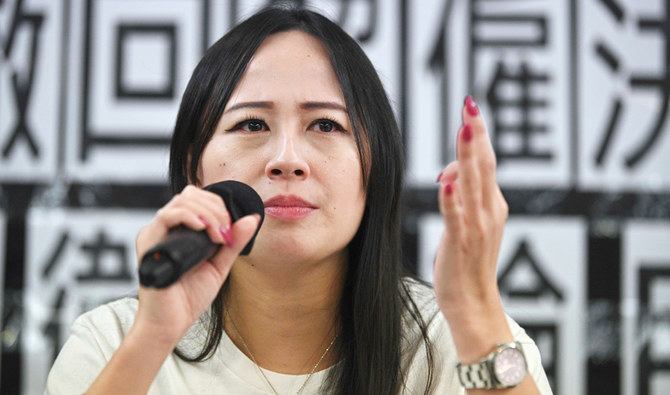
Hong Kong protesters denounce Cathay Pacific for firing cabin crew
- Police said they respected the rights of people in detention and were aware of online “rumors” that a person had been sexually harassed, which they said were false


Latest updates


© 2026 SAUDI RESEARCH & PUBLISHING COMPANY, All Rights Reserved And subject to Terms of Use Agreement.