KUALA LUMPUR: Malaysia is in talks with at last six countries on the possibility of using palm oil to pay for arms, as Southeast Asia’s third-biggest economy seeks to replace old equipment to boost its defense capabilities.
Malaysia has struggled to update its defense equipment over the years and a cut in its defense budget this year all but derailed efforts to replace navy ships, some of which have been in service for 35 years or more.
Costs have been a big hurdle but using palm oil to help pay for equipment could open new avenues to upgrade, Defense Minister Mohamad Sabu said on Monday.
Mohamad said discussions on paying with palm oil had started with China, Russia, India, Pakistan, Turkey and Iran.
“If they are prepared to accept a palm barter trade, we are very willing to go in that direction,” Mohamad told Reuters in an interview.
“We have a lot of palm oil.”
Malaysia and Indonesia, the world’s two largest palm oil producers, are embroiled in a dispute with the European Union over a plan to phase out the commodity from renewable fuels used by the bloc by 2030 over deforestation concerns.
The two countries supply about 85% of global palm oil, much of which is used in food but also in items such as lipstick and soap.
Mohamad said he could not put a figure on how much palm oil Malaysia was looking to trade for defense equipment.
Besides new ships, Malaysia was also keen to acquire long-range surveillance aircraft, unmanned aerial vehicles and fast intercept boats, the minister said.
The planned barter is part of a 10-year defense policy to be tabled in parliament this year, which Mohamad said would focus on boosting naval capabilities, including in the disputed South China Sea.
China claims historic jurisdiction over the sea via a so-called nine-dash line on maps, but it overlaps with territory claimed by Malaysia, China, Vietnam, Brunei and the Philippines.
Taiwan also claims most of the sea.
Recent Chinese naval deployments in the disputed sea, through which over $3.4 trillion in goods are transported annually, have reignited tension with Vietnam and the Philippines.
Malaysia had been critical of China’s South China Sea position, but has not been excessively outspoken recently, especially after China pumped in billions of dollars into infrastructure projects under its Belt and Road Initiative.
Malaysia regularly tracked Chinese naval and coast guard vessels entering Malaysia’s territorial waters, Mohamad said, but added that China respects Malaysia and had “not done anything that caused us trouble, so far.”
However, Southeast Asian counties would need to work together to make sure their interests are not drowned out by big powers like the US and China jostling for control, Mohamad said.
“We want this region to remain peaceful and neutral,” Mohamad said.


Malaysia hopes to pay for military equipment with palm oil
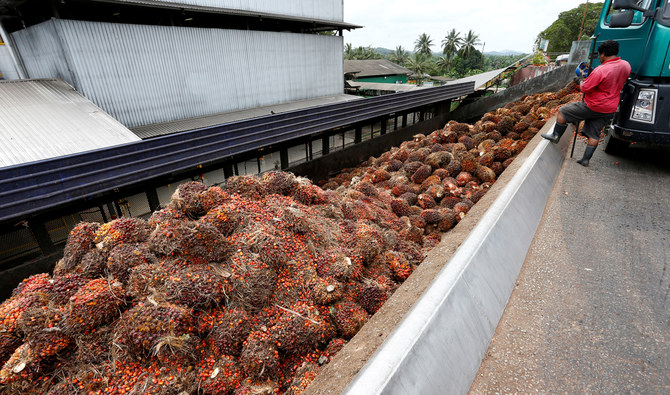
Malaysia hopes to pay for military equipment with palm oil

- Discussions on paying with palm oil had started with China, Russia, India, Pakistan, Turkey and Iran


Higher inflation, tighter credit markets if Iran war persists, experts warn
- Moody’s and Fitch have warned of the economic impact of a prolonged conflict
- Experts tell Arab News that ‘historical playbook’ offers some reassurance
JEDDAH: As the US-backed conflict between Israel and Iran entered its fourth day, economists warned the fallout could spread well beyond the region, threatening higher inflation, tighter credit markets and slower growth in energy-importing economies if hostilities persist.
Global markets have already reacted, with oil benchmarks surging after the conflict disrupted traffic through the Strait of Hormuz, a key chokepoint handling about a fifth of global seaborne oil trade.
Spot crude premiums hit multi-year highs as tanker traffic declined and insurers withdrew war-risk cover, underscoring supply risks.
Equity and credit markets also felt the impact, with European stock indexes falling sharply, credit indicators widening and investors seeking refuge in safe-haven assets such as gold and government bonds. Risk-off positioning in credit markets pushed corporate default premiums higher, reflecting mounting geopolitical and financial concerns.
The Strait of Hormuz is a key shipping route, carrying around 20 percent of the global oil supply. A prolonged closure could push oil prices higher, drive inflation up, and tighten financial conditions worldwide, particularly in energy-importing economies.
Fitch highlights sovereign credit risks
Middle Eastern sovereign ratings generally have sufficient headroom to withstand a short regional conflict that does not escalate further, according to Fitch Ratings.
The course of the conflict, the agency’s report added, is uncertain and lasting damage to key energy infrastructure or protracted hostilities could pose risks to regional sovereign ratings.
“The attacks launched by Israel and the US on Iran on Feb. 28 have already had a greater impact than those of June 2025,” the report said.
Fitch believes that the conflict will last less than a month, with the duration being shaped by factors including the destruction of Iranian military capacity and US aversion to a longer, more involved conflict.
“Attacks by Iran and its proxies across the region will continue and could intensify over the short term,” it warned.
The report added that material damage to Gulf Cooperation Council energy export infrastructure would be the most likely channel to pressure sovereign ratings.
The agency emphasized that the Strait of Hormuz, which handles refined products, along with significant liquefied natural gas flows, is assumed to remain effectively closed for the duration of the conflict, whether due to physical blockages, insurance constraints for vessels, or other threat-related factors.
Fitch noted that Saudi Arabia and the UAE have pipelines that allow much of their production to bypass the Strait, and all key oil exporters maintain oil storage outside the region.
It said a near-term hit to oil and gas activity is likely for Bahrain, Kuwait, and Qatar, which lack alternative supply routes, and for Iraq, whose exports rely heavily on Hormuz.
“Higher energy prices would mitigate the impact of a short-lived disruption on export earnings, to the extent that shipments still get out,” the report said.
The analysis also warned of near-term effects on non-oil economic activity, with much regional air travel suspended, slower consumer activity, and potential lingering impacts on tourism.
Fitch expects these effects on economic growth to be temporary, but there could be longer-term consequences for parts of the region that position themselves as havens for international businesses and expatriates. An outflow of expatriates could put pressure on some GCC housing markets.
Most GCC sovereigns, Fitch said, have substantial financial assets to buffer short-term energy revenue disruptions, and lightly taxed non-energy sectors would limit the fiscal impact of economic slowdowns.
Geopolitical risk is already reflected in sovereign ratings through World Bank governance indicators, with additional overlays applied to Abu Dhabi and the UAE to provide extra rating headroom.
Moody’s flags heightened energy and credit risks
Moody’s said the US-Israel strikes and Iran’s retaliation have sharply heightened geopolitical risk and pushed energy prices higher.
It said the “unprecedented” killing of Iran’s supreme leader, Ayatollah Ali Khamenei, and US calls for regime change add further uncertainty over how the conflict may evolve and how long instability could last.
Although core energy infrastructure, it noted, has not been directly targeted, marine traffic through the Strait of Hormuz has slowed to a near standstill as insurers withdraw coverage and operators avoid the area.
Several Middle Eastern ports have suspended operations after Iranian attacks, and significant portions of regional airspace are closed or severely restricted.
Moody’s said the overall credit outlook depends on whether disruptions to the Strait prove short-lived and whether alternative arrangements can preserve energy availability.
In the near term, oil stored outside the Gulf, including in offshore tankers that sailed before the strikes, provides a buffer, similar to that used after the 2019 attack on Saudi oil facilities.
OPEC+’s planned 206,000-barrel-a-day production increase from April offers additional, though limited, mitigation.
“Our baseline scenario is that the conflict is relatively short-lived, likely a matter of weeks, and that navigation through the Strait of Hormuz will then resume at scale. This scenario is unlikely to result in meaningful credit impact on the issuers we rate,” Moody’s said.
However, it warned, any lengthy disruption to the Strait of Hormuz would drive a sustained rise in oil prices, deepen global risk aversion and likely generate wider credit-spread pressure across high-yield markets.
“Such a scenario would heighten refinancing risks for issuers with near-term maturities, particularly in energy-intensive and cyclical industries that already face high input costs. It would also complicate the course of interest rates and central bank decision-making,” Moody’s said.
Oil is geopolitical “fever thermometer”
Mathieu Racheter, head of equity strategy research at Julius Baer, commented that the historical playbook offers some reassurance, as geopolitical shocks in the Middle East have typically triggered short, sharp drawdowns followed by stabilization over subsequent months.
He added that starting valuations matter and many indices, particularly in Europe, are trading close to recent highs, leaving limited room for disappointment, and increasing the risk of near-term de-rating if escalation persists.
“Sector dispersion is therefore likely to dominate: cyclicals, consumer-facing industries, chemicals and transport remain most exposed to sustained energy cost pressure, while oil and gas stocks have historically provided a partial hedge against supply-driven price spikes, an area investors may want to look at from a portfolio-construction perspective, even if we do not actively advocate an overweight,” he added.
Norbert Rucker, head of economics and next-generation research at Julius Baer, said oil acts as a geopolitical “fever thermometer”, reacting to the escalating conflict in the Middle East. The broader economic impact, he added, hinges on oil and gas flows through the Strait of Hormuz.
Rucker added that the most feared scenario is not its closure, but serious damage to the region’s key oil and gas infrastructure.
“Over time, the risk of such a disruption seems to lessen. Recognizing the dynamics and uncertainty of the situation, our base case is the usual pattern of a short-lived but more intense spike in oil and gas prices,” he said.
He added that trade out of the Arabian Gulf is likely to remain crippled for days or weeks, but this scenario does not threaten oil and gas supplies.
“We maintain our neutral view on oil but revise the three-month price target upwards and upgrade our view on European gas prices to neutral. We will review this as the situation evolves,” he added.
Speaking to Arab News, CIO at Century Financial, Vijay Valecha, said that the US-Iran war now presents another test to the oil–geopolitics decoupling pattern.
“This poses a threat to Iran’s 3 million barrels per day supply, which amounts to about 5 percent of global output,” he said, adding that the nation also wields great influence over energy supplies, given its strategic location alongside the strait.
He noted that oil from the Arabian Gulf must pass through the waterway to get to major markets such as China, India, and Japan. He added that danger also lies in a regional spillover that would hit global oil arteries.
“Further, if the conflict continues spreading to other Gulf producers, up to one-third of global oil supply would be exposed,” Valecha said.