

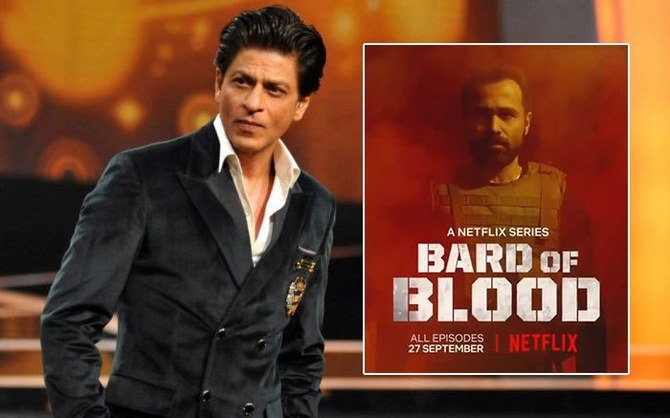

ISLAMABAD: Bollywood’s reigning king Shah Rukh Khan’s dropped the trailer this week for his latest production for streaming giant Netflix, “Bard of Blood,” inciting an overwhelmingly negative response from viewers for its “jingoistic” storyline, with the Pakistan Army also weighing in.
The series is based on a book of the same name written by Bilal Siddiqi. The trailer begins in Balochistan, a southwestern province in Pakistan, and shows that Indian spies captured by Pakistan are about to be beheaded before they can relay important information to India. Former spy Kabir Anand, played by Emraan Hashmi, is then tasked by the government of India to travel to Balochistan for a rescue mission.
In Pakistan, the trailer has drawn sharp criticism and is being seen as an irresponsible attempt at war-mongering at a time when tensions between arch-rivals India and Pakistan are at an all-time high over the disputed Kashmir region.
Among the Pakistans irked by the trailer was Pakistan Army Spokesman General Asif Ghafoor who tweeted at Khan, asking the actor to use his platform to promote peace and highlight human rights violations by India in Jammu and Kashmir.
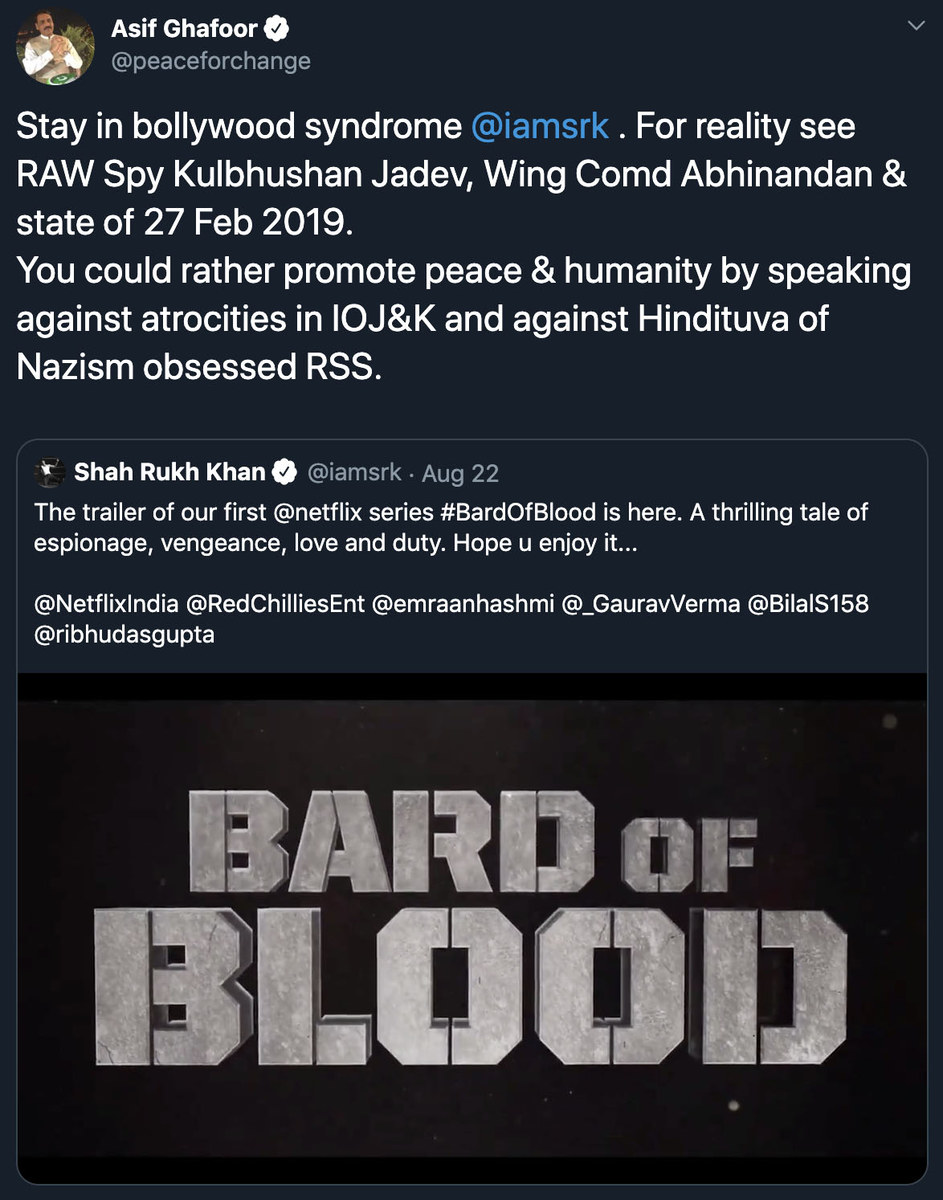
Other Pakistani Twitter users also took to the social media platform to express disapproval.
This Twitter user accused Khan of making “jingoistic content”:
Producer Khan, lead Hashmi, wroter Siddiqi.
As panic & fear has taken over Indian Muslims with Kashmir lockdown & NRC in Assam, Bollywood Muslims are busy making jingoistic content. https://t.co/KJ9pRNp2If— omer (@intellectroll) August 22, 2019
Rights activist Sabahat Zakariya wrote:
Am I allowed to snigger a little at SRK fangirls and boys who were propping him up as the ideal silent bystander on Kashmir? If his utterly trashy film choices hadn’t woken you up yet to the fact that he only cares about big money & commercial success, then perhaps this will. https://t.co/YLpcNRcAli
— Sabahat Zakariya (@sabizak) August 22, 2019
Haroon Rashid, the editor of Independent Urdu, had this to say:
A country whose majority of movies depict Muslims as terrorists - another feather in their cap? Cashing in on typical stereo types, sorry to say https://t.co/gjXQwmvBOL
— Haroon Rashid (@TheHaroonRashid) August 23, 2019
Another Twitter user was equally miffed:
Bollywood congratulating itself after making yet another movie portraying Muslims negatively https://t.co/9WFlHYnNj6 pic.twitter.com/FSGjfZwziZ
— Aminah (@aminahqk) August 23, 2019


