BAGHDAD: Two paramilitary fighters were killed on Sunday in an unclaimed drone attack near Iraq’s western border with Syria, the powerful Hashed Al-Shaabi force said in a statement.
The deaths come after a month of mysterious blasts at Hashed Al-Shaabi arms depots and training camps that some of the force’s top officials blamed on the US.
“Two unidentified drones targeted a Brigade 45 position belonging to the Hashed Al-Shaabi in the Anbar district, 15 kilometers (10 miles) from the Iraqi-Syrian border,” the statement said.
The attack “killed two fighters from the unit, wounded another and burned two vehicles,” it added.
The statement did not accuse any particular force and there was no immediate claim of responsibility.
The Hashed was established from disparate armed groups and volunteers that united to fight back Daesh’s sweep across a third of Iraq in 2014.
The network is mostly Shiite and has received Iranian training and advice, but operates officially under Iraq’s armed forces and uses military unit names.
Brigade 45 is one of several units made up of Kataib Hezbollah fighters, designated by the US as a “foreign terrorist organization.”
Over the last month, a string of suspicious explosions and drone sightings at Hashed bases have sparked concerns that escalating tensions between the US, Israel and Iran are boiling over into Iraq.
Hashed chief and Iraqi National Security Adviser Faleh Al-Fayyadh has said preliminary investigations found the incidents were premeditated but had not yet revealed the perpetrators.
Meanwhile, his deputy Abu Mehdi Al-Muhandis, whom analysts say holds the real reigns in the Hashed, has been unequivocal in blaming Washington.
The Pentagon has denied involvement, and US officials have told the New York Times that Israel had carried out multiple strikes in Iraq this month.
Israel has not claimed responsibility but Prime Minister Benjamin Netanyahu hinted at involvement last week, saying his country would “act against (Iran) whenever necessary.”


![]()


Two fighters killed in drone attack: Iraq paramilitary force
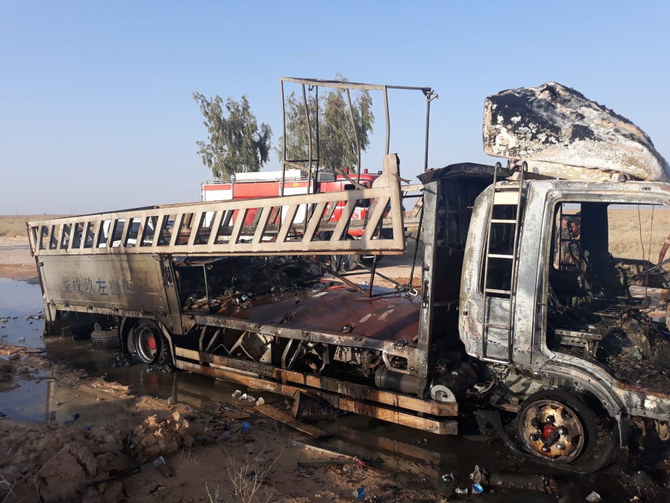
Two fighters killed in drone attack: Iraq paramilitary force
- Two unidentified drones killed two Iraqi members of an Iran-backed paramilitary force
- No one claimed responsibility, and the PMF statement did not assign blame


Hamas armed wing confirms spokesman killed by Israel in August
GAZA CITY: Hamas’s armed wing confirmed on Monday the death of its spokesperson, Abu Obeida, months after Israel announced he had been killed in an air strike in Gaza.
The Ezzedine Al-Qassam Brigades released a video statement on its Telegram channel, saying: “We pause in reverence before... the masked man loved by millions... the great martyred commander and spokesperson of the Qassam Brigades, Abu Obeida.”
Israel previously announced it had killed Abu Obeida in a strike on Gaza on August 30.
During the war, Abu Obeida, whose real name was Hudhayfa Samir Al-Kahlout, emerged as a central figure eagerly awaited by Gazans, as well as by Arab and international media, for official statements from Hamas’s military wing, particularly those related to prisoner-exchange operations.
Born on February 11, 1985, and raised in the Jabalia refugee camp in northern Gaza, Abu Obeida joined Hamas at an early age before becoming a member of the Ezzedine Al-Qassam Brigades.
He later became the group’s sole spokesman, delivering video statements in military uniform with his face consistently concealed by a red keffiyeh.
He had been the target of multiple Israeli assassination attempts.
According to Hamas officials, Abu Obeida embodied what they describe as “resistance” and was known for fiery and impactful speeches, many of which included threats against Israel or announcements of military operations.
“For many years, only a very small circle of Hamas officials knew his true identity,” a Hamas official told AFP.
Israel has decimated Hamas’s leadership, saying it seeks to eradicate the group following Hamas’s October 7, 2023 attack on Israel, which triggered the war.
The video announcing Abu Obeida’s death was delivered by a masked man dressed in the former spokesperson’s distinctive style, who said he would adopt his predecessor’s name for future statements.
In the same video, he also announced the deaths of four other Hamas commanders in Israeli attacks during the war.
The Ezzedine Al-Qassam Brigades released a video statement on its Telegram channel, saying: “We pause in reverence before... the masked man loved by millions... the great martyred commander and spokesperson of the Qassam Brigades, Abu Obeida.”
Israel previously announced it had killed Abu Obeida in a strike on Gaza on August 30.
During the war, Abu Obeida, whose real name was Hudhayfa Samir Al-Kahlout, emerged as a central figure eagerly awaited by Gazans, as well as by Arab and international media, for official statements from Hamas’s military wing, particularly those related to prisoner-exchange operations.
Born on February 11, 1985, and raised in the Jabalia refugee camp in northern Gaza, Abu Obeida joined Hamas at an early age before becoming a member of the Ezzedine Al-Qassam Brigades.
He later became the group’s sole spokesman, delivering video statements in military uniform with his face consistently concealed by a red keffiyeh.
He had been the target of multiple Israeli assassination attempts.
According to Hamas officials, Abu Obeida embodied what they describe as “resistance” and was known for fiery and impactful speeches, many of which included threats against Israel or announcements of military operations.
“For many years, only a very small circle of Hamas officials knew his true identity,” a Hamas official told AFP.
Israel has decimated Hamas’s leadership, saying it seeks to eradicate the group following Hamas’s October 7, 2023 attack on Israel, which triggered the war.
The video announcing Abu Obeida’s death was delivered by a masked man dressed in the former spokesperson’s distinctive style, who said he would adopt his predecessor’s name for future statements.
In the same video, he also announced the deaths of four other Hamas commanders in Israeli attacks during the war.
Latest updates


© 2025 SAUDI RESEARCH & PUBLISHING COMPANY, All Rights Reserved And subject to Terms of Use Agreement.