SRINAGAR: Authorities in the main city of Indian-administered Kashmir tightened security ahead of Friday prayers after separatists called for a protest march to a UN office, with streets bristling with paramilitary personnel and some blocked by checkpoints.
Posters appeared overnight this week in Srinagar, the Muslim-majority region’s main city, calling for a march to the office of the UN Military Observer Group for India and Pakistan (UNMOGIP), to protest against India’s revocation of Jammu and Kashmir state’s special autonomy.
The call by separatists seeking Kashmir’s secession from India was the first since that decision on August 5, which brought communication and travel restrictions in Kashmir that are still largely in place. Some landlines were restored last week.
The UNMOGIP was set up in 1949 after the first war between India and Pakistan over Kashmir, the Himalayan region both countries claim in full but rule in part. The group monitors cease-fire violations along the border between the countries.
US President Donald Trump plans to discuss Kashmir when he meets Indian Prime Minister Narendra Modi on the sidelines of a G7 meeting in France this weekend, a senior US administration official said on Thursday.
Trump, who has offered to mediate between Indian and Pakistan, will press Modi on how he plans to calm regional tensions after the withdrawal of Kashmir’s autonomy, and stress the need for dialogue, the official said.
Protests have broken out in parts of Srinagar over the last two weeks, some drawing hundreds of people. At least 152 people have been hurt by teargas and pellets since security forces launched a sweeping crackdown, data from the Himalayan region’s two main hospitals shows.
On Friday, several dozen paramilitary personnel manned at least two barriers on the main road leading to the office of UNMOGIP in Srinagar and public movement around it was blocked.
Entry into the city’s old quarter, which has long been a center for protests, was severely curtailed, as policemen blocked street after street with concertina wire.
Large swathes of Srinagar remained deserted with shops shut except for some provision stores with shutters half-down.
Police vans patrolled some areas announcing a curfew and asking people to stay indoors.
On the Dal Lake, long rows of houseboats, which would typically be packed with tourists this time of the year, floated closed and empty, as police patrolled its mirror-calm waters in boats.


India increases restrictions in Kashmir ahead of separatist call for protests
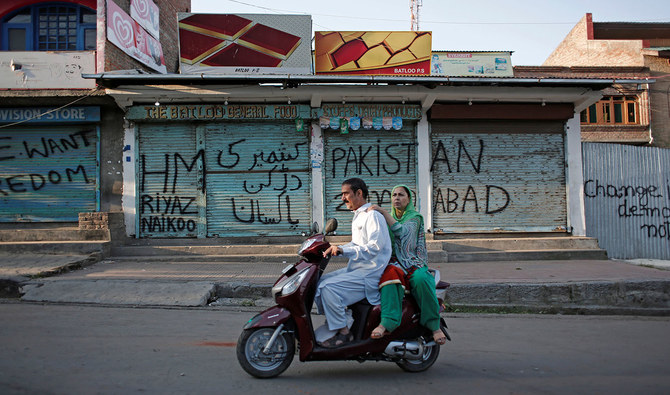
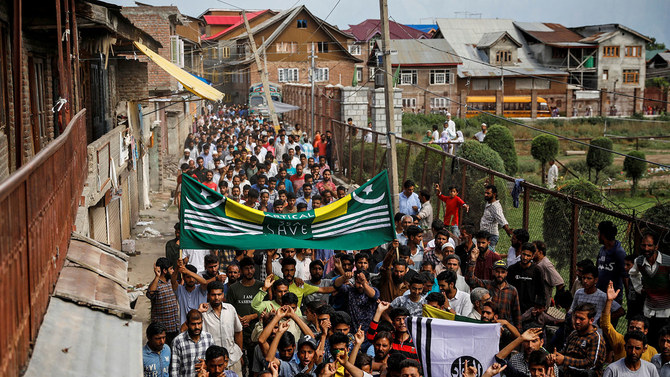
India increases restrictions in Kashmir ahead of separatist call for protests

- Posters appeared overnight in Srinagar calling for a march to UN Military Observer Group’s office
- Protests have broken out in parts of Kashmir over the last two weeks, drawing hundreds of people

Iran war unsettles India’s packaged water makers as bottles, caps get pricey
- Higher polymer prices hurt bottled water industry
- Industry worth $5 billion has big multinational players like Pepsi, Coca-Cola
NEW DELHI: The Iran war is rattling India’s $5 billion packaged water market just ahead of the sweltering summer season.
One of the world’s fastest growing bottled water markets is seeing some manufacturers hike prices for distributors, as supply disruptions linked to the war fuel higher costs in everything from plastic bottles to caps, labels and cardboard boxes.
Though retail prices are yet to feel the heat and bigger companies are absorbing the pain, about 2,000 smaller bottled water makers have increased rates for their resellers by around 1 rupee per bottle, a 5 percent hike, which will rise by a further 10 percent in coming days, according to the Federation of All India Packaged Drinking Water Manufacturers’ Association.
Consumers usually pay less than 20 rupees, or around 20 US cents, for a one-liter bottle.
“There is chaos and within the next 4-5 days, this will start impacting customer prices,” said Apurva Doshi, the federation’s secretary general.
Rising oil prices have increased the cost of polymer, which is made from crude oil and is a key material for the industry’s plastic bottles. The cost of material used in making plastic bottles has risen by 50 percent to 170 rupees per kilogram, while the price of the caps has more than doubled to 0.45 rupees apiece. Even corrugated boxes, labels and adhesive tape are costing much more, industry letters showed.
Clean water is a privilege in the country of 1.4 billion people where researchers say 70 percent of the groundwater is contaminated, leaving people reliant on bottled water. Companies including Bisleri, Coca-Cola’s Kinley, Pepsi’s Aquafina, billionaire Mukesh Ambani’s Reliance and Tata all compete for a share of the $5 billion market. The companies did not respond to Reuters request for comment.
PREMIUM WATER FACES HEAT TOO
Within the broad bottled water market, natural mineral water is a $400 million business in India and a new, fast-growing wellness product for India’s wealthy.
The premium water segment accounted for 8 percent of the bottled water market last year in India, compared to just 1 percent in 2021, Euromonitor says.
Aava, which sells mineral water sourced from the foothills of the Aravalli mountains, has increased prices of its water bottles by 18 percent for resellers, Shiroy Mehta, CEO of the company, told Reuters.
“Most manufacturers are absorbing 40-50 percent of the cost to ensure that they don’t lose clients. It’s a poor situation for the beverage industry ahead of the summer season,” he said.
The mass market, however, is dominated by companies that produce “drinking water” to be sold in 1-liter bottles to customers. Clear Premium Water, a brand of India’s Energy Beverages, said in a notice to its distributors there had been an “unprecedented and continuous surge” in prices of key raw materials used in packaging and production.
“It is no longer possible for us to absorb the escalating costs while maintaining existing product prices,” the notice said.


