

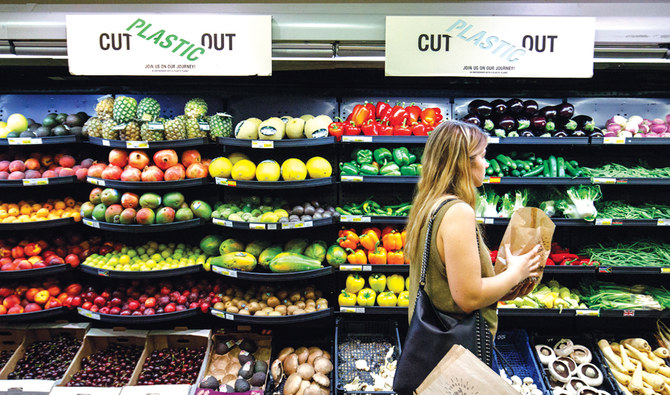

LONDON: British supermarkets are starting to go “nude.” Bowing to pressure from environmentally conscious consumers, big brand shops have begun taking steps to strip their shelves of plastic wrapping over concerns about saving the oceans from waste.
“Nude zones” and “Food in the Nude” campaigns are already being rolled out in places such as New Zealand and South Africa, where many fresh fruits and vegetables are grown within relatively easy reach.
Now retailers in Britain, where even bananas are often sealed in plastic to keep them fresh and during shipping, are following suit.
“I've just done my first-ever plastic-free shop,” said May Stirling, 49, who travelled 60 kilometers from the village of Ramsbury to Oxford for the university city’s “unpackaging” event at the local Waitrose supermarket.
“It's so liberating,” she siad, carrying her own containers for the loose products.
The Oxford branch of the upmarket chain was selling 160 types of vegetables and fruits, plus cereals, grains, couscous, lentils, wine, beer and other items in bulk, in what was initially planned as an 11-week trial.
“I just wish there were a few more things I could have got today,” said Stirling, who added that she would have liked more choice of non-packaged cereals.
British stores rely greatly on plastic to ship, store and sell items.
Like Stirling, other shoppers have also been pressing the Oxford Waitrose supermarket to do more to stop plastics pollution via a wall, set up by staff, where customers have pinned hundreds of suggestions, many asking for refillable bottles for items like milk and cleaning products.
It has now extended its trial in the branch and announced that it would soon introduce the scheme in three other stores.
Waitrose has said however that it has yet to establish whether plastic-free zones would work in all of its 344 locations across Britain.
“While the priority is the environmental benefit, we clearly need to ensure (the trial) is commercially viable,” spokesman James Armstrong said.
Plastic packaging is cheaper than some of the other possible options.
So, are shoppers ready to pay more for their groceries to come wrapped in ecological packaging?
Fran Scott, a 55-year-old marketing consultant, is unsure.
“I genuinely don’t know,” she said, while also shopping at Waitrose, armed with her own plastic containers.
“I would like to think that,” she added however.
Other big supermarket chains have signed up to The UK Plastics Pact. The pledge's four tenets include eliminating all single-use packaging and making the remainder recyclable or compostable by 2025.
Tesco and Asda, a low-cost retailer, have promised to stop using plastic for online shopping deliveries.
Morrisons, which like Tesco and Asda is among the biggest five supermarket chains in Britain, intends to install plastic-free produce zones in 60 locations by the end of the year.
Others are going further. Budgens Belsize Park, a London branch of the smaller supermarket chain Budgens — part of a 147-year-old company of nearly 250 franchises — has already ripped the plastic off more than 2,300 of its 14,000 products.
“We did this to show the other big supermarket chains that it wasn’t as difficult as they said it was,” said a Budgens manager.


