UN resumes Sanaa aid distribution halted after Houthi thefts

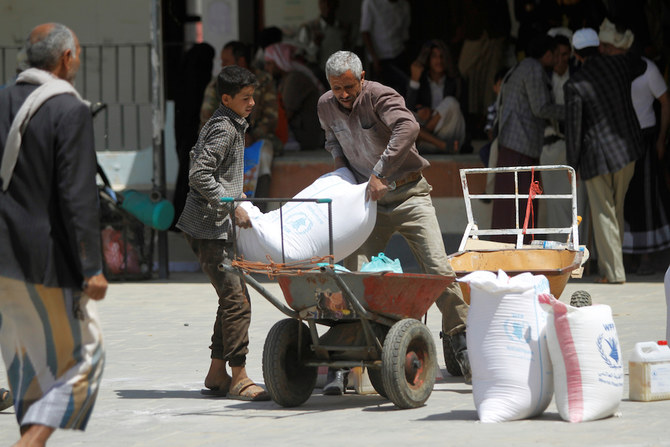
Workers carry the aid provided by the World Food Programme (WFP) for distribution in Sanaa Wednesday. (Reuters)
Updated 21 August 2019
Follow

UN resumes Sanaa aid distribution halted after Houthi thefts

  • The halt in aid came after UN officials found the Houthis were diverting food away from those who desperately needed it
  • But UN says 22 'life saving' programs may close due to $1bn funding shortfall

SANAA: The World Food Programme (WFP) on Wednesday resumed distributing food in Yemen's capital Sanaa after a two-month stoppage.

The halt in aid came after UN officials found the Houthis were diverting food away from those who desperately needed it. 

Dozens of people gathered at a distribution centre in Sanaa to be given flour, vegetable oil, pulses, salt and sugar.

"We are relieved. Thank God. All we can do is praise God," said one recipient, Um Ahmed.

Food distribution for 850,000 people had resumed after the WFP was allowed to "introduce the key accountability measures", its spokeswoman Annabel Symington told Reuters.

When the agreement with Houthi authorities was reached in early August, the WFP said a biometric registration process would be introduced for 9 million people living in areas under Houthi control.

The system - using iris scanning, fingerprints or facial recognition - is already used in areas controlled by the Saudi-backed government that holds the southern port city of Aden and some western coastal towns.

Meanwhile, the UN Wednesday warned that 22 "life-saving" aid programs will be forced to close in Yemen in the next two months if countries do not pay more than $1 billion in funding that they pledged earlier this year.

In February countries pledged $2.6 billion to help, but UN humanitarian coordinator for Yemen, Lise Grande, said less than half that had been paid.

The UN said that of 34 key aid programs only three were funded for the year and 22 "life-saving" programs will need to close in the next two months.



Arab, Muslim countries slam US ambassador’s remarks on Israel’s right to Middle East land

Updated 22 February 2026
Follow

Arab, Muslim countries slam US ambassador’s remarks on Israel’s right to Middle East land

  • The backlash widened sharply on Sunday as more than a dozen Arab and Islamic governments issued a joint statement denouncing the US diplomat’s comments as “dangerous and inflammatory”

JERUSALEM: Arab and Islamic countries issued a joint condemnation on Sunday of remarks by US ambassador to Israel Mike Huckabee, who suggested Israel had a biblical right to a vast swath of the Middle East.
Huckabee, a former Baptist minister and a fervent Israel supporter, was speaking on the podcast of far-right commentator and Israel critic Tucker Carlson.
In an episode released Friday, Carlson pushed Huckabee on the meaning of a biblical verse sometimes interpreted as saying that Israel is entitled to the land between the river Nile in Egypt and the Euphrates in Syria and Iraq.
In response, Huckabee said: “It would be fine if they took it all.”
When pressed, however, he continued that Israel was “not asking to take all of that,” adding: “It was somewhat of a hyperbolic statement.”
The backlash widened sharply on Sunday as more than a dozen Arab and Islamic governments — alongside three major regional organizations — issued a joint statement denouncing the US diplomat’s comments as “dangerous and inflammatory.”
The statement, released by the United Arab Emirates’ foreign ministry, was signed by the UAE, Egypt, Jordan, Indonesia, Pakistan, Turkiye, Saudi Arabia, Qatar, Kuwait, Oman, Bahrain, Lebanon, Syria and the State of Palestine, as well as the Organization of Islamic Cooperation, the Arab League and the Gulf Cooperation Council.
They said the comments contravene the UN Charter and efforts to de-escalate the Gaza war and advance a political horizon for a comprehensive settlement.
Iran joined the chorus with its foreign ministry accusing Huckabee on X of revealing “American active complicity” in what it called Israel’s “expansionist wars of aggression” against Palestinians.
Earlier, several Arab states had issued unilateral condemnations.
Saudi Arabia described the ambassador’s words as “reckless” and “irresponsible,” while Jordan said it was “an assault on the sovereignty of the countries of the region.”
Kuwait decried what it called a “flagrant violation of the principles of international law,” while Oman said the comments “threatened the prospects for peace” and stability in the region.
Egypt’s foreign ministry reaffirmed “that Israel has no sovereignty over the occupied Palestinian territory or any other Arab lands.”
The Palestinian Authority said on X that Huckabee’s words “contradict US President Donald Trump’s rejection of (Israel) annexing the West Bank.”
On Saturday, Huckabee published two posts on X further clarifying his position on other topics touched upon in the interview, but did not address his remark about the biblical verse.
The speaker of the Israeli parliament, Amir Ohana, praised Huckabee on X for his general pro-Israel stance in the interview, and accused Carlson of “falsehoods and manipulations.”
Carlson has recently found himself facing accusations of antisemitism, particularly following a lengthy, uncritical interview with self-described white nationalist Nick Fuentes — a figure who has praised Hitler, denied the Holocaust and branded American Jews as disloyal.