



KHARTOUM: Sudan's generals and protest leaders on Tuesday formed the sovereign council that will steer the country through three years of transition towards civilian rule.
The body replaces the Transitional Military Council that took over from longtime ruler Omar al-Bashir when he was forced from power in April amid relentless protests.
The former president appeared in court Monday, sitting in a cage to face graft charges — a sight that the two thirds of Sudan's 40 million inhabitants who were born under his rule could hardly have imagined.
The very first steps of the transition to civilian rule after 30 years of Bashir's regime proved difficult however with disagreements within the protest camp holding up the formation of Sudan's new ruling body for two days.
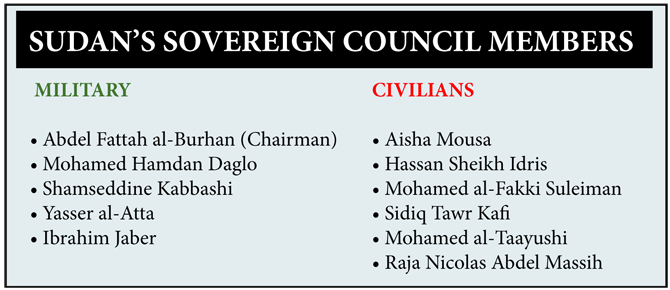
The names of the joint civilian-military council's 11 members were eventually announced late Tuesday by the spokesman of the TMC.
The council includes five members of the military and will be headed by General Abdel Fattah al-Burhan, who was already the head of the TMC.
"The president of the sovereign council will be sworn in tomorrow morning at 11:00 am (0900 GMT)," TMC spokesman Shamseddine Kabbashi said in a short televised address.
Burhan will head the council for the first 21 months and a civilian will take over for the remaining 18 months of the transitional period, which is due to end in 2022 with democratic elections.
Among the six civilian members of the new ruling council are two women, one of them from Sudan's Christian minority.
The protest camp last week picked Abdalla Hamdok, a former UN economist based in Addis Ababa, as transitional prime minister. He will be formally appointed on Wednesday.
The transition's key documents were signed on Saturday at a ceremony attended by a host of foreign dignitaries, signalling that Sudan could be on its way to shedding the pariah status it had taken on through years of devastating war in Darfur.
But amidst the euphoria celebrating the promise of civilian rule, unease was palpable within the protest camp that brought about one of the most crucial changes in Sudan's modern history.
One reason is the omnipresence in the transition of Mohamed Hamdan Daglo, a paramilitary commander and one of the signatories of the documents, whose forces are blamed for the deadly repression of the protests.
Sudanese women, who played a leading role in the protests, have also expressed their shock at female under-representation in the transition.
Every newspaper in Sudan made its headlines with Bashir's landmark court appearance Tuesday.
Some of them carried pictures of the ousted ruler in his courtroom cage, an image that instantly became another symbol of his military regime's downfall.
Large amounts of cash were found at his residence after he was toppled and police investigator Ahmed Ali said the case brought before the court concerned some of that money.
"The accused told us that the money was part of a sum of $25 million sent to him by Prince Mohammed bin Salman to be used outside of the state budget," he said.
On the streets of Khartoum, residents were not trying to hide their contentment at seeing their longtime tormentor in the dock.
"Bashir has done a lot against us in 30 years," said Fatma Abdallah Hussein, a young medical student who took part in the protests earlier this year.
"Hunger, lack of education, what he did in Darfur and other issues, it is for these things we took to the streets, faced the teargas and the harassment," she said.
Alhaj Adam, a Khartoum resident, argued that Bashir's corruption trial should not distract from the need for the new administration to ratify the Rome Statute.
That would allow the former ruler's transfer to the International Criminal Court in The Hague, where he faces charges over the war in Darfur that erupted in 2003.
"The evidence he committed genocide should come forward... Many civilians inside and outside Sudan have died because of him and he should face justice," Adam said.


