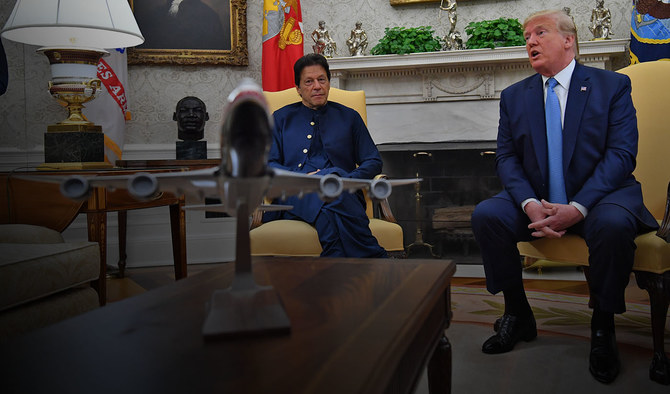
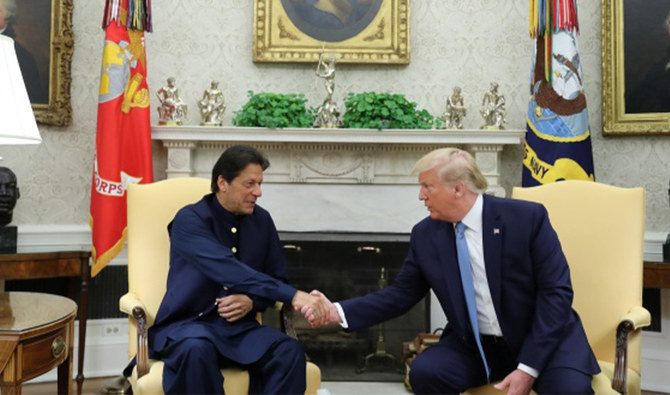
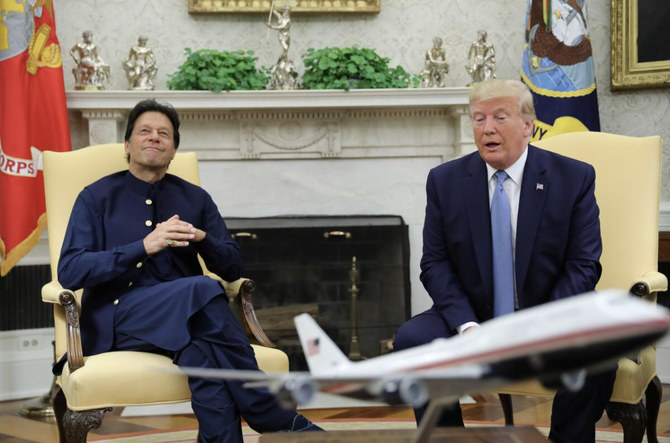
ISLAMABAD: US President Donald Trump called Prime Minister Imran Khan late Monday night, after a telephonic conversation with Indian Premier Narendra Modi, and discussed the prevailing situation in Jammu and Kashmir, according to Pakistan's Foreign Minister Shah Mahmood Qureshi.
Khan told President Trump that Pakistan foresees a “humanitarian crisis” in the making in Indian-administered Kashmir hoped “the United States will play its role to resolve this issue,” Qureshi said while addressing a news conference in Islamabad late night.
“The prime minister said that a curfew had been in place in Jammu and Kashmir for fifteen days. He also added that thousands of Kashmiris, including [the local] leadership, had been detained and many of them had been sent [to prisons] outside native region,” he added divulging details of the telephonic conversation.
Khan further stressed that “a UN observer mission should be dispatched forthwith to Indian-administered Kashmir” and the curfew to be “lifted immediately,” Qureshi said.
Earlier in the day, the US president spoke to Indian Prime Minister Narendra Modi in a quest to reduce tensions between India and Pakistan over the Kashmir issue.
“The president conveyed the importance of reducing tensions between India and Pakistan and maintaining peace in the region,” White House Spokesperson Hogan Gidley said in a statement.
The foreign minister said Trump made the phone call to the Indian leader in response to his conversation with Khan on August 16 wherein the Pakistani leader told him about the unilateral steps taken by the Modi government in the disputed Kashmir region and explained how they were detrimental to regional peace.
“By taking these steps India wants to end the disputed status of the [Kashmir] valley. It wants to turn Muslim majority into minority by bringing about a demographic shift,” Qureshi quoted Khan as saying.
Khan further told Trump that India’s unilateral steps taken on Kashmir were a “violation of UN resolutions and the international law.”
“India should find solution to this crisis through UN Security Council resolutions which are binding,” he added.
Hassan Askari, a Lahore based defense analyst, opines that it is in the US interest to diffuse tensions between Pakistan and India to avoid any military conflict in the region. “Avoidance of war is the primary American interest because both Pakistan and India are nuclear powers,” he told Arab News.
“So, when Trump says that he would like to mediate basically he is suggesting that American government has deep interest in the situation in South Asia.”
The US has a different relation with Pakistan while its engagement with India involves trade and economic ties. Therefore, Trump is “not siding either with India or Pakistan but rather trying to diffuse the situation,” Askari added.
Khalid Rehman, director general of Islamabad based think-tank Institute of Policy Studies, said that US should have “condemned Indian unilateral actions” if it was serious in de-escalation tension in the region. “The US role in this situation would be likely based on their own interests rather than justice for Kashmir,” he said.
“If the US was serious, they would have asked India to immediately lift all restrictions in Indian-administered Kashmir. But they have made Pakistan and India at par by saying that both sides should try to solve this issue mutually,” Rehman said.


Pakistan urges US to help avert ‘humanitarian crisis’ in Kashmir — Qureshi

Pakistan urges US to help avert ‘humanitarian crisis’ in Kashmir — Qureshi

- President Trump spoke with Pakistani and Indian leaders on Monday urging tension in the region to be de-escalated
- Pakistani premier stressed deployment of UN observers in Kashmir and immediate lifting of curfew

Pakistan says it seized 32 square kilometers inside Afghanistan as border clashes escalate
- Security official describes ‘limited tactical action’ in Gudwana after Afghan assaults
- Islamabad accuses Kabul of sheltering militants as UN, China and Russia urge restraint
ISLAMABAD: Pakistan has seized a 32-square-kilometer area inside Afghanistan following overnight fighting, a security official said on Saturday, as cross-border clashes between the two countries escalated sharply.
A Pakistani security official, speaking on condition of anonymity, said troops carried out a “limited tactical action” in the Gudwana area opposite the Zhob sector along the frontier, capturing Afghan territory after responding to attacks on Pakistani positions.
“On the night of Feb. 26/27, posts opposite the Zhob sector launched anticipated physical attacks on multiple Pakistani positions,” the official said, referring to fighters linked to Afghanistan’s Taliban authorities, whom Islamabad identifies as Tehreek-e-Taliban Afghanistan (TTA).
“In response to aggressive unprovoked fire and physical attacks, Pakistan security forces launched a limited tactical action on the night of Feb. 27/28 in the general area of Gudwana with a view to capture TTA Tahir Post,” he continued, adding that 32 square kilometers of Afghan territory were seized.
The official said special combat teams crossed the border after preparatory bombardment, supported by intelligence, surveillance and reconnaissance assets providing “real-time battlefield awareness.”
He said 24 Afghan Taliban fighters were killed and 37 wounded, with no Pakistani casualties reported.
The claims could not be independently verified, and there was no immediate confirmation from Taliban authorities in Kabul of any territorial loss in the Gudwana area.
The latest clashes erupted after Pakistani airstrikes targeted what Islamabad described as militant hideouts inside Afghanistan over the weekend, triggering retaliatory fire along the frontier and sharply escalating long-running tensions. Islamabad accuses Kabul of sheltering Pakistani Taliban militants responsible for attacks inside Pakistan, an allegation that Afghanistan denies.
Pakistan’s Information Minister Attaullah Tarar said on Saturday evening that 352 Afghan Taliban fighters had been killed and more than 535 wounded since the latest phase of hostilities began.
Tarar said Pakistani strikes had destroyed 130 check posts, 171 tanks and armored vehicles and targeted 41 locations across Afghanistan by air. Those figures could not be independently verified.
The United Nations, as well as China and Russia, have called for restraint.
The United States said Pakistan has the right to defend itself against cross-border militancy.


