

Yemen coalition strikes caves used by Houthis to store missiles and drones

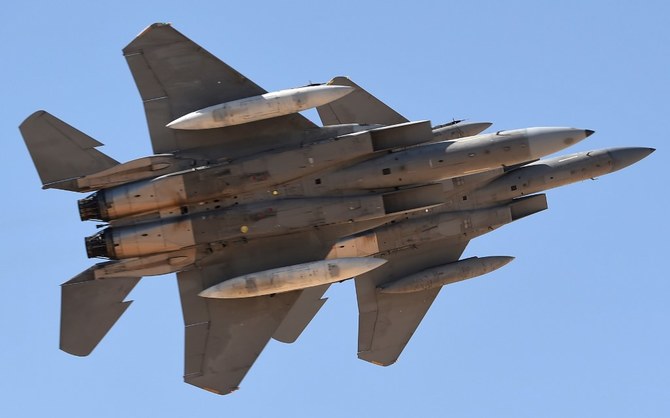
The coalition warned people in Sanaa to stay away from military targets. (AFP/File photo)
Updated 26 August 2019
Follow

Yemen coalition strikes caves used by Houthis to store missiles and drones

  • Coalition advised civilians to stay away from military sites
  • Strikes follow a Houthi drone attack on a Saudi Aramco gas plant on Saturday

JEDDAH: The Arab coalition in Yemen launched an attack Monday on Houthi military targets in Sanaa.

The coalition advised civilians to stay away from the targeted areas, Saudi Arabia’s Al Ekhbariya TV channel said.

A report by the Saudi Press Agency (SPA) quoted Col. Turki Al-Maliki, coalition spokesman, as saying the Joint Forces Command carried out at past 10 p.m. a specific military operation "to destroy a number of caves used by the Houthi terrorist militia to store ballistic missiles, drones as well as weapons."

The caves are located in Faj Atan and Al-A'amd camp in the capital Sana'a, he said.

Al-Maliki stressed that the targeting process "is in accordance with international humanitarian law and customary rules, and that the command of the joint forces of the coalition took all preventive measures and measures to protect civilians from any collateral damage."

The strikes happened hours after the coalition accused the Houthis of endangering global energy security when they attacked a Saudi Aramco plant on Saturday.

Houthi militants claimed they used a number of drones to hit the Shaybah gas facility, but Saudi Arabia said operations were unaffected and no one was injured. 

The attack by the Iran-backed Houthis was the latest using drones laden with explosives to target the Kingdom’s infrastructure.

The militants, who sparked the Yemen conflict in 2014 by seizing Sanaa from the internationally-recognized government, have targeted oil pipeline infrastructure and Abha airport in the south. 


Iran FM tells UN all military bases of ‘hostile forces’ legitimate targets

Updated 28 February 2026
Follow

Iran FM tells UN all military bases of ‘hostile forces’ legitimate targets

  • UN chief condemns escalation, calls for immediate return to negotiating table
  • Emergency session of Security Council set to convene on Saturday in New York

NEW YORK: Iran will use “all necessary defensive capabilities and means” to confront attacks by the US and Israel, and will treat “all bases, facilities, and assets of the hostile forces in the region” as legitimate military targets under its right to self-defense, Foreign Minister Abbas Araghchi said on Saturday.

In a letter to UN Secretary-General Antonio Guterres and the president of the Security Council, Araghchi said US and Israeli airstrikes are “a clear violation” of the UN Charter and amount to “an open armed aggression” against Iran.

Tehran is exercising its “inherent and lawful right of self-defense” under the UN Charter, he added.

The letter, seen by Arab News, accused the US and Israel of launching coordinated, large-scale attacks on Iranian territory, targeting defensive facilities and civilian sites in several cities.

Araghchi said Iran will continue to act “decisively and without hesitation until the aggression ceases fully and unequivocally,” adding that the US and Israel “shall bear full and direct responsibility for all ensuing consequences, including any escalation arising from their unlawful actions.”

He called on the 15-member Security Council to convene an emergency meeting to address a “breach of peace which is a real and serious threat to international peace and security,” and urged UN member states to “unequivocally condemn this act of aggression.”

An emergency session of the council is set to convene in New York on Saturday, requested by France, Bahrain, Colombia, China and Russia.

The Russian mission at the UN said in a statement that during the meeting, Moscow will demand that the US and Israel “immediately cease their illegal and escalatory actions and embark on a path toward a political and diplomatic settlement.” It added that “Russia is willing to provide all necessary assistance in this process.”

Meanwhile, Guterres condemned the military escalation, saying “the use of force by the United States and Israel against Iran, and the subsequent retaliation by Iran across the region, undermine international peace and security.”

The UN Charter clearly prohibits “the threat of the use of force against the territorial integrity or political independence of any state, or in any other manner inconsistent with the Purposes of the United Nations,” Guterres said in a statement.

He called for an immediate cessation of hostilities and de-escalation, and an immediate return to the negotiating table, adding that “failing to do so risks a wider regional conflict with grave consequences for civilians and regional stability.”

UN human rights chief Volker Turk also deplored the escalation and warned that civilians are the ones who end up paying “the ultimate price.”

He said: “Bombs and missiles are not the way to resolve differences but only result in death, destruction and human misery.”

Turk called for restraint and implored the parties “to see reason, to de-escalate, and (return) to the ‘negotiating table’ where they had been actively seeking a solution only hours earlier.”