Bangladesh, UNHCR to survey Rohingya regarding return to Myanmar

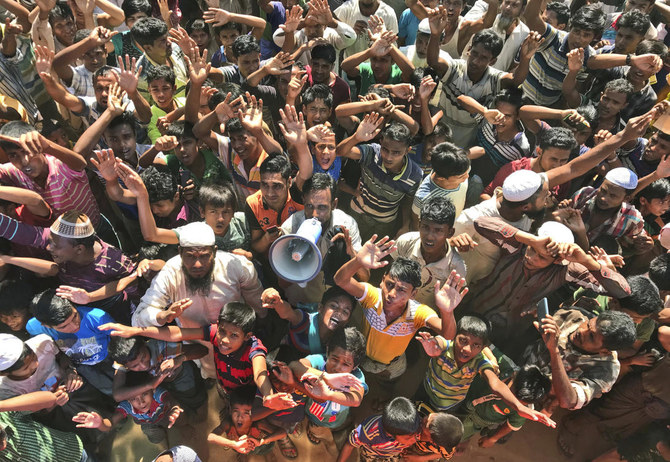
In this Nov. 15, 2018, file photo, Rohingya refugees shout slogans against repatriation at Unchiprang camp near Cox's Bazar, in Bangladesh. (AP)
Updated 19 August 2019
Follow

Bangladesh, UNHCR to survey Rohingya regarding return to Myanmar

  • More than 730,000 Rohingya fled Rakhine for camps in Bangladesh
  • Myanmar has cleared 3,450 people from a list of more than 22,000 refugees provided by Bangladesh

DHAKA: Bangladesh will work with the United Nations refugee agency to determine if more than 3,000 Rohingya refugees will accept Myanmar’s offer to return home, an official said on Monday, nearly a year after a major repatriation plan failed.
More than 730,000 Rohingya fled Rakhine for camps in Bangladesh after a military-led crackdown in August 2017 the United Nations has said was perpetrated with “genocidal intent,” but many refugees refuse to go back, fearing more violence.
“It will be a joint exercise led by UNHCR,” Abul Kalam, Bangladesh’s Refugee Relief and Repatriation commissioner, told Reuters by telephone on Monday, referring to the refugee agency.
The United Nations Security Council is due to discuss the latest repatriation plan behind closed doors on Wednesday at the request of France, Britain, the United States, Germany and Belgium, diplomats said.
Myanmar has cleared 3,450 people from a list of more than 22,000 refugees provided by Bangladesh, government spokesman Zaw Htay told a news conference in the capital Naypyitaw on Friday.
“We have already negotiated with Bangladesh to accept these 3,450 people on August 22,” he said, adding they would be divided into seven groups for repatriation.
A foreign ministry spokesman previously gave Reuters a figure of 3,540 refugees verified under the plan.
Zaw Htay said officials had scrutinized the list to determine whether the refugees had lived in Myanmar and whether they had been involved in attacks on the military.
The 2017 crackdown was preceded by attacks on security forces by insurgents calling themselves the Arakan Rohingya Salvation Army, which Myanmar has classified as a terrorist organization.
Previous attempts at persuading Rohingya to return to Rakhine have failed due to opposition from refugees. An effort in November sowed fear and confusion in the camps, and finally failed after refugee protests.


Bangladesh police say student leader’s killers fled to India

Updated 17 sec ago
Follow

Bangladesh police say student leader’s killers fled to India

DHAKA: Bangladesh police on Sunday said the alleged killers of popular student leader Sharif Osman Hadi had fled to India, in comments likely to further strain relations with its neighbor.
Hadi, a vocal India critic who took part in last year’s mass uprising, was shot by masked assailants in Dhaka earlier this month and later succumbed to his injuries at a hospital in Singapore.
His death set off violent protests with angry mobs torching several buildings, including two major newspapers deemed to favor India as well as a prominent cultural institution.
With protests being held across the country almost daily, pressure has been growing on Bangladesh’s interim government to arrest the killers of Hadi, who was set to contest general elections in February next year.
“The killing was premeditated. Those behind it have been identified,” SN Nazrul Islam, a senior Dhaka Metropolitan Police officer, said at a news conference.
Suspects Faisal Karim Masud and Alamgir Sheikh left Bangladesh through the Haluaghat border with India shortly after attacking Hadi on December 12, Islam said.
They were received at the border by two Indian citizens, who escorted them into the northeastern state of Meghalaya before handing them over to two accomplices.
Bangladeshi investigators were in contact with their Indian counterparts who had arrested the two suspected accomplices, Islam said.
“We are communicating with Meghalaya police, who have confirmed the arrest of two Indian nationals,” he added.
Two senior Meghalaya police officers however did not comment when contacted by AFP.
The Indian foreign ministry had earlier said it rejects “false narratives” about New Delhi’s involvement in Hadi’s killing.
Ties between the neighbors have deteriorated since ousted prime minister Sheikh Hasina fled the pro-democracy uprising and sought refuge in India.
India says it is still considering Dhaka’s requests to extradite Hasina, who was sentenced to death in absentia for orchestrating a deadly crackdown on the uprising.
The lynching of a Hindu garment worker by a mob on December 18 has also hit ties.
Amid the deteriorating security situation in the Muslim-majority country, Khuda Baksh Chowdhury, special assistant to interim leader Muhammad Yunus overseeing the home department, stepped down on Wednesday.