LONDON: Australia defied the absence of star batsman Steve Smith because of a concussion and more devastating spells of pace bowling by Jofra Archer to hold out for a draw in the second Ashes Test against England on Sunday.
Set an improbable victory target of 267 off 48 overs at Lord’s, the Australians quickly slumped to 47-3 but a fourth-wicket stand of 85 between Marnus Labuschagne (59) and Travis Head (42 not out) helped push them to safety.
Australia lost three more wickets in a five-over stretch to keep the match alive as the light faded, but managed to survive to 154-6 at the end.
Australia retain a 1-0 lead in the five-match series.
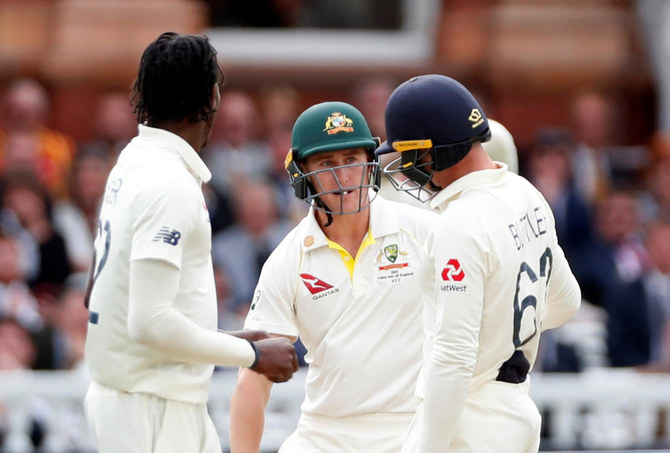
Labuschagne had an interesting day. He only found out he’d be playing as Test cricket’s first-ever concussion substitute when Smith was withdrawn from the team early Sunday after waking up with a headache and feeling groggy after being hit in the neck by an Archer bumper on Saturday.
Labuschagne came to the middle with Australia struggling on 19-2 after 5.3 overs and, off the second ball he faced, was hit on the grille of his helmet by another vicious delivery from Archer. The batsman dropped to the ground, was checked out by medical staff and required a new helmet.
In a blistering spell by Archer, balls flew past Labuschagne but he survived and looked more comfortable in the final session as England’s hopes began to dwindle at the home of cricket. He finally departed, somewhat controversially, when England captain Joe Root was adjudged to have got his fingers under a diving catch at midwicket from Labuschagne’s sweep.
It was Labuschagne’s second half-century in his sixth Test and he could stay in the team for the third Test starting Thursday at Headingley, with Smith’s availability in doubt.
With Australia currently holding the Ashes urn, the English need to win two of the final three tests to take it off their fierce rivals.
Archer’s performance at Lord’s on his test debut will give England real hope, though. He was a permanent menace, taking 2-59 off 29 overs in the first innings and then 3-32 off 15 overs in the second.
A day after flooring Smith with a vicious 92 mph delivery, the Barbados-born quick removed David Warner for 5 — his fourth straight single-figure score this series — and then Usman Khawaja for 2 to catches behind the wicket.
He peppered Bancroft and Labuschagne with missiles but they lasted until tea.
Bancroft (16) was trapped lbw by spinner Jack Leach early in the final session but England could only make further inroads when it was too late.
After Labuschagne’s departure, Leach removed Matthew Wade for 1 before Joe Denly produced a sensational one-handed catch at midwicket off Archer to take out Australia captain Tim Paine for 4.
Head, who was dropped on 22 by Jason Roy at second slip, persevered and Archer had to be withdrawn from the attack late on because of the poor light. He put his hat back on, and Australia’s players could breathe a sigh of relief.
Earlier, Ben Stokes brought up his seventh Test century before England declared their second innings on 258-5 — the same total the team was all out for in its first innings.
Stokes was unbeaten on 115 after hitting 11 fours and three sixes at the ground where he helped win the Cricket World Cup for England barely a month ago. Jonny Bairstow was not out on 30.
England resumed Sunday on 96-4 in its second innings and added 162 runs before declaring midway through the second session.


![]()

Australia salvage a draw in second Ashes Test at Lord’s, stay 1-0 ahead of England
Australia salvage a draw in second Ashes Test at Lord’s, stay 1-0 ahead of England
Latest updates


© 2026 SAUDI RESEARCH & PUBLISHING COMPANY, All Rights Reserved And subject to Terms of Use Agreement.