KARACHI: Special Assistant to Prime Minister on Information and Broadcasting Dr. Firdous Ashiq Awan on Sunday denied that her government had curbed media freedom in Pakistan while addressing a special ceremony in Islamabad to mark the completion of Pakistan Tehreek-e-Insaf (PTI) party’s first year in government.
Rejecting the censorship allegations, she said that Prime Minister Imran Khan had not tried to control the media at any level or forum. “The greatest achievement of the government in the past one year is that it has kept a firm belief in the freedom of expression and speech,” Awan noted.
“During the coming week, the media will hold ministries answerable [in press briefings],” she continued while referring to the upcoming news conferences of government functionaries to discuss the performance of their ministries as the ruling party observes its first anniversary in power.
Apart from press freedom, Awan counted the ongoing housing project, health care program and foreign policy among the government’s top achievements. She said the prime minister was scheduled to address the nation, to sum up, the accomplishments of his administration but his speech was postponed since the government was completely focusing on the Kashmir issue.
“The foreign ministry should be praised for raising the Kashmir dispute at international forums, including the United Nations,” she said while describing the recent Security Council session on Kashmir as a huge success since the world’s top diplomatic forum had taken up the issue for the first time in several decades.
“The government under the leadership of Prime Minister Imran Khan will continue to present the Kashmir issue at an international level,” she added.
Awan also hailed the opposition for supporting the government on Kashmir, pointing to the fact that all political parties had set aside their differences to project a greater cause.
Discussing her government’s performance in other areas, she said: “We have allocated Rs 152 billion for the Ehsaas Program, which is an ambitious social safety and poverty alleviation program for the welfare of the public. Ehsaas comes close to the heart of the prime minister who believes that a society cannot change until its people understand each other’s condition.”
Addressing the occasion, Prime Minister’s Special Assistant on Political Affairs Naeemul Haque said the government got an empty exchequer from previous administrations. “We will start various schemes to pay the country’s pending debt,” he said.
Haque added that the country’s underprivileged population would find a roof over its head in the next five years. “The poor will own a house by paying 5,000 to 15,000 rupees a month.”
Analysts told Arab News it was not possible to gauge the performance of an administration on the basis of its one-year record, though that the PTI “will have to work quite diligently to fulfill its promises to people.”
“We cannot expect jobs and homes in the first year since the government had promised to provide 500,000 houses and 200 million jobs during its five-year tenure,” said Mazhar Abbas, a Karachi-based political commentator.
He said that PTI voters and supporters were satisfied with the proactive National Accountability Bureau (NAB), though independent observers believed that the country’s anti-graft body was only targeting opposition politicians.
“The government’s performance at the foreign policy level is not bad,” he added. “Both the civilian and military leadership of the country seem to be on the same page as well, though the military seems to be in greater command lately.”
Abbas said the PTI government had failed to control the economic crisis in the country. “Within a year, the economic team was totally changed. The hike in the rate of the US dollar and spiraling inflation are also damaging the government’s reputation,” he continued.
“There has hardly been any education, health, civil services, police and judicial reforms due to the tense environment in parliament, mainly due of the attitude of people at the treasury benches,” he noted. “The government needs to create a conducive environment that may catalyze the long-overdue reform process in the country.”


![]()

No curb on media freedom in Pakistan, says Firdous Ashiq Awan
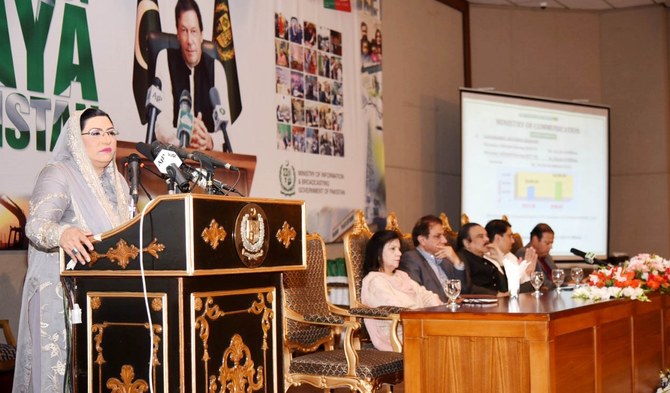
No curb on media freedom in Pakistan, says Firdous Ashiq Awan
- The special assistant to prime minister counts the government’s foreign policy and social reform agenda as its accomplishments in one year
- Analysts say the PTI administration needs to do a lot more to stabilize the country’s economy
Latest updates





© 2026 SAUDI RESEARCH & PUBLISHING COMPANY, All Rights Reserved And subject to Terms of Use Agreement.