DERA ISMAIL KHAN, Pakistan: Pakistani intelligence officials say a roadside bomb attack has killed two army soldiers in the country’s northwest.
The officials say the planted bomb exploded Saturday afternoon when a security forces vehicle was patrolling in Ladha area of South Waziristan.
The officials spoke on condition of anonymity because they were not authorized to speak to media.
No group immediately claimed responsibility for the attack but past such attacks have been claimed by Pakistani Taliban.
South Waziristan has been a stronghold of Mahsud militants until the army carried out multiple offensives against them in recent years.
The army claims to have cleared the area near the Afghan border of Islamic militants.

Pakistan officials say roadside bomb kills 2 soldiers
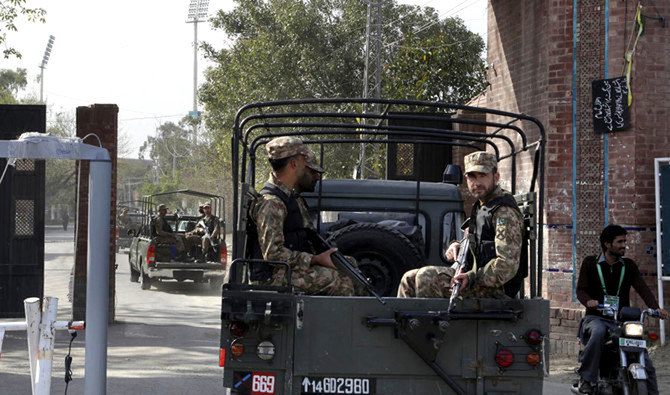
- Planted bomb exploded when a security forces vehicle was patrolling in South Waziristan
- Area has been a stronghold of militants until the army carried out multiple offensives against them
UN says 270,000 Afghans have returned from Iran, Pakistan this year
- UNHCR says 110,000 Afghans returned from Iran while 160,000 returned from Pakistan since start of 2026
- Return numbers seem to have risen since Gulf war erupted on Feb. 28, says UNHCR official in Afghanistan
GENEVA: Some 270,000 Afghans have returned to their country from Pakistan and Iran so far this year, the UN said Tuesday, warning that the escalating Middle East war risked pushing the numbers higher.
UNHCR, the United Nations’ refugee agency, said that 110,000 Afghans had returned from Iran and another 160,000 had returned from Pakistan since the start of 2026.
And the numbers seem to have risen since the Middle East erupted on February 28, with the United States and Israel unleashing a barrage of strikes on Iran, and Tehran responding with drone and missile strikes on Israeli and US interests across the region.
Since then, there have been some 1,700 returns from Iran to Afghanistan each day, Arafat Jamal, UNHCR’s representative in Afghanistan, told reporters in Geneva.
Speaking from Islam Qala, on the Afghan-Iranian border, he said the situation there was “deceptively calm.”
“Returns are orderly but freighted with tension and apprehension,” he said, adding that with the hostilities elsewhere escalating, “I do fear there is more to come.”
“We are preparing for massive returns.”
He pointed out that Afghanistan was “facing the ramifications of what is happening with Iran,” while clashes have erupted along the Afghan border with Pakistan.
The new Middle East war, he warned, was “layering itself on top of an existing war on another frontier,” Jamal said.
UNHCR highlighted that the latest crises came after returns to Afghanistan had already been “exceptionally high” in recent years.
More than five million Afghans had returned from neighboring countries in the past two years, including 1.9 million returning from Iran last year alone.
Jamal warned that “many Afghan families are now facing cycles of displacement: first forced to flee Afghanistan, later displaced again inside Iran due to conflict, and now returning once more to Afghanistan.”
“And upon return in Afghanistan, the triply-displaced enter a spiral of precarity and uncertainty.”
Returns from Pakistan had meanwhile stabilized in recent weeks, as the main crossing point at Torkham remained closed due to the tensions there, Jamal said.
But he warned that “movements could increase sharply once the border reopens.”
UNHCR and the UN children’s agency UNICEF said Tuesday they were working to strengthen their capacity to operate at the borders and within Afghanistan.
But “given the scale of returns and the financial constraints facing humanitarian operations, additional support will be needed if arrivals increase,” UNHCR said, without specifying the amount needed.


