NEW YORK/WASHINGTON: An autopsy of the financier Jeffrey Epstein, who died in an apparent suicide while awaiting trial on sex trafficking charges, found his neck had been broken in several places, according to two law enforcement sources.
Such injuries can occur to people who hang themselves or who are strangled.
Epstein was found dead in his jail cell in New York City on Saturday. The circumstances of the multi-millionaire’s death are under investigation, and it was unclear when a report of the autopsy would be made public.
One of the two law enforcement sources familiar with the Epstein case said there was no evidence or suggestion of foul play but cautioned the investigation was at an early stage.
“In all forensic investigations, all information must be synthesized to determine the cause and manner of death,” Barbara Sampson, New York City’s chief medical examiner, said in a statement on Thursday. “Everything must be consistent; no single finding can be evaluated in a vacuum.”
Epstein’s broken neck was reported earlier by the Washington Post.
The Federal Bureau of Prisons, which runs the Metropolitan Correctional Center in lower Manhattan where Epstein was jailed, said there had not been an inmate suicide there since 2006.
Zhongxue Hua, the Bergen County medical examiner in New Jersey, said a neck fracture was atypical in a suicide but warned not to jump to conclusions.
“It’s unusual to have a neck fracture,” Hua said. “But the first question to address is when did it occur.”
If Epstein’s neck fracture was fresh, Hua said, then “at a minimum, it’s a very unusual suicide.”
Epstein, 66, who once counted Republican President Donald Trump and Democratic former President Bill Clinton as friends, was found unresponsive in his cell on Saturday morning, according to the prison bureau.
A source told Reuters previously that he was found hanging by the neck.
Mark Epstein, who is Jeffrey Epstein’s brother, said in an interview on Thursday he had last seen his brother in the morgue on Sunday.
Jeffrey Epstein pleaded not guilty in July to charges of sex trafficking involving dozens of underage girls between 2002 and 2005. Prosecutors said he recruited and paid girls to give him massages, which became sexual in nature.
The financier had been on suicide watch at the MCC but was taken off prior to his death, according to a source who was not authorized to speak on the matter.
Epstein was alone in a cell when he was found hanging there.
Attorney General William Barr has said the criminal investigation into any possible co-conspirators would continue.
Barr, whose agency oversees the Bureau of Prisons, has also demanded an investigation into Epstein’s death and ordered the temporary reassignment of his jail warden.
The bureau said 20 of its inmates, including those under home confinement or in halfway houses, committed suicide in the 10 months ending in July, and 109 committed suicide in its previous five fiscal years, which end on Sept. 30.
It also said its suicide rate is lower than that for the overall US population.
At the MCC, two jail guards are required to make separate checks on all prisoners every 30 minutes, but that procedure was not followed overnight, the source said.
Separately, a team at the jail on Wednesday began an “after action” review, which is normally triggered by significant events such as a prominent inmate’s death, a person familiar with the matter said.


![]()


Jeffrey Epstein autopsy report shows broken neck
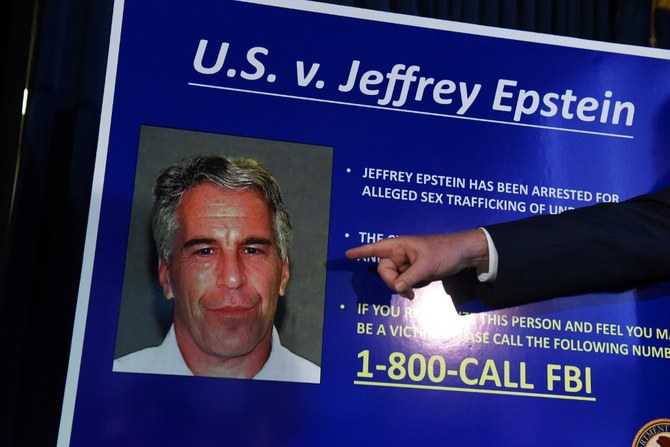
Jeffrey Epstein autopsy report shows broken neck
- Epstein committed suicide while awaiting trial on sex trafficking charges
- Medical examiner says a neck fracture was atypical in a suicide


Trump says he’s thinking of putting Republican Senator Ted Cruz on Supreme Court
- Trump, introducing Cruz at a rally in Corpus Christi, called the Texas Republican ‘an amazing guy’
CORPUS CHRISTI, Texas: President Donald Trump on Friday said he was considering nominating Republican Senator Ted Cruz for a future seat on the US Supreme Court, although Cruz last month said he was not interested.
Trump, introducing Cruz at a rally in Corpus Christi, called the Texas Republican “an amazing guy,” joking that he would easily win confirmation from Democrats and Republicans in Congress alike because they wanted to get him out of the Senate.
“He’s the only guy I know, he’ll get 100 percent of the Democrat vote, 100 percent of the Republican vote. They want to get him out of there. He is such a pain in the ass, but he’s so good and so talented.”
Latest updates


© 2026 SAUDI RESEARCH & PUBLISHING COMPANY, All Rights Reserved And subject to Terms of Use Agreement.