SAN FRANCISCO/SINGAPORE: Boeing has pushed back the entry into service of an ultra-long-range version of its forthcoming 777X widebody, the US planemaker said on Wednesday, as it grapples with fallout from the 737 MAX crisis and engine issues with the 777X.
The fresh delay comes as the grounding of Boeing’s money-spinning 737 MAX single-aisle entered a sixth month in August, and as the world’s largest planemaker faces engine-related delays on the 777X widebody that have pushed the first flight of the 777-9 into 2020.
The delay in the slower-selling, longer-range 777-8 will hamper Boeing’s ability to provide a plane in line with the schedule for Qantas Airways’ plan for 21-hour non-stop Sydney-London flights.
The Australian airline had hoped for first deliveries of the planes in 2022 and the launch of the world’s longest commercial flight in 2023.
“We reviewed our development program schedule and the needs of our current 777X customers and decided to adjust the schedule,” Boeing spokesman Paul Bergman said by email, adding that the manufacturer remained committed to the 777-8.
“The adjustment reduces risk in our development program, ensuring a more seamless transition to the 777-8. We continue to engage with our current and potential customers on how we can meet their fleet needs. This includes our valued customer Qantas.”
The Air Current website first reported the delays, saying the 350-seat 777-8 model revised for ultra-long-range flights had originally been scheduled to enter service in 2022 after the arrival of the 777-9 in 2020.
The decision effectively means Boeing engineers have frozen development work on the ultra-long-range version of the 777X. The schedule delay could jeopardize competition with European arch-rival Airbus for a slice of the ultra-long-haul travel market.
Airbus, which is offering an ultra-long-range version of its A350-1000, and Boeing have already submitted their “best and final” offers to Qantas for planes capable of the 17,000-kilometer Sydney-London route, a Qantas spokesman said.
“We still expect to make a decision by the end of this calendar year,” he said.
Boeing’s proposal included a “compelling option” to help deal with the 777-8 delay because it was keen to the stay in the race, according to a source with knowledge of the matter who was not authorized to speak publicly.
An Airbus spokesman said details of its discussions with Qantas remained confidential but the A350 was a “perfect solution” to meet the airline’s needs.
To date, Emirates and Qatar Airways are Boeing’s only customers for the 777-8, having ordered 35 and 10 respectively. The Seattle Times in June reported Emirates was renegotiating its 777X orders.
Emirates and Qatar Airways did not respond immediately to requests for comment about the 777-8 delays.

Boeing delays delivery of ultra-long-range version of 777X aircraft
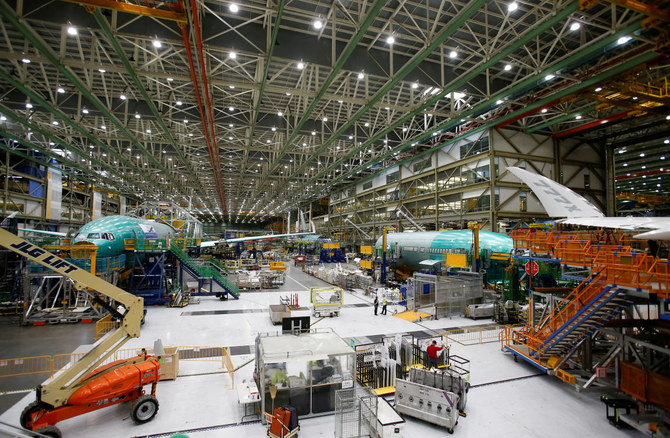
- Boeing still grapples with fallout from the 737 MAX crisis and engine issues with the 777X
- schedule delay could jeopardize competition with European arch-rival Airbus
Arab food and beverage sector draws $22bn in foreign investment over 2 decades: Dhaman
JEDDAH: Foreign investors committed about $22 billion to the Arab region’s food and beverage sector over the past two decades, backing 516 projects that generated roughly 93,000 jobs, according to a new sectoral report.
In its third food and beverage industry study for 2025, the Arab Investment and Export Credit Guarantee Corp., known as Dhaman, said the bulk of investment flowed to a handful of markets. Egypt, Saudi Arabia, the UAE, Morocco and Qatar attracted 421 projects — about 82 percent of the total — with capital expenditure exceeding $17 billion, or nearly four-fifths of overall investment.
Projects in those five countries accounted for around 71,000 jobs, representing 76 percent of total employment created by foreign direct investment in the sector over the 2003–2024 period, the report said, according to figures carried by the Kuwait News Agency.
“The US has been the region's top food and beverage investor over the past 22 years with 74 projects or 14 projects of the total, and Capex of approximately $4 billion or 18 percent of the total, creating more than 14,000 jobs,” KUNA reported.
Investment was also concentrated among a small group of multinational players. The sector’s top 10 foreign investors accounted for roughly 15 percent of projects, 32 percent of capital expenditure and 29 percent of newly created jobs.
Swiss food group Nestlé led in project count with 14 initiatives, while Ukrainian agribusiness firm NIBULON topped capital spending and job creation, investing $2 billion and generating around 6,000 jobs.
At the inter-Arab investment level, the report noted that 12 Arab countries invested in 108 projects, accounting for about 21 percent of total FDI projects in the sector over the past 22 years. These initiatives, carried out by 65 companies, involved $6.5 billion in capital expenditure, representing 30 percent of total FDI, and generated nearly 28,000 jobs.
The UAE led inter-Arab investments, accounting for 45 percent of total projects and 58 percent of total capital expenditure, the report added, according to KUNA.
The report also noted that the UAE, Saudi Arabia, Egypt, and Qatar topped the Arab ranking as the most attractive countries for investment in the sector in 2024, followed by Oman, Bahrain, Algeria, Morocco, and Kuwait.
Looking ahead, Dhaman expects consumer demand to continue rising. Food and non-alcoholic beverage sales across 16 Arab countries are projected to increase 8.6 percent to more than $430 billion by the end of 2025, equivalent to 4.2 percent of global sales, before exceeding $560 billion by 2029.
Sales are expected to remain highly concentrated geographically, with Egypt, Saudi Arabia, Algeria, the UAE and Iraq accounting for about 77 percent of the regional total. By product category, meat and poultry are forecast to lead with sales of about $106 billion, followed by cereals, pasta and baked goods at roughly $63 billion.
Average annual per capita spending on food and non-alcoholic beverages in the region is projected to rise 7.2 percent to more than $1,845 by the end of 2025, approaching the global average, and to reach about $2,255 by 2029. Household spending on these products is expected to represent 25.8 percent of total expenditure in 13 Arab countries, above the global average of 24.2 percent.
Arab external trade in food and beverages grew more than 15 percent in 2024 to $195 billion, with exports rising 18 percent to $56 billion and imports increasing 14 percent to $139 billion. Brazil was the largest foreign supplier to the region, exporting $16.5 billion worth of products, while Saudi Arabia ranked as the top Arab exporter at $6.6 billion.


