

Philippine beauty queen dreams of Palestine

1 / 3
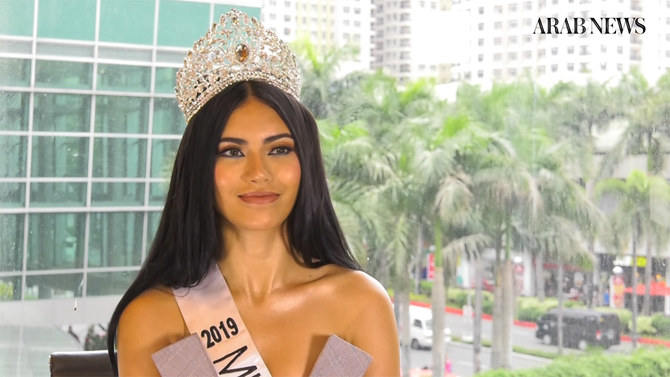
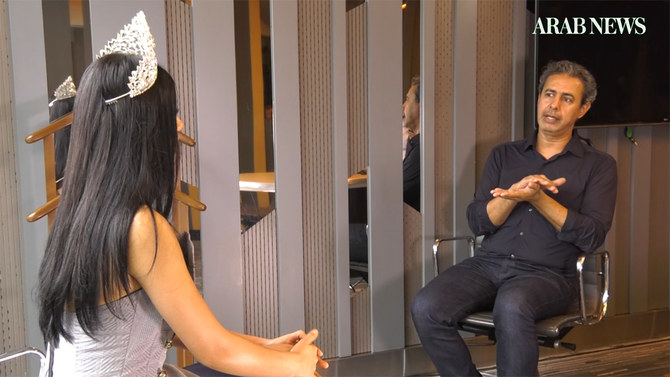
Half-Palestinian Gazini Christiana Jordi Ganados is named after her Palestinian father Ghassan. (Instagram)
2 / 3
Half-Palestinian Gazini Christiana Jordi Ganados is named after her Palestinian father Ghassan. (Instagram)
3 / 3
Half-Palestinian Gazini Christiana Jordi Ganados is named after her Palestinian father Ghassan. (Instagram)
Updated 08 August 2019
Follow

Philippine beauty queen dreams of Palestine

  • 24-year-old Gazini Christiana Jordi Ganados is the Philippines’ contestant for Miss Universe 2019
  • She is the daughter of a Filipino woman and a Palestinian man

MANILA: She has her father’s eyes and her mother’s hair. And that is good enough for Gazini Christiana Jordi Ganados, 24, who says that even though they are separated, at least on her face her parents are still together.

The half-Palestinian, half-Filipino contender for the Miss Universe pageant this year credits her looks, especially her nose and height, to her Arab-Mediterranean father, whom she hopes to meet some day.

“I’d love to meet him. I have no grudges because that won’t bring me anywhere. But instead I’ll just thank him, and know that he’s still alive,” Ganados told Arab News.

FAST FACTS

  • Miss Universe 2019 will take place on Dec. 19.
  • Catriona Gray, Miss Universe Philippines 2018, was crowned Miss Universe last year.
  • Gazini Christiana Ganados was crowned Miss Universe Philippines 2019 in June.

“I’d be happy to know his side (of the family) and if I have a grandfather or a grandmother. Or maybe I have a stepsister or a brother. I’ve always wanted to have more family since all my life I’ve grown up alone.

While she knows very little about her father Ghassan, Ganados said that besides a photograph, what keeps his memory alive is the fact that she shares her name with him.

“My mother named me after him … My name is Gazini, which is from his name Gazan (from Ghassan); Christiana because my mom is a devout Catholic; Jordi because she told me it means flowing water, and I’m assuming it’s like the Jordan River,” she said.
Born in Dapitan City, in the Philippines’ Zamboanga del Norte province, Ganados began modeling at 15. Her first major break came in the form of a contract with Origin Model Management, which thrust her into the world of glamor and spotlights.

“At 15, I started modeling and supported myself through education. And then I took up nursing care, graduated from it, and then started another course in tourism management,” she said.


By 2014, she had already enlisted to participate in the Miss World Philippines contest, all while setting her sights on the bigger title of Miss Universe.

“I wanted to try another pageant one last time before I embarked on working a stable job … I just gave it my all,” she said.

The hard work paid off in June this year when Ganados beat 40 other Filipinos to win the Miss Philippines title — her ticket to the biggest beauty pageant in the world. It is a dream which she said she has always shared with her single mother.

“I hoped for this day to come, and now I’m Miss Universe Philippines 2019. None of this would’ve been possible without my mother,” she said. 

She added that being raised by a single mother “made my foundation very strong.”
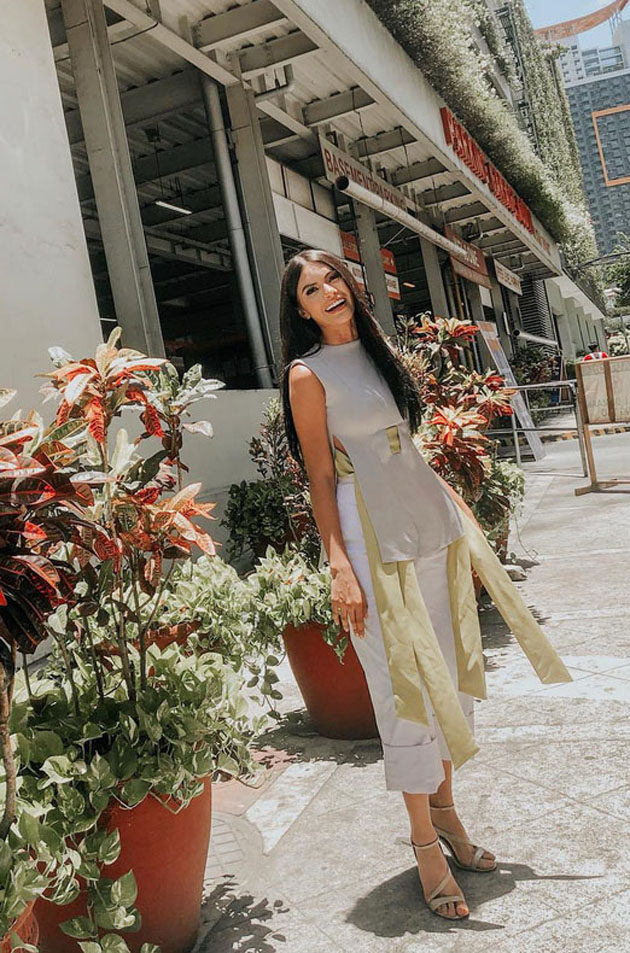


Gazini Christiana Jordi Ganados says she will promote the rights of the elderly if wins the Miss Universe title. (Instagram photo)

Ganados said: “Growing up without a dad has made me a little bit stronger because my mom showed me if men can do something, a woman can do it too … and I’m so proud that I was born and raised by a strong mother.”

If she does win the Miss Universe title, Ganados has committed to promoting the rights of the elderly. “I’m extremely close to my grandparents and therefore want to be an advocate of elderly care. There’s a lack of facilities in our country, and a lot of people can’t work any more because of the age restrictions. I want to incorporate an active lifestyle for elderly people,” she said.

She intends to set up an elderly care center in every province where they can work.

“It’s a place where they can do stitching, or maybe they can create some artwork that can still be sold.  And at the same time, they’re earning and still stimulating their mind as well as promoting our local products here in the Philippines. So they’re already earning, plus they’re enjoying being active while aging,” she said.

Ganados said that taking care of the elderly is a major aspect of Filipino culture, something which she shares with her Middle Eastern lineage. 

“I’ve heard a lot of good stories about the Middle East: They have a lot of good food. I’ve researched about Palestine on Google. There’s a lot of architecture which is beautiful. I love exploring new cultures and I’m hoping that, maybe some day, I’ll visit,” she said.


Madeeha Qureshi’s new cookbook brings Saudi flavors to the world 

Updated 12 March 2026
Follow

Madeeha Qureshi’s new cookbook brings Saudi flavors to the world 

  •  The former ‘MasterChef UK’ contestant’s recipes pay homage to her childhood in the Kingdom

JEDDAH: Born in Pakistan, raised in Saudi Arabia, and now living in the UK, Madeeha Qureshi says she belongs to “a third-culture space.” Her debut publication, “The Red Sea Cookbook,” is her way of coming home to Saudi Arabia. 

“Among the vibrancy of Saudi food and picturesque landscape, you will find a little girl’s heartwarming stories and memories,” Qureshi, a food writer, recipe developer and content creator who has more than 300,000 followers on Instagram, tells Arab News. “I cannot separate Saudi Arabia from my core DNA. It is with me wherever I go. It is the place where I was brought up, where my memories were made.” 

Born in Pakistan, raised in Saudi Arabia, and now living in the UK, Madeeha Qureshi says she belongs to “a third-culture space.” (Supplied)

British food writer Tom Parker Bowles hailed “The Red Sea Cookbook” as “a joyous introduction to the wonders of Saudi Arabian cookery.” It is part memoir, part culinary atlas, and, Qureshi says, “an applaudable ending to the person who wrote my beginning” — her late father.  

Qureshi arrived in the Kingdom as a baby in the early 1980s, when her father worked on Royal Commission projects in Yanbu and Jubail. Her earliest memories are of living in a community of expatriate families from around the world. 

“We talk about diversity in the West, but Saudi Arabia, at its core, is as diverse as anywhere,” she says. “I was surrounded by people from all walks of life, from every corner of the world.” 

This is the Saudi Arabia that rarely reaches Western audiences: a civilization influenced by centuries of trade routes and pilgrimage.  

Qureshi as a child with her father at the Red Sea coast in Saudi Arabia. (Instagram)

In “The Red Sea Cookbook,” Qureshi writes of a land where the scent of cardamom and dried limes drifts through historic markets, where fishermen along the Red Sea coast haul in grouper and emperor fish at dawn, and where family meals stretch into long evenings filled with coffee and conversation. And Saudi cuisine, she argues, has long been misunderstood and pigeonholed into a vague notion of “Arab food.” 

“There is a general misconception in the West that it’s bland, beige, boring. But it is the polar opposite,” she notes. 

The book’s origins are inseparable from personal loss. When her father — whom she refers to as her “safe space” and the “core of my whole existence”— died, she found herself unable to process the grief.  

“So much happened in such a short time,” she recalls. “I had a rainbow baby, then another baby. Then the (COVID-19) pandemic happened and I lost my job.”  

The cover of Madeeha Qureshi's 'The Red Sea Cookbook.' (Supplied)

The latter shock did mean, however, that she was able to join “MasterChef UK” as a contestant in 2021. 

In the quarterfinals of the famed culinary show, contestants were asked to create a dish that carried deep personal meaning. The challenge transported Qureshi back to the beaches of Yanbu and a childhood snack her father would bring home for her. 

“The thing that popped into my head was mutabbaq — which I associated with my dad from a very young age,” she says. “I decided to give them a taste of something which has never been showcased to the British media.” 

When she presented the dish — a stuffed, shallow-fried pastry common across the Kingdom and the Gulf — to the judges and began explaining the memory behind it, something gave way.  

“All of a sudden, this whole tsunami of tears that was sitting inside me came out. The cameras captured it and when it went on air, the whole country cried with me; they grieved with me.” 

She realized that personal food stories resonate across cultures and that Saudi cuisine had never really been presented on a Western platform. And so, the idea for her memoir-style cookbook was born. 

Qureshi spent three years working on it and weathered hundreds of rejections before Nourish, an imprint of Watkins Media, took the leap.  

“Writing this book made me reflect on the significance of my upbringing in Saudi Arabia and the way it has shaped my life and seasoned my palate,” Qureshi says. 

“The Red Sea Cookbook” was born from the years she spent adapting Saudi dishes with British pantry staples. She found ways to liberate Saudi recipes from the assumption that authentic cooking requires specialist ingredients or elaborate techniques. Her mutabbaq, for example, uses spring roll pastry instead of hand-stretched dough.  

“I actually showcased the idea on ‘MasterChef,’” she explains. “(Because the pastry is ready-made) you can make it within half an hour.” It’s a convenient dish for students and busy professionals living abroad and craving a taste of home. The small change also makes Saudi cooking approachable without losing its soul.  

“The ingredients are not difficult to source,” she adds. “And you can still have the best of your memories, those foods from Saudi Arabia that you remember, without compromising the key flavors.” 

When Qureshi visited Saudi Arabia in April last year, she retraced her childhood, made a pilgrimage to Madinah, and enjoyed exploring Riyadh. She found some places unchanged and others unrecognizable. The country felt transformed and eager to showcase its culture to the world. “The Red Sea Cookbook” is well-suited to this moment. 

“This is actually a book showing Saudi culture moving forward rather than still chained to its past,” she says. “It’s like how the country is unfolding and showing its colors to the world, which people need to see.” 

Those colors include the extraordinary and deceptively simple seafood of the Red Sea coast as well as beloved national favorites such as kabsa, mandi and saleeq, and traditional sweet treats such as sh’ariya and areeka malakiya.  

“Food has the incredible power to transport you somewhere without physically being there,” she writes in the book. “During these unpredictable times, this is the best we can do.”