Pakistan took "irreversible" steps to curb terror financing — finance ministry

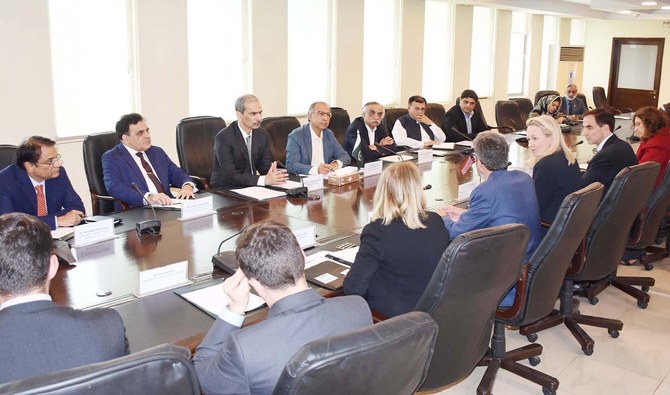
Abdul Hafeez Shaikh, Adviser to the Prime Minister on Finance & Revenue, leading the Pakistani side in a meeting with visiting US delegation led by Ambassador Alice G. Wells, Acting Assistant Secretary of State for the Bureau of South and Central Asian Affairs, at Finance Division, Islamabad on Aug. 6, 2019. (Photo courtesy: PID)
Updated 07 August 2019
Follow

Pakistan took "irreversible" steps to curb terror financing — finance ministry

  • Ministry briefed US delegation on the progress made in implementing FATF plan
  • Islamabad hopes to be removed from the global watchdog's grey list by October

ISLAMABAD: Pakistan’s government said on Tuesday that it was pulling out all stops to implement the Financial Action Task Force’s (FATF) 27-point action plan for anti-money laundering and counter-terrorism measures by ensuring that the actions undertaken are irreversible and sustainable. 
Islamabad was formally placed on the FATF’s grey-list in June last year after the 37-member global watchdog found deficiencies in the country’s legal framework to counter-terrorism financing. 
The United States had spearheaded the move to place Pakistan on the FATF grey list for its lack of actions against proscribed outfits such as Jaish-e-Mohammad and Jamatud Dawa, both of which were accused of cross border terrorism.
Experts believe that if Pakistan is successful in convincing the US about its recent actions against banned outfits, countering money laundering and terrorism financing, it can have itself removed from the grey list after a final review in October this year.
“Pakistan remains committed to enhancing the effectiveness of its AML/CFT Framework, with the objective to ensure that all the actions that are being taken to curb terror financing are irreversible and sustainable,” Abdul Hafeez Shaikh, Adviser to Prime Minister on Finance told a US delegation led by ambassador Alice G. Wells, Acting Assistant Secretary of State for the Bureau of South and Central Asian Affairs.
Shaikh also informed the visiting delegation of the measures undertaken by the government to ensure economic discipline, including the efforts being made toward the implementation of the FATF action plan and the key challenges ahead.
He emphasized the importance of bilateral engagement with the US and the need to encourage entrepreneurs from the private sectors of both the countries for enhanced trade ties.
Shaikh added that over the past three months, the government has taken significant steps to bring financial discipline in the country which included a reduction in current account deficit, focus on increasing revenue generation, measures to reduce fiscal expenditures, reducing fiscal borrowings, efforts to enhance foreign exchange reserves through bilateral and multilateral support, arrangement of a petroleum credit facility with Saudi Arabia and Islamic Development Bank, and an aid program with the International Monetary Fund.
“The US would continue to remain engaged with Pakistan in its economic reforms efforts and help build an environment that facilitates business development between the two countries,” Wells said.
Pakistan is now required to submit a final compliance report on the FATF’s 27-point action plan before August 13, following which the watchdog will decide whether or not to remove Islamabad from the grey-list or downgrade it further.
Dr. Ashfaque Hasan Khan, a senior economist and member of the government’s Economic Advisory Council, said that Wells’ visit to Pakistan is a follow-up of Prime Minister Imran Khan’s recent meetings with President Donald Trump and other top US officials in Washington.
“We have done a lot to implement the FATF’s action plan and this has been briefed to the US team today in detail,” he told Arab News.
Khan expressed hope that Pakistan would be removed from the FATF’s grey list “on the basis of its actions to counter money laundering and terrorism financing, and the US’ support due to our key role in the Afghan peace process.”


Pakistan seeks Chinese investment in push to shift minerals sector toward value addition

Updated 4 sec ago
Follow

Pakistan seeks Chinese investment in push to shift minerals sector toward value addition

  • Islamabad says mineral exports could reach $6–8 billion annually with processing and refining
  • Pakistan aims to move beyond raw extraction toward processing, refining, export-oriented industrial clusters

ISLAMABAD: Pakistan on Wednesday said it was seeking Chinese investment to develop its vast but underexploited mineral resources, pitching a strategy focused on value addition, processing and export-oriented industrial clusters as it looks to turn mining into a pillar of long-term economic growth.

At the Pakistan–China Mineral Cooperation Forum in Islamabad, senior ministers said the government’s priority was to move beyond the export of raw minerals by developing processing plants, smelters and mineral-based industrial clusters linked to Special Economic Zones (SEZs), according to reports in state-run Radio Pakistan and the Associated Press of Pakistan (APP).

Pakistan holds significant reserves of copper, gold, coal and other critical minerals, but its mining sector has historically been constrained by limited infrastructure, regulatory complexity and a lack of downstream processing capacity. The government has identified mining as a potential source of foreign exchange and industrial development as it seeks international investment amid broader economic reforms.

The flagship of that strategy is the Reko Diq copper-and-gold project in Balochistan, one of the world’s largest undeveloped copper deposits, which officials see as a test case for attracting large-scale foreign capital and integrating Pakistan into global mineral supply chains.

Speaking at the forum, Planning and Development Minister Ahsan Iqbal said Pakistan’s mineral exports could rise substantially if value was added domestically rather than through raw material exports, stressing the importance of Chinese partnership in achieving that shift.

“Pakistan’s mineral exports have the potential to reach $6-8 billion dollars annually within this decade through value addition,” Ahsan Iqbal said, according to a Radio Pakistan report. 

He said Pakistan’s objective was to develop mineral processing plants, smelters and refining facilities, adding that “transformation of Pakistan’s mineral economy cannot happen without strategic partners and China’s role is central in this regard.”

Ahsan Iqbal also linked the minerals push to the second phase of the China–Pakistan Economic Corridor (CPEC), saying it aimed to translate infrastructure connectivity into productivity, exports and jobs, while reaffirming that the security of Chinese nationals and investments remained a top national priority.

Separately, Board of Investment Minister Qaiser Ahmed Sheikh said at the forum Pakistan and China were expanding cooperation in the minerals sector alongside broader economic engagement, citing growing business-to-business activity, according to an APP report.

He said more than 300 Pakistani companies visited China in September 2025 alone and that 167 memorandums of understanding were signed at a Pakistan–China business-to-business conference, with the Board of Investment working on their implementation.

Petroleum Minister Ali Pervaiz Malik invited Chinese firms to participate in the Pakistan Minerals Investment Forum 2026, scheduled for April 8–9, describing it as a platform for structured engagement with policymakers, regulators and project sponsors, according to APP.

He said China’s experience in rare earth elements, copper smelting and refining offered lessons for Pakistan as global demand accelerates for critical minerals linked to the energy transition, adding that Pakistan, with China’s support, was positioning itself as a long-term partner in global mineral supply chains.