


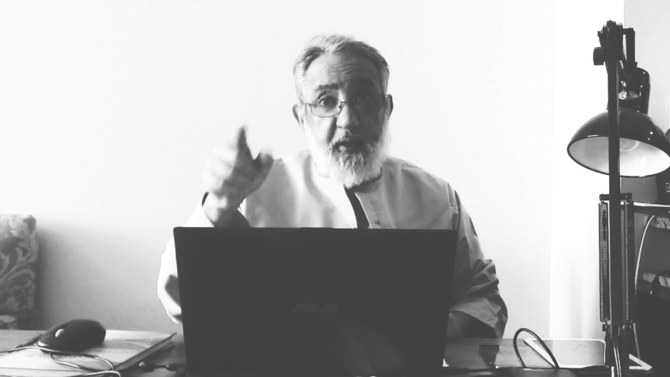

DUBAI: It may seem strange that a prominent Sunni Salafi jihadist and preacher of hate has lived unmolested in the West since the 1980s. Yet Dr. Tariq Abdelhaleem probably sees nothing odd at all about promoting Islamic radicalism while enjoying the hospitality of Canada.
He is an unabashed proponent of the ideas of two major Salafi revivalists of the last century: Syed Abul ‘Ala Maududi, the Pakistani author and activist, and Sayyid Qutb, the Egyptian theorist of violent jihad.
Abdelhaleem’s regressive views on women offer a window into his mind. “The secular West has dangerously affected our society and Islamic concepts through its cultural legacy, despite the widespread veiling of Arab women,” he has said. “To see the deep impact of Western culture on Arab societies, it is enough to look at the phenomena of unveiling and debauchery.”
Drawing lines between “pious and impious women,” he claims both “have lived in the same environments, subjected to the same cultural impacts (but that the former) have rejected everything that is banned and contrary to Islam. There are some things that are inculcated in the environment, fueled by cultural sources such as the media, education and emerging customs, which resonates in women’s spirits, hidden in a dark corner of the human psyche.”
Dr. Hani Nasira, an expert on ideological movements, said Abdulhaleem has been taking advantage of the freedoms granted by his adopted country to disseminate his message.
Following the upheavals of 2011 in Egypt, which saw the Muslim Brotherhood gain political power, Canada-based Abdelhaleem founded what he called the “Sunni Movement to Save Egypt” and became its secretary-general, in partnership with Sheikh Dr. Hani Sibai. He also wrote ferociously, including on “Introducing the Sunni Movement to Save Egypt” and “Our Faith and Our Movement.”
BIO
Name: Tariq Abdelhaleem
Nationality: Egyptian
Place of Residence" Mississauga, Ontario, Canada
Occupation Cleric: head of the Dar Al-Arqam Institute
Medium: YouTube, Twitter, and his website Tariq-abdelhaleem.net
But when Mohamed Morsi was ousted by the Egyptian military in July 2013, Abdelhaleem vented his displeasure at the Grand Sheikh of Al-Azhar, Ahmed El-Tayeb, considered by many to be the highest authority in Sunni Islamic thought.
“A coup has been carried out by the military, supported by crusaders, secularists, the atheist media, artists and the Egyptian judiciary,” he said in an interview. “This whole group, and those who follow them, are like the dog of Al-Azhar, who ... is not worthy of praise, but is loathsome, malicious and abominable.”
Abdelhaleem also accused El-Tayeb of sitting at “the council of politicians with (deposed Egyptian President Hosni) Mubarak in the presence of … infidels loyal to infidels.”
According to Nasira, “Abdelhaleem’s bet is on a global armed Islamic revolution. He also calls for individual jihadist attacks and offers religious justification for suicide bombings and other terrorist operations.”
Born in Egypt in 1948, his maternal grandfather was Abdul Aziz Al-Bishri, an academic and moderate writer, while his paternal grandfather was a scholar at Cairo’s Al-Azhar University.
By all accounts, Abdelhaleem warmed to the idea of violent jihad from a relatively young age. After settling in Canada in the late 1980s, he founded the Dar Al-Arqam Institution and began teaching a course in Islamic sharia law in cooperation with the American Open University in 1998. He also edited Ummat Al-Islam, a periodical that appears in both Arabic and English, for several years in Toronto.
ALSO READ:
• Preachers of Hate: Tariq Abdelhaleem
Most of Abdelhaleem’s writing revolves around monotheism, governance, Western principles and policies, and the actions of specific groups and ongoing developments, especially those concerning Syria and jihadist factions active in the Levant. He distributes his takes on international issues via Twitter.
“Abdelhaleem is particularly dangerous because of his numerous publications and media platforms,” Nasira told Arab News. “As soon as one is shut, he sets up another. He also has a YouTube channel and a website through which he propagates his views and analysis.”
Exposure to Canada’s democratic values does not appear to have affected him. Take, for instance, his views Abdel Fattah El-Sisi.
“I do not blame this godless El-Sisi. I do not blame him,” Abdelhaleem said after Mohamed Morsi was ousted in Egypt. “This is how he was raised. He was raised in depravity and was taught to steal and loot. This is, in fact, one of Morsi’s failings. It is one of his failings and he did not realize this. He indulged in democracy and kept repeating words like ‘democracy, freedom, we are this, we are that,’ etc. This has brought us to the current situation.
“The establishment of Daesh … has revived in the hearts of many Muslims a dream that was hard to achieve, but now seems closer,” he said. “This news has quenched the thirst of many Muslims in the desert of defeat ... but events can be unpredictable, and calamities come from where they are not expected.
“But this is not the time for blame. We have done enough blaming, and protested and criticized a lot, but no one listened. But today is the day of Islam’s victory … I say that the situation today is very critical for Muslims.”
To say Abdelhaleem encouraged unrest in Egypt in the wake of the events of 2013 would be an understatement. “El-Sisi is a godless, filthy dog,” he said of the president. “This is the chastisement God has decided for the likes of these: Let them be killed and crushed, do not stop. It is wonderful that you are demonstrating, but there must be a real, well-planned and organized attack.”
Nasira describes Abdelhaleem’s remarks about Egypt as “nothing short of an invitation to kill military officers and assassinate government officials.”
Ideologically, Canada-based Abdelhaleem endorses the tactics of Al-Qaeda and its affiliates. It appears he broadly supports Salafi jihadist ideologues while disagreeing with them selectively. Choosing between Al-Qaeda and Daesh, when the latter first appeared on the scene in the Middle East, was not easy for him.
Opinion
This section contains relevant reference points, placed in (Opinion field)
“We had described the people of Daesh as pure and serious in their jihad, as the martyr Sheikh Osama bin Laden said when it was first formed, and he was joined by Sheikh Ayman Al-Zawahiri. However, time has shown us in the leadership of Al-Qaeda things that erased doubts and replaced pain with hope after the creed of this state began to gradually emerge, revealing its truth and forming a complete picture.”
At the same time, from his perch in Canada, Abdelhaleem has peddled familiar anti-Western conspiracy theories. “Daesh is both a local and a US creation. The US has been turning a blind eye, removing obstacles from its way, guiding its leader while he was in a US prison, and providing Baathists with information to infiltrate its leadership,” he said on Twitter. “The purpose here is to create an internal conflict between Muslims after US troops withdraw from Iraq.
“We have never seen an internal conflict so fierce between Muslim factions before. The US had to withdraw from Iraq while ensuring the continuation of the internal conflict. Therefore, it offered Daesh the opportunity to divide and fragment any potential future effort under the illusion of monotheism, and this is a well-known US tactic.”
According to Nasira, "In Abdelhaleem’s view, democracy and human rights are apostasy while the rules-based international order is merely the law of the Christian-Zionist West, with which the current conflict is a religious one persisting for centuries since the advent of Islam.
“Here is a man, who sounds overly confident of his ideas and positions and hates not just Islamic governments and the West but everyone who does not support Al-Qaeda’s ideology and ideas.”


