ISLAMABAD: Nawaf bin Said Al-Malki, Saudi Arabia’s Ambassador to Pakistan met with Chairman Senate Muhammad Sadiq Sanjrani on Monday where the two discussed matters of bilateral and regional interest.
During the meeting in Islamabad, Sanjrani lauded the Saudi government, particularly Crown Prince Mohammed bin Salman for his plans to invest in Pakistan, especially in the mineral-rich southwestern province of Balochistan, a statement released by his office read.
Sanjari said that Pakistan valued its relationship with Saudi Arabia and hopes that it “expand further.”
“There are huge opportunities for investment in Pakistan and Saudi investors can benefit from investing in different sectors,” Sanjrani told Al-Malki.
The Saudi envoy, for his part, congratulated Sanjrani for winning the confidence of the Senate or the upper house of the parliament last week after he survived a no-confidence motion by the opposition parties.
“The Upper House (Senate) can play an important role in promoting the relations between the two countries,” the statement read.
During the meeting with the Saudi envoy, Sanjrani also discussed the recent tensions in Kashmir and said that the Organization of Islamic Countries (OIC) can help highlight the issues of the people of “occupied Kashmir.” “Saudi Arabia should play its role in resolving the Kashmir issue,” Sanjrani said.
The statement, quoting Al-Malki, added: “Pakistan is an important country in the region and solutions to problems can be found through negotiation.”
On Sunday, Pakistan’s Ambassador to Saudi Arabia, Raja Ali Ejaz called on Dr. Abdullah Mosa Altayer, Chief Adviser to the Secretary General of the Organization of the OIC and apprised him on the “Indian aggression along the Line of Control (LoC) and the Indian military’s use of illegal cluster ammunition to target civilian populations,” the Pakistan Consulate General in Jeddah said.


Senate chairman lauds Saudi for its plans to invest in Pakistan
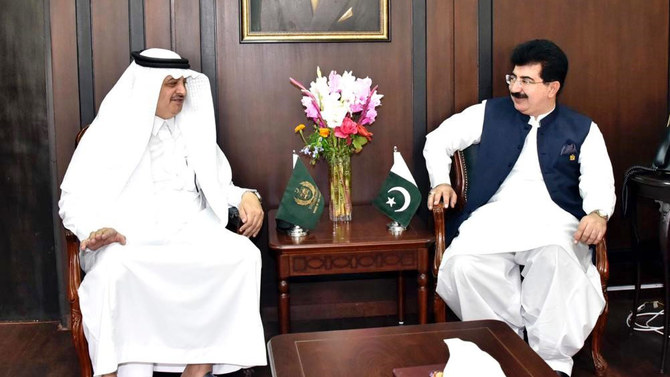
Senate chairman lauds Saudi for its plans to invest in Pakistan

- Sanjrani also discussed the situation in Kashmir during talks with envoy
- Says Riyadh can benefit from investment opportunities in Islamabad

Pakistan’s Mahnoor Omer named among TIME’s ‘Women of the Year’ for 2026
- Omer moved a Pakistani court against the so-called ‘period tax’ in Sept. 2025 which has since sparked a national debate
- Taxes on sanitary pads in Pakistan can add up to 40 percent to retail price, UNICEF says only around 12 percent women use such products
ISLAMABAD: Pakistani women’s rights activist Mahnoor Omer, who fought against taxes on menstrual products, has been named among the TIME magazine’s ‘Women of the Year’ for 2026.
Omer’s efforts have been recognized alongside 16 activists, artists, athletes and businesswomen in the TIME’s Women of the Year 2026 list, including Olympic gold medalist Sydney McLaughlin-Levrone and Oscar-nominated filmmaker Chloe Zhao.
Dissatisfied with the efforts to educate Pakistani girls about sexual violence, Omer founded the Noor Foundation at the age of 14 and held her own workshops with village girls about everything from climate change to menstruation, according to the TIME magazine.
Two years later, a conversation with a domestic worker about the price of pads made her realize that not everyone could afford these essentials. She moved a court against the so-called “period tax” in Sept. 2025 and the case has sparked a national debate on the subject, considered a taboo by many in Pakistan, since its first hearing late last year.
“A decade and one law degree after her interest in activism was sparked, Omer, now 25, is putting her passion and expertise to work in the name of gender equity,” TIME wrote about Omer on its website.
Taxes imposed on sanitary products in Pakistan can add up to 40 percent to the retail price. UNICEF estimates just 12 percent of women in the country use commercially produced pads or tampons. The alternative, using cloth, risks health impacts including rashes and infections, and can make it impossible for girls to attend school while menstruating.
Omer’s suit, which awaits the government response, has sparked a national discussion. She says she spoke about menstruation to her father and male cousins, who thanked her for standing up for their daughters.
The 25-year-old, who is currently enrolled in a master’s degree in gender, peace, and security at the London School of Economics, sees this case as just the first of many.
“I’m not free until every woman is free,” she was quoted as saying by TIME. “I want to leave no stones unturned in terms of what I can do with the next few decades, as a lawyer for the women in my country and gender minorities in general.”


