Iran general says chances of Gulf conflict decreasing

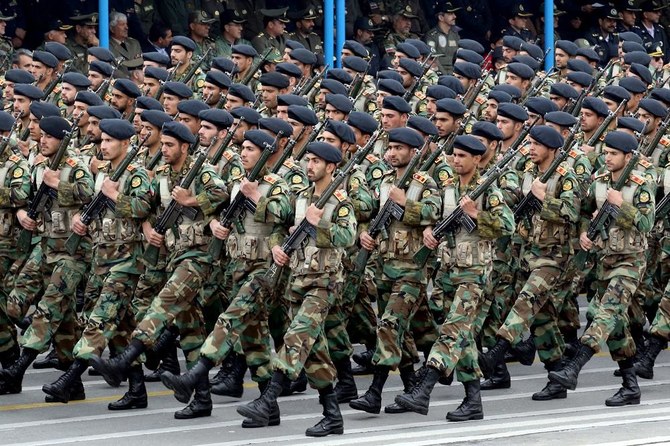
Iranian soldiers march during a military parade as they mark the country's annual army day in Tehran, on April 18, 2019. (File/AFP)
Updated 04 August 2019
Follow

Iran general says chances of Gulf conflict decreasing

  • Tensions between arch-enemies Iran and the United States have soared this year after Washington stepped up its "maximum pressure" campaign against Tehran
  • At the height of the crisis, US President Donald Trump called off air strikes against Iran at the last minute in June after the Islamic republic's forces shot down a US drone

TEHRAN: An Iranian general said on Sunday the chances of a conflict breaking out in the Gulf region have decreased, after a spate of hostile acts in the key waterway.

"At first glance, it may seem that the situation in the Persian Gulf is heading towards a military conflict but when studying the situation more deeply, we see that chances for such a conflict become less probable," said Brigadier General Ahmadreza Pourdastan.

"All countries which have interests in the region are by no means willing to see a new crisis in the Middle East," he said, quoted by Mehr news agency.

"The military capabilities of our armed forces are to such an extent that the enemies don't dare go for a military option against us.

"The Persian Gulf is like a tinderbox and explosion of the first firecracker can lead to a huge disaster," the general said.

Tensions between arch-enemies Iran and the United States have soared this year after Washington stepped up its "maximum pressure" campaign against Tehran.

Ships have been attacked, drones downed and oil tankers seized since May, after the United States withdrew from a landmark nuclear deal between Iran and world powers and reimposed biting sanctions against the country.

At the height of the crisis, US President Donald Trump called off air strikes against Iran at the last minute in June after the Islamic republic's forces shot down a US drone.


Israeli strikes killed eight people in south Lebanon: state media

Updated 05 March 2026
Follow

Israeli strikes killed eight people in south Lebanon: state media

  • Israeli strikes killed eight people in Lebanon on Thursday as Israel renewed its evacuation call for vast areas of the country’s south, long a stronghold of Hezbollah

BEIRUT: Israeli strikes killed eight people in Lebanon on Thursday as Israel renewed its evacuation call for vast areas of the country’s south, long a stronghold of Hezbollah.
The Iran-backed militant group, which dragged Lebanon into the regional war on Monday when it launched an attack on Israel, said it had launched missiles at positions in the Galilee area.
The National News Agency (NNA) reported that the mayor of a village in the Nabatieh region of south Lebanon and his wife were killed in one strike, while in a nearby village another strike killed two children and their parents.
The Lebanese health ministry said two people were killed by a strike on a car near the city of Zahle in the east of the country.
There were new strikes on the southern suburbs of the capital, Hezbollah’s main bastion, early on Thursday, NNA reported, with AFPTV footage showing smoke coming from the area.
It also said a pre-dawn Israeli drone strike hit an apartment in Beddawi, a Palestinian refugee camp near Tripoli in the north of Lebanon, killing senior Hamas official Wassim Atallah Al-Ali and his wife.
Also on Thursday, Israel renewed its warning to residents of hundreds of square kilometers (miles) of southern Lebanon to evacuate because of military action.
Arabic-language spokesman for the Israeli military Avichay Adraee posted on X: “Urgent warning to residents of southern Lebanon: you must immediately continue evacuating to the north of the Litani river.”
The warning included the cities of Tyre and Bint Jbeil.
On Tuesday, Israel’s military said it was creating a buffer zone inside Lebanon to protect Israeli residents.
The following day, it said troops from three divisions, including infantry, armored and engineering units were operating inside Lebanon.