Thousands of Indians flee Kashmir after security advisory

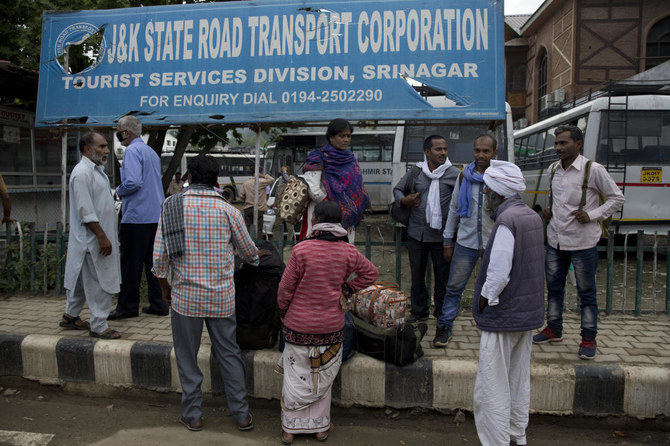
A government order in Kashmir asked tourists and Hindu pilgrims visiting a Himalayan cave shrine "to curtail their stay" in the disputed territory. (AP)
Updated 03 August 2019
Follow

Thousands of Indians flee Kashmir after security advisory

  • Indian security officials on Friday said they had found evidence of attacks planned by Pakistani military-backed militants on a major Hindu pilgrimage in Kashmir
  • A local government order effectively called off the pilgrimage, asking the pilgrims and tourists to return home

SRINAGAR: Thousands of Indians have started leaving the disputed region of Kashmir after the local government issued a security alert related to possible militant attacks in the area, a senior government official said on Saturday.
Indian security officials on Friday said they had found evidence of attacks planned by Pakistani military-backed militants on a major Hindu pilgrimage in Kashmir.
The security officials said a mine with Pakistan ordinance markings was among caches of ammunition retrieved following intelligence reports of likely attacks on routes used by devout Hindus who trek to the region’s holy Amarnath cave every year.
A local government order effectively called off the pilgrimage, asking the pilgrims and tourists to return home.
On Saturday, a senior local government official in Kashmir said the advisory had caused panic and led to the departure of “thousands” of tourists, pilgrims and laborers.
The official did not give a specific number, but he said most of the 20,000 Hindu pilgrims and Indian tourists and the more than 200,000 laborers were leaving the region.
Around 60 international tourists arrived in Kashmir on Saturday, however, the official said. The Indian advisory had cautioned tourists in general, but did not give any specific advice to foreign nationals.
Tensions have run high in the mountainous region since a vehicle laden with explosives rammed into an Indian police convoy on Feb. 14, killing 40 paramilitary policemen, and leading to aerial clashes between the two nations.
India accuses Pakistan of funding armed militants, as well as separatist groups in India’s portion of the region that are considered non-violent by international observers.
Islamabad denies the Indian accusation, saying it provides only diplomatic and moral support to the separatist movement.
The advisory has left the fleeing tourists and pilgrims disappointed. Kashmir touts itself as a “Paradise on Earth,” with Dal Lake — a favorite destination centuries ago for Mughal emperors escaping the summer heat of India’s plains — and its famous houseboats, mountains and glaciers a major attraction.
Prabakar Iyer, 45, had traveled to Srinagar from the southern Indian city of Bengaluru on Thursday with his family for a 10-day holiday, but they returned on Friday night.
“I was staying in a houseboat on Dal Lake when the advisory was issued. I fail to understand why we are being asked to leave. Everything is normal here,” he said.
Labourer Manjit Singh, a carpenter from the northern state of Uttar Pradesh who has been working in Kashmir for the last nine years, also left.
“I am not afraid but the government advisory has created panic and my family wants me back ... I will return if the situation improves,” he said.


Afghan returnees in Bamiyan struggle despite new homes

Updated 58 min 44 sec ago
Follow

Afghan returnees in Bamiyan struggle despite new homes

  • More than five million Afghans have returned home since September 2023, according to the International Organization for Migration

BAMIYAN, Afghanistan: Sitting in his modest home beneath snow-dusted hills in Afghanistan’s Bamiyan province, Nimatullah Rahesh expressed relief to have found somewhere to “live peacefully” after months of uncertainty.
Rahesh is one of millions of Afghans pushed out of Iran and Pakistan, but despite being given a brand new home in his native country, he and many of his recently returned compatriots are lacking even basic services.
“We no longer have the end-of-month stress about the rent,” he said after getting his house, which was financed by the UN refugee agency on land provided by the Taliban authorities.
Originally from a poor and mountainous district of Bamiyan, Rahesh worked for five years in construction in Iran, where his wife Marzia was a seamstress.
“The Iranians forced us to leave” in 2024 by “refusing to admit our son to school and asking us to pay an impossible sum to extend our documents,” he said.
More than five million Afghans have returned home since September 2023, according to the International Organization for Migration (IOM), as neighboring Iran and Pakistan stepped up deportations.
The Rahesh family is among 30 to be given a 50-square-meter (540-square-foot) home in Bamiyan, with each household in the nascent community participating in the construction and being paid by UNHCR for their work.
The families, most of whom had lived in Iran, own the building and the land.
“That was crucial for us, because property rights give these people security,” said the UNHCR’s Amaia Lezertua.
Waiting for water
Despite the homes lacking running water and being far from shops, schools or hospitals, new resident Arefa Ibrahimi said she was happy “because this house is mine, even if all the basic facilities aren’t there.”
Ibrahimi, whose four children huddled around the stove in her spartan living room, is one of 10 single mothers living in the new community.
The 45-year-old said she feared ending up on the street after her husband left her.
She showed AFP journalists her two just-finished rooms and an empty hallway with a counter intended to serve as a kitchen.
“But there’s no bathroom,” she said. These new houses have only basic outdoor toilets, too small to add even a simple shower.
Ajay Singh, the UNHCR project manager, said the home design came from the local authorities, and families could build a bathroom themselves.
There is currently no piped water nor wells in the area, which is dubbed “the dry slope” (Jar-e-Khushk).
Ten liters of drinking water bought when a tanker truck passes every three days costs more than in the capital Kabul, residents said.
Fazil Omar Rahmani, the provincial head of the Ministry of Refugees and Repatriation Affairs, said there were plans to expand the water supply network.
“But for now these families must secure their own supply,” he said.
Two hours on foot
The plots allocated by the government for the new neighborhood lie far from Bamiyan city, which is home to more than 70,000 people.
The city grabbed international attention in 2001, when the Sunni Pashtun Taliban authorities destroyed two large Buddha statues cherished by the predominantly Shia Hazara community in the region.
Since the Taliban government came back to power in 2021, around 7,000 Afghans have returned to Bamiyan according to Rahmani.
The new project provides housing for 174 of them. At its inauguration, resident Rahesh stood before his new neighbors and addressed their supporters.
“Thank you for the homes, we are grateful, but please don’t forget us for water, a school, clinics, the mobile network,” which is currently nonexistent, he said.
Rahmani, the ministry official, insisted there were plans to build schools and clinics.
“There is a direct order from our supreme leader,” Hibatullah Akhundzada, he said, without specifying when these projects will start.
In the meantime, to get to work at the market, Rahesh must walk for two hours along a rutted dirt road between barren mountains before he can catch a ride.
Only 11 percent of adults found full-time work after returning to Afghanistan, according to an IOM survey.
Ibrahimi, meanwhile, is contending with a four-kilometer (2.5-mile) walk to the nearest school when the winter break ends.
“I will have to wake my children very early, in the cold. I am worried,” she said.