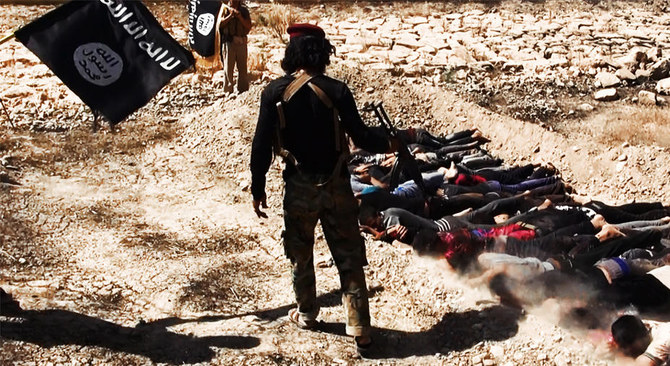
UNITED NATIONS: Leaders of the Daesh extremist group are aiming to consolidate and create conditions for an “eventual resurgence in its Iraqi and Syrian heartlands,” UN experts said in a new report.
The panel of experts said in a report to the Security Council this week that the process is more advanced in Iraq, where Daesh leader Abu Bakr Al-Baghdadi and most of the militant group’s leadership are now based following the fall of the so-called “caliphate” that he declared in the two neighboring countries.
In Syria, where the last Daesh stronghold was toppled in March, the Daesh covert network is spreading and sleeper cells are being established at the provincial level, mirroring what has been happening in Iraq since 2017, the report said.
As for Al-Qaeda, the panel said the extremist group “remains resilient” though its immediate global threat is not clear, with its leader, Ayman Al-Zawahiri, “reported to be in poor health and doubts as to how the group will manage the succession.”
The report said “the most striking international developments” during the first six months of 2019 include “the growing ambition and reach of terrorist groups in the Sahel and West Africa,” where fighters from Daesh and Al-Qaeda are collaborating to undermine fragile countries. “The number of regional states threatened with contagion from insurgencies in the Sahel and Nigeria has increased,” said the experts, who monitor UN sanctions against both extremist groups.
In a video message in late April, Al-Baghdadi said Daesh “still aspires to have global relevance and expects to achieve this by continuing to carry out international attacks,” the panel said.
The experts said Daesh is currently dependent on attacks that it inspires like the Easter Sunday church bombings in Sri Lanka. Al-Baghdadi mentioned the bombings but the panel said Daesh leaders “clearly knew nothing” in advance.
Whether or not the Sri Lankan attacks were motivated by a previous attack on Muslims at mosques in Christchurch, New Zealand, in March, “the narrative of interfaith conflict is concerning,” the panel added.
Looking ahead, the experts said the Daesh group “will reinvest in the capacity to direct and facilitate complex international attacks when it has the secure space and time to do so.” The panel added, “The current abatement of such attacks, therefore, may not last long, possibly not even until the end of 2019.”
The panel said up to 30,000 foreign fighters and others who traveled to the so-called “caliphate” that Daesh established in parts of Iraq and Syria may still be alive, “and their future prospects will be of international concern for the foreseeable future.”
Outside Syria and Iraq, the experts said, Daesh and Al-Qaeda are contending “for dominance and international relevance.” They said that in Afghanistan, concerns remain about short-term and long-term threats posed by groups affiliated with both Daesh and Al-Qaeda as well as “foreign terrorist fighters who have established themselves on Afghan territory.”
Here are the experts’ assessments of threats posed by Daesh and Al-Qaeda in other regions:
ARABIAN PENINSULA — Regional member states say the temporary strategy of Al-Qaeda in the Arabian Peninsula is to prioritize the fight against the Daesh affiliate in Yemen to maintain its dominant position, rather than fight Houthi Shiite rebels who are in a war with the government, which is backed by a Saudi-led coalition. An unidentified country reported that Al-Qaeda has been unable to establish itself in Saudi Arabia.
AFRICA — Daesh activity in southern Libya gained momentum as a result of preoccupation with fighting around the capital of Tripoli, and the extremist group is assessed to have substantial financial resources seized when it controlled the city of Sirte. A sharp rise in violence and recruitment efforts in West Africa, motivated by Daesh or Al-Qaeda affiliates, has been exacerbated “by porous borders and authorities ill-equipped to confront the growing threat.” In Somalia, Al-Qaeda affiliate Al-Shabab has shifted from high-impact attacks to sustained, frequent and eventually daily multiple attacks.
EUROPE — Online propaganda encouraging low-tech, Daesh-inspired attacks is still available but member states report a reduced incidence of successful attacks. Nonetheless, European countries “assess that the risk remains high.”
ASIA — Countries in central Asia see the greatest threat from their nationals returning from Iraq and Syria, and to a lesser extent from Afghanistan. In Southeast Asia, a series of successful and thwarted attacks attributed to Daesh-affiliated groups “underscores the persistent nature of the threat in the region.”


![]()

UN experts: Daesh aims for resurgence in Iraq, Syria
UN experts: Daesh aims for resurgence in Iraq, Syria
- The process is more advanced in Iraq, where Daesh leader Al-Baghdadi and most of the militant group’s leadership are now based
Latest updates


© 2026 SAUDI RESEARCH & PUBLISHING COMPANY, All Rights Reserved And subject to Terms of Use Agreement.