SEOUL, South Korea: North Korea fired two short-range ballistic missiles off its east coast Wednesday, South Korea’s military said, its second weapons test in less than a week. North Korea is angry over planned US-South Korean military drills and may be trying to boost pressure on the United States to win concessions as the rivals struggle to set up talks over the North’s nuclear weapons.
South Korea’s Joint Chiefs of Staff said Wednesday’s missiles were launched from Wonsan, a city the North pushes as a vacation destination but that it also uses as a regular launch site. The joint chiefs’ statement said both missiles were believed to have flown about 250 kilometers (155 miles) at a maximum altitude of 30 kilometers (19 miles) and that the South Korean and US militaries were trying to gather more details.
“The North’s repeated missile launches are not helpful to efforts to ease tensions on the Korean Peninsula, and we urge (North Korea) to stop this kind of behavior,” the statement said. Japanese Prime Minister Shinzo Abe briefly told reporters the launches were “no threat to Japanese national security.”
Six days earlier, North Korea fired two short-range ballistic missiles that Seoul officials said flew 600 kilometers (370 miles) before landing in the sea.
UN Security Council resolutions ban North Korea from using ballistic technology in any weapons launches. But it’s unlikely that the nation, already under 11 rounds of UN sanctions, will be hit with fresh punitive measures. Past sanctions were imposed only when the North conducted long-range ballistic launches.
Japan’s Defense Minister Takeshi Iwaya told reporters Wednesday that the most recently launched weapons did not reach Japan’s exclusive economic zone and that officials are still analyzing details, including the flight distance and trajectory. Referring to the previous launches, Iwaya said, “It is extremely regrettable that North Korea continues firing the missiles that violate the UN resolutions.”
North Korea’s state media said last week’s tests were supervised by leader Kim Jong Un and were designed to deliver a “solemn warning” to South Korea over its purchase of high-tech US-made fighter jets and planned military drills that Pyongyang calls an invasion rehearsal.
Wednesday’s launches came hours after a senior US official said President Donald Trump sent Kim mementos from his brief visit to an inter-Korean border town late last month.
The official said a top staffer from the National Security Council hand-delivered photographs from the June Trump-Kim meeting at the Korean Demilitarized Zone to a North Korean official last week. The Trump administration official spoke on the condition of anonymity because the official wasn’t authorized to speak publicly.
The DMZ meeting was the third summit between Trump and Kim. At their second meeting, in Vietnam, Trump rejected Kim’s demand for widespread sanctions relief in return for dismantling the North’s main nuclear complex, a partial disarmament step.
During the DMZ meeting, Trump and Kim agreed to resume nuclear diplomacy in coming weeks, but there hasn’t been any known meeting between the countries. Some experts say North Korea wants a US promise to ease sanctions, accept a slow, step-by-step disarmament process by the North or for the US to make other concessions once the diplomacy restarts.
Despite a recent lack of progress in nuclear diplomacy, both Trump and Kim have said they have maintained good relations with each other. After Thursday’s missile launches, Trump tried to downplay the significance of the tests, saying that “short-range” was the most important detail. He said North Korea fired “standard” missiles that many countries possess.
South Korea’s military said the flight data of the weapon launched last week showed similarities to the Russian-made Iskander, a short-range, nuclear-capable missile. A North Korean version could likely reach all of South Korea — and the 28,500 US forces stationed there — and would be extremely hard to intercept.
After entering talks with Washington, North Korea has suspended nuclear and long-range missile tests, and Trump says that is proof that his North Korea policy is working well and has eased the danger of a war with the North. In 2017, Trump and Kim exchanged crude insults and threats of destruction as Kim oversaw a series of high-profile nuclear and missile tests meant to build nuclear missiles capable of reaching the continental United States.


![]()

North Korea launches 2 short-range ballistic missiles: Seoul
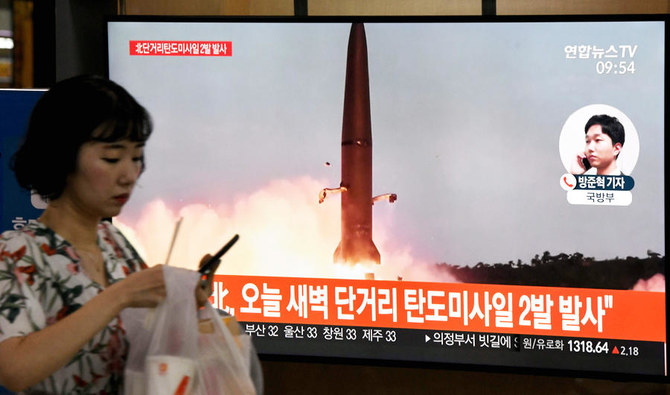
North Korea launches 2 short-range ballistic missiles: Seoul
- Despite a recent lack of progress in nuclear diplomacy, both Trump and Kim have said they have maintained good relations with each other


Latest updates





© 2026 SAUDI RESEARCH & PUBLISHING COMPANY, All Rights Reserved And subject to Terms of Use Agreement.