ISLAMABAD: President Dr. Arif Alvi said on Sunday that Pakistan was on the tipping point of socioeconomic development, and it was high time that all the citizens played their role to uplift the country’s poor by providing them education, health and other opportunities.
Addressing a National Conference themed ‘Invest in Eliminating Hepatitis from Pakistan’ in connection with the World Hepatitis Day that is annually observed on July 28, the president said the prevalence of hepatitis B and C in 15 to 20 million people of Pakistan was alarming.
Radio Pakistan adds: He added that Pakistan was trying to deal with the challenge of hepatitis despite its limited resources.
Alvi said that dissemination of awareness about the disease was also the responsibility of doctors and they should also be engaged to create greater awareness about hepatitis among the general public.
The president said that Pakistan was also facing malnutrition, stunted growth and other health problems for which a comprehensive policy needed to be devised.
He also asked the government to redesign the national hepatitis policy while urging private institutions to join hands with the government to meet health challenges since such complicated problems could not be resolved without the assistance of private sector.

Pakistan on tipping point of socioeconomic development: President Alvi
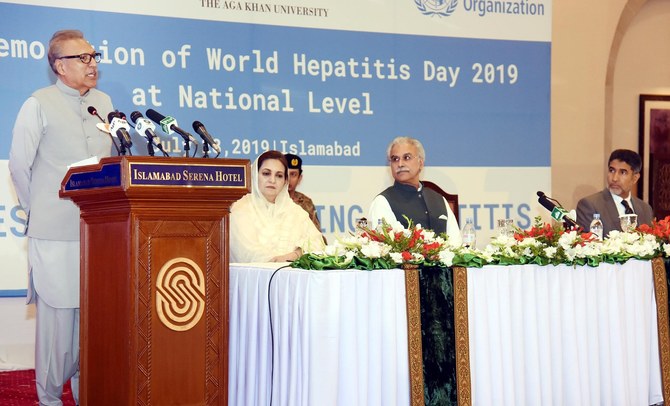
- Says the country’s affluent citizens must play their role to help the poor
- Asks the government to redesign the national hepatitis policy
Pakistan high court pauses tree-cutting in Islamabad until Feb. 2
- Islamabad High Court asks CDA to ‘explain and justify’ tree-cutting at next hearing
- CDA officials say 29,000 trees were cut due to allergies, deny felling in green belts
ISLAMABAD: The Islamabad High Court has ordered an immediate halt to tree-cutting in the federal capital until Feb. 2, seeking justification from civic authorities over the legality of a large-scale felling drive that has seen thousands of trees removed in recent months.
The interim order, issued by a single-judge bench led by Justice Khadim Hussain Soomro, came during proceedings on a petition challenging the Capital Development Authority’s (CDA) tree-cutting operations in Islamabad’s Shakarparian area and H-8 sector.
At the outset of the hearing, the petitioner’s counsel argued that trees were being felled in violation of the Pakistan Environmental Protection Act 1997, the Islamabad Wildlife Ordinance 1979 and the city’s master plan.
“Respondents shall not cut trees till the next date of hearing,” Justice Soomro said in the court order released on Friday while referring to CDA officials.
“Respondents are directed to come fully prepared and to file paragraph-wise comments before the next date of hearing, along with a comprehensive report explaining the justification and legal basis for the cutting of trees,” he added.
According to the court order, the petitioner maintained that the CDA had not made any public disclosure regarding the legal basis for the operation and that the felling was causing environmental harm.
The petition sought access to the official record of tree-cutting activities and called for the penalization of CDA officials responsible for the act under relevant criminal and environmental laws.
It also urged the court to impose a moratorium on infrastructure projects in Islamabad, order large-scale replanting as compensation and constitute a judicial commission headed by a retired Supreme Court judge to probe the alleged violations.
CDA officials acknowledge around 29,000 paper mulberry trees have been cut in the capital in recent months, arguing that the species triggers seasonal allergies such as sneezing, itchy eyes and nasal congestion.
They also maintain that no trees have been removed from designated green belts and that the number of replacement trees planted exceeds those felled.
Designed in the 1960s by Greek architect Constantinos Doxiadis, Islamabad was conceived as a low-density city with green belts and protected natural zones at its core.
Critics, however, say the recent felling has extended beyond paper mulberry trees and question whether authorities are adhering to the city’s master plan and the legal protections governing forested and green areas.
The court has adjourned its hearing until Feb. 2, 2026.


