

Saudi climbing federation concludes summer academy in Tanomah

1 / 2
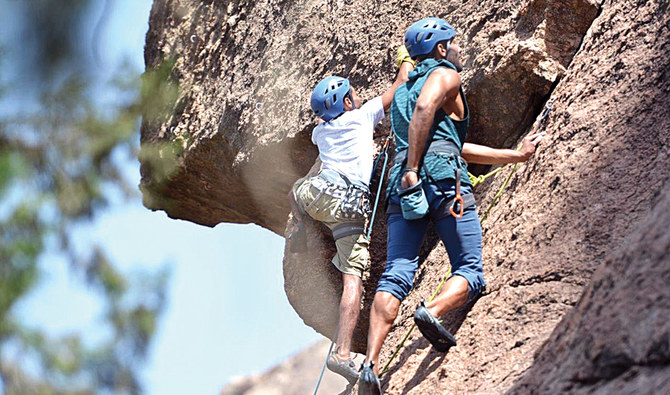
Youths aged between 15 and 19 organized a camp through which they were introduced to the basics of rock climbing, hiking, self-reliance and coping with the desert environment. (SPA)
2 / 2
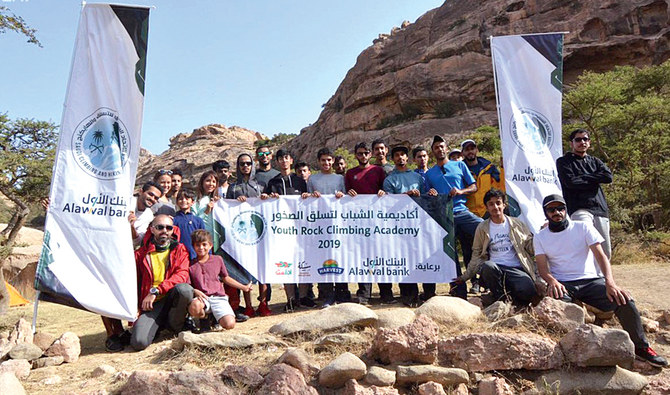
Youths aged between 15 and 19 organized a camp through which they were introduced to the basics of rock climbing, hiking, self-reliance and coping with the desert environment. (SPA)
Updated 28 July 2019
Follow

Saudi climbing federation concludes summer academy in Tanomah

  • Tanomah was chosen because it has all the necessary elements for climbing

RIYADH: The Saudi Climbing and Hiking Federation (SCHF) concluded its summer academy, which took place over four days in Tanomah.

Youths aged between 15 and 19 organized a camp through which they were introduced to the basics of rock climbing, hiking, self-reliance and coping with the desert environment.

Trainers held educational courses, field training and a “leave no trace” course, which focused on preserving and developing the environment.

“The academy witnessed significant interaction from many young people and their parents, which encouraged us to hold the event on future occasions,” said the SCHF’s executive director, Yasmine Al-Qahtani. “The academy aims to increase the number of climbers and hikers.”

She commended the support of Asir Gov. Prince Turki bin Talal bin Abdul Aziz, who ordered the provision of facilities for participants’ comfort.

BACKGROUND

• The Saudi Climbing and Hiking Federation (SCHF) is the national governing body for all aspects of rock climbing and mountaineering in Saudi Arabia.

• The federation was founded in February 2018, and operates under the General Sports Authority and the Saudi Arabian Olympic Committee.

“Tanomah was chosen because it has all the necessary elements for climbing, such as rocks, mountains, and natural and safe spaces,” Al-Qahtani said, also citing “its summer atmosphere and moderate weather at night.”

She added: “The mountains that surround the region make it a safe place for camping. Tanomah’s location 2,300 meters above sea level gave it a distinctive characteristic with its sceneries and various rock formations.”

Promoting the importance of physical fitness as part of the Kingdom’s Vision 2030 reform plan is one of the objectives of the SCHF.

Al-Qahtani said: “Participants changed their lifestyle as they got used to waking up early and left the place better than it was.”

She lauded the trainers, adding: “Climbing and hiking are dangerous sports that need to be practiced safely.”

Saudi Arabia champions AI and sustainable growth at UN tourism meeting in Kuwait

Updated 12 February 2026
Follow

Saudi Arabia champions AI and sustainable growth at UN tourism meeting in Kuwait

  • Saudi Tourism Minister says tourism today accounts for approximately 10 percent of the world economy, contributing about $10 trillion to global GDP 

KUWAIT CITY: Saudi Arabia’s Tourism Minister Ahmed Al-Khateeb has called for stronger international cooperation to build a tourism ecosystem that is integrated, resilient, and future-ready, the Saudi Press Agency reported Thursday.

In a opening address at the 52nd UN Tourism Regional Commission for the Middle East in Kuwait City, he noted that tourism is “no longer a peripheral activity but a massive engine of economic development.”

“With an estimated contribution exceeding $10 trillion to global GDP, tourism today accounts for approximately 10 percent of the world economy,” said Al-Khateeb, speaking as president of the 26th UN Tourism General Assembly. The three-day conference opened on Feb. 10.

He pointed to the Middle East’s exceptional recovery, which recorded a 39 percent increase in international arrivals in 2025 compared to 2019, welcoming nearly 100 million visitors last year.

The minister highlighted Saudi Arabia’s driving force behind these regional statistics, noting that the Kingdom now represents approximately 30% of the Middle East tourism market in both visitor numbers and spending.

“We are proud that Saudi tourism’s uninterrupted growth has become a driving force for regional tourism, and we look forward to continuing our close cooperation with UN Tourism to share our expertise with the world,” he said.

Focus on AI

Addressing the meeting’s central theme of Artificial Intelligence (AI), Al-Khateeb emphasized the need for responsible innovation. He described AI as a key enabler for growth but stressed that the “human touch” defining the hospitality sector must be maintained and the workforce protected.

On the sidelines of the regional commission, the minister met with counterparts from across the region to explore ways to promote regional cooperation and alignment to enhance resilience and build tourism industries that can drive inclusive economic and social development.

Al-Khateeb also met with leading investors from Kuwait to discuss investments in the Kingdom’s tourism sector and explore new opportunities to leverage Saudi Arabia’s integrated investment ecosystem, designed to enable regional and international investors to achieve sustainable, long-term value.

The 52nd UN Tourism Regional Commission for the Middle East is the first held in the region since the 26th UN Tourism General Assembly, hosted in Riyadh last November. 

That assembly resulted in the historic “Riyadh Declaration on the Future of Tourism,” which established a global consensus on sustainability, inclusive growth, and the responsible adoption of human-centric AI for the next fifty years.