

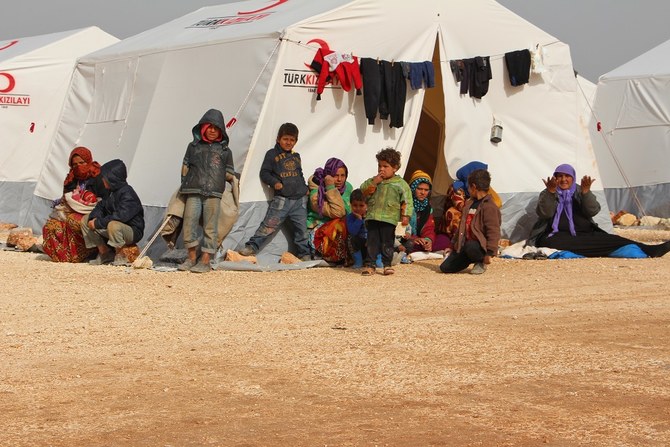
Syrian refugees in Turkey ‘detained’ and ‘forced’ to return to conflict zones

More than 400,000 people have already died because of the war in Syria. (File/AFP)
Updated 27 July 2019
Follow

Syrian refugees in Turkey ‘detained’ and ‘forced’ to return to conflict zones

  • According to the report, Syrians are being coerced into signing forms saying they want to return to Syria
  • Over 3.6 million Syrian refugees are in Turkey – half a million of them in Istanbul

DUBAI: Syrians are being “detained” and “coerced” to go back to their war-torn country by Turkish authorities, according to a report published by Human Rights Watch on Saturday.

“Turkey claims it helps Syrians voluntarily return to their country, but threatening to lock them up until they agree to return, forcing them to sign forms, and dumping them in a war zone is neither voluntary nor legal,” Gerry Simpson, associate Emergencies director at Human Rights Watch, said.

According to the report, Syrians are being coerced into signing forms saying they want to return to Syria, and then detained before they are sent back to conflict zones including Idlib and Aleppo, where more than 400,000 people already died in the armed conflict.

Although the Turkish Interior Minister Suleyman Soylu denied such claims, several Syrians testified to have experienced maltreatment from Turkish authorities, drawing criticisms from rights groups.

The UN High Commissioner for Refugees called on states not to “forcibly return Syrian nationals and former habitual residents of Syria,” and argues that asylum seekers “need international refugee protection.”

Over 3.6 million Syrian refugees are in Turkey – half a million of them in Istanbul. Recently, Turkey has intensified its crackdown on “unregistered” refugees, increasing police spot-checks of Syrians’ registration documents.

“Turkey should protect the basic rights of all Syrians, regardless of registration status, and register those denied registration since late 2017,” HRW’s report said, citing an international law that prohibits the return of anyone to “a place where they would face a real risk of persecution, torture, or other ill-treatment, or a threat to life.”


UN chief condemns Israeli law blocking electricity, water for UNRWA facilities

Updated 01 January 2026
Follow

UN chief condemns Israeli law blocking electricity, water for UNRWA facilities

  • The agency provides education, health and aid to millions of Palestinians in Gaza, the West Bank, Jordan, Lebanon and Syria

United Nations Secretary General Antonio Guterres condemned on Wednesday a move by Israel to ban electricity or water to facilities owned by the UN Palestinian refugee agency, ​a UN spokesperson said.
The spokesperson said the move would “further impede” the agency’s ability to operate and carry out activities.
“The Convention on the Privileges and Immunities of the United Nations remains applicable to UNRWA (United Nations Relief and Works Agency for Palestine Refugees in the Near East), its property and assets, and to its officials and other personnel. Property used ‌by UNRWA ‌is inviolable,” Stephane Dujarric, spokesman for the ‌secretary-general, ⁠said ​while ‌adding that UNRWA is an “integral” part of the world body.
UNRWA Commissioner General Phillipe Lazzarini also condemned the move, saying that it was part of an ongoing “ systematic campaign to discredit  UNRWA and thereby obstruct” the role it plays in providing assistance to Palestinian refugees.
In 2024, the Israeli parliament passed a law banning the agency from operating in ⁠the country and prohibiting officials from having contact with the agency.
As a ‌result, UNRWA operates in East Jerusalem, ‍which the UN considers territory occupied ‍by Israel. Israel considers all Jerusalem to be part ‍of the country.
The agency provides education, health and aid to millions of Palestinians in Gaza, the West Bank, Jordan, Lebanon and Syria. It has long had tense relations with Israel but ties have deteriorated ​sharply since the start of the war in Gaza and Israel has called repeatedly for UNRWA to ⁠be disbanded, with its responsibilities transferred to other UN agencies.
The prohibition of basic utilities to the UN agency came as Israel also suspended of dozens of international non-governmental organizations working in Gaza due to a failure to meet new rules to vet those groups.
In a joint statement, Canada, Denmark, Finland, France, Iceland, Japan, Norway, Sweden, Switzerland and the United Kingdom said on Tuesday such a move would have a severe impact on the access of essential services, including health care. They said one in ‌three health care facilities in Gaza would close if international NGO operations stopped.