

US to ease Pakistan travel advisory, enabling more investment — commerce minister

1 / 2
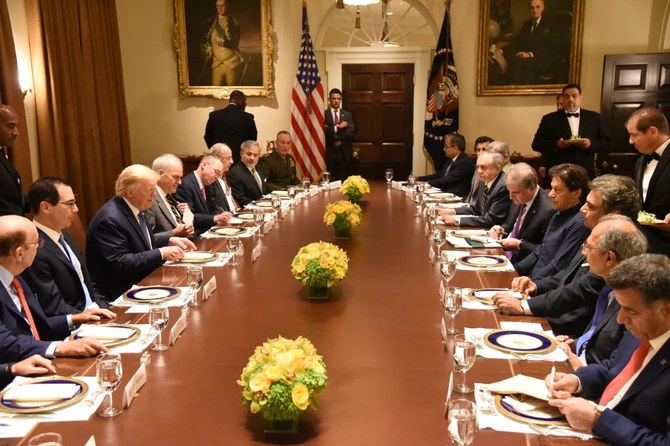
Prime Minister Imran Khan leading delegation-level talks with US President Donald Trump at White House on July 2019. (PID)
2 / 2
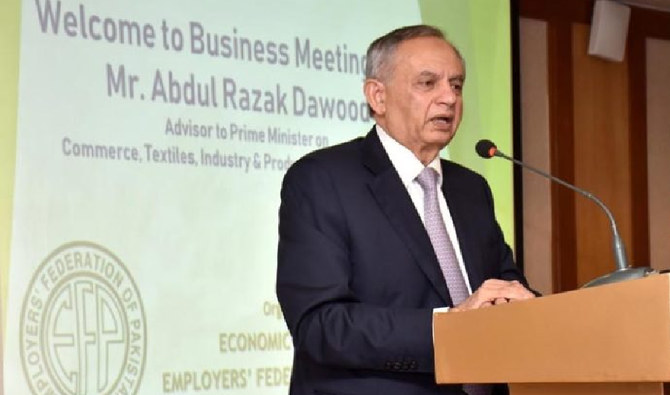
Adviser to the Pakistani Prime Minister on Commerce, Textile, Industry and Production and Investment, Abdul Razak Dawood, addresses a press conference in Islamabad on February 11, 2019 (APP photo)
Updated 28 July 2019
Follow

US to ease Pakistan travel advisory, enabling more investment — commerce minister

ISLAMABAD: The United States is considering a review of its “reconsider travel” advisory for Pakistan, leading to more investment in the country, a key Pakistani official said on Friday, days after Prime Minister Imran Khan returned home from a visit to the US that supporters have called a major success.
Khan’s visit included a one-on-one meeting with President Donald Trump and his offer that Pakistan would help seal a peace agreement with the Taliban to allow US troops to withdraw from Afghanistan has gone some way toward rebuilding Pakistan’s image in Washington after years of US suspicions.
“I have discussed this matter with my counterpart during the US visit and he has assured me that they will look into this matter,” a local Pakistani newspaper quoted de facto Commerce Minister Abdul Razak Dawood as telling reporters. “I came to know that they are going to be soft on this issue.”
The last US travel advisory for Pakistan came in April this year and urged US citizens to avoid visiting the country “due to terrorism.” 
Prior to Khan’s visit to the US, Pakistan arrested Hafiz Saeed, an accused militant leader with a $10 million US bounty on his head, in the hopes of a more favorable reception at the White House and the Pentagon.
Khan’s visit also had a strong investor tilt as the country, battling to stave off a balance of payments crisis, was forced to seek a bailout from the International Monetary Fund. 
Dawood said if the US withdrew its travel advisory, Pakistan would be able to initiate better business activities with the US, adding that six American delegations would visit Pakistan over the next five months. He said Khan had requested the US for increased investment in Pakistan and more bilateral trade rather than aid, like past governments. 
Currently, US and Pakistan have two-way goods trade worth $6.6 billion, according to the office of the US Trade Representative. 


Pakistani, Bangladeshi officials discuss trade, investment and aviation as ties thaw

Updated 28 December 2025
Follow

Pakistani, Bangladeshi officials discuss trade, investment and aviation as ties thaw

  • Pakistan and Bangladesh were once one nation, but they split in 1971 as a result of a bloody civil war
  • Ties between Pakistan, Bangladesh have warmed up since last year and both nations have resumed sea trade

ISLAMABAD: Pakistan's High Commissioner to Bangladesh Imran Haider on Sunday met Chief Adviser Muhammad Yunus in Dhaka, the latter's office said on, with the two figures discussing trade, investment and aviation.

Pakistan and Bangladesh were once one nation, but they split in 1971 as a result of a bloody civil war, which saw the part previously referred to as East Pakistan seceding to form the independent nation of Bangladesh.

Ties between Pakistan and Bangladesh have warmed up since former prime minister Sheikh Hasina’s ouster as a result of a student-led uprising in August 2024. Relations remain frosty between Dhaka and New Delhi over India’s decision to grant asylum to Hasina.

Pakistan has attempted to forge closer ties with Bangladesh in recent months and both South Asian nations last year began sea trade, followed by efforts to expand government-to-government commerce.

"During the meeting, both sides discussed ways to expand cooperation in trade, investment, and aviation as well as scaling up cultural, educational and medical exchanges to further strengthen bilateral relations between the two South Asian nations," Yunus's office said in a statement on X.

In 2023-24 Pakistan exported goods worth $661 million to Bangladesh, while its imports were only $57 million, according to the Trade Development Authority of Pakistan. In Aug. this year, the Pakistani and Bangladeshi commerce ministries signed a memorandum of understanding to establish a Joint Working Group on Trade, aiming to raise their bilateral trade volume to $1 billion in the financial year that began in July.

The Pakistani high commissioner noted that bilateral trade has recorded a 20 percent growth compared to last year, with business communities from both countries actively exploring new investment opportunities, according to the statement.

He highlighted a significant increase in cultural exchanges, adding that Bangladeshi students have shown strong interest in higher education opportunities in Pakistan, particularly in medical sciences, nanotechnology, and artificial intelligence. Haider also said that Dhaka-Karachi direct flights are expected to start in January.

"Chief Adviser Professor Muhammad Yunus welcomed the growing interactions between the two countries and emphasized the importance of increased visits as well as cultural, educational and people-to-people exchanges among SAARC (South Asian Association for Regional Cooperation) member states," the statement read.

"Professor Yunus also underscored the need to further boost Bangladesh–Pakistan trade and expressed hope that during Mr. Haider’s tenure, both countries would explore new avenues for investment and joint venture businesses."