Family and friends await return of jailed Pakistani trucker pardoned by Saudi Arabia

1 / 2
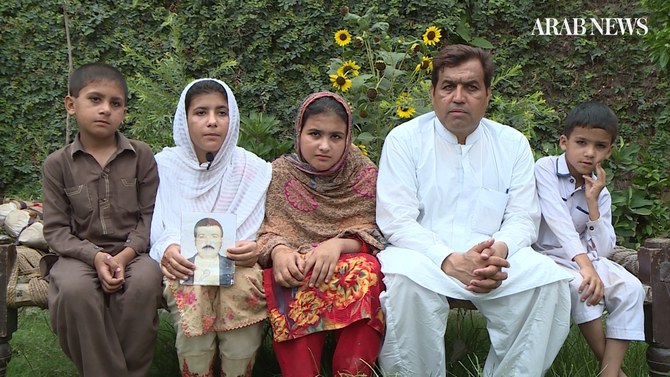
Hidayatullah, the brother of Pkaistani trucker Zahir Hussain Zar Khan, detained in Saudi Arabia since 2012, poses for a photo with Khan's four children in Peshawar, Pakistan. One of Khan's daughters is seen holding a photograph of her father who is set to return to Pakistan after being pardoned by the Kingdom this month. (Photo Arab News)
2 / 2
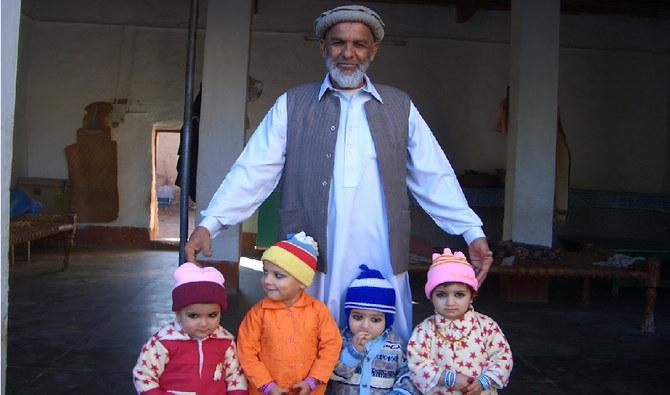
In this undated file photo, late father of Zahir Hussain Afridi sits with his grandchildren at his hometown in Khyber tribal district in 2011. Afridi’s father died whole his son was detained in Saudi Arabia after four people were killed in an accident with his vehicle in 2012. Two weeks ago, Saudi Arabia’s bait-ul-maal social welfare organisation paid off Afridi's blood money and now his family and friends excitedly await his return home after spending seven years in a Saudi prison. (Photo credit family)
Updated 27 July 2019
Follow

Family and friends await return of jailed Pakistani trucker pardoned by Saudi Arabia

  • Afridi imprisoned in 2013 after his vehicle killed four in road accident, Kingdom's bait ul maal pays blood money this month
  • Relatives, neighbours all praise for Saudi crown prince and government for allowing Afridi's freedom

WAZIR DHAND, Khyber Agency: Afreen Khan was four years old when she last saw her father.

Zahir Hussain Zar Khan went to Saudi Arabia from the Pakistani town of Peshawar in 2012 to work as a trucker but ended up in jail after getting into a road accident that killed four people. Since then, unable to pay the 1.3 million riyals – or $350,000 – in blood money to the relatives of those who had died, Khan has languished in jail.
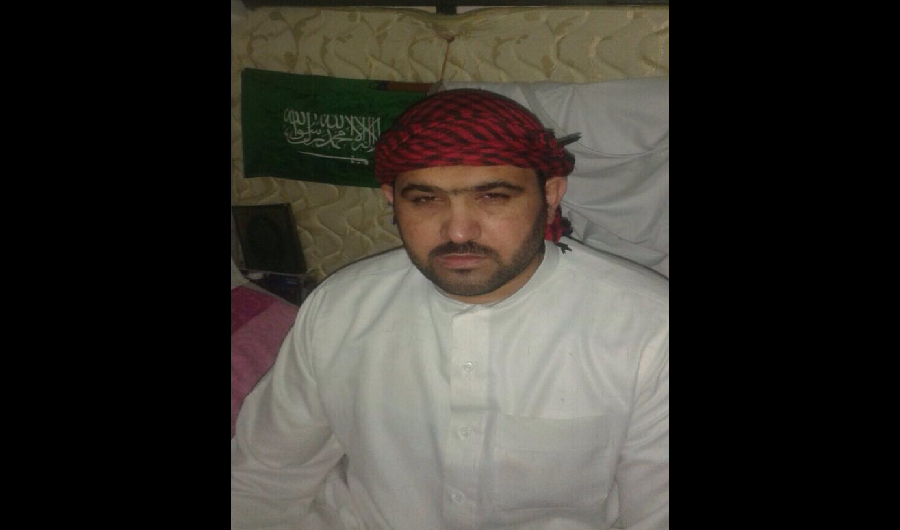


In this undated file photo, Zahir Hussain Afridi, a tribesman from Khyber tribal district, poses for a photo in Saudi Arabia in 2011. Two weeks ago, Saudi Arabia’s bait-ul-maal social welfare organisation paid off Afridi's blood money and now his family and friends excitedly await his return home after spending seven years in a Saudi prison. (Photo courtesy Afridi family)

This month, Saudi Arabia’s bait-ul-maal social welfare organization paid off the blood money and now his family and friends excitedly await his return home. His daughter Afreen will finally see her father again.

“It feels like Eid every day,” 11-year-old Afreen said, speaking about the time since she had heard her father would walk free. “We pray for Crown Prince Mohammed bin Salman and the government of Saudi Arabia for paying the blood money which led to the release of my father. We have missed him for years.”


In this undated file photo, late father of Zahir Hussain Afridi sits with his grandchildren at his hometown in Khyber tribal district in 2011. Afridi’s father died whole his son was detained in Saudi Arabia after four people were killed in an accident with his vehicle in 2012. Two weeks ago, Saudi Arabia’s bait-ul-maal social welfare organisation paid off Afridi's blood money and now his family and friends excitedly await his return home after spending seven years in a Saudi prison. (Photo credit family)

Khan’s brother Hidayatullah Khan said he had received a copy of the order of a Makkah court about two weeks ago saying Khan would be home in the next two weeks.

“We are poor people. We could not have paid the blood money without the cooperation of Saudi authorities even if we had toiled for seven more years,” Hidayatullah said.

Bismillah Khan, the detained man’s first cousin, said jubilant relatives and villagers were now daily visiting his hometown of Wazir Dhand, a dusty hamlet on the outskirts of Peshawar, to congratulate his family.


In this file photo, Zahir Hussain Afridi (right) poses for a picture with his friend at his hometown of Khyber tribal district in 2010. Two weeks ago, Saudi Arabia’s bait-ul-maal social welfare organisation paid off Afridi's blood money and now his family and friends excitedly await his return home after spending seven years in a Saudi prison. (Photo credit family)

“You cannot gauge our happiness. I traveled to Saudi Arabia last year for umrah and tried to meet my cousin in prison but I could not see him,” Bismillah said.

Nasrullah Khan, a neighbor, said a steady procession of villagers had been arriving at the residence of the truck driver each day to congratulate his family over his release orders.

“The announcement that hundreds of Pakistani prisoners would be set free on the instruction of the crown prince is something we will remember as long as we live,” he said

Hidayatullah added: “I wish there was a way we could convey to the crown prince how grateful and happy we are today at the release of our loved one from prison.”


Over 50 feared dead in Karachi shopping plaza fire, officials say

Updated 19 January 2026
Follow

Over 50 feared dead in Karachi shopping plaza fire, officials say

  • Search teams recover 14 bodies as officials warn toll may rise sharply
  • Traders seek urgent compensation after 1,200 shops destroyed in blaze

ISLAMABAD: Pakistani authorities warned on Monday the death toll from a massive fire at a shopping plaza in Karachi could exceed 50, as recovery operations continued a day after the blaze destroyed over 1,200 shops in one of the city’s busiest commercial districts.

The fire broke out late Saturday at Gul Plaza in Karachi’s Saddar business area and spread rapidly through multiple floors. Firefighters battled for more than 24 hours to bring the blaze under control, which was fully extinguished by Monday, officials said, with cooling and debris removal now underway.

Deadly fires in commercial buildings are a recurring problem in Karachi, a city of more than 20 million people, where overcrowding, outdated infrastructure and weak enforcement of fire safety regulations have repeatedly resulted in mass casualties and economic losses.

During a meeting at the Chief Minister’s House on Monday, officials briefed Sindh Chief Minister Murad Ali Shah that 14 bodies had so far been recovered from the site, while the overall death toll could climb significantly as debris is cleared.

“Estimated fatalities could exceed 50,” the Sindh chief minister’s office said in a statement, quoting officials who briefed Shah on the scale of the disaster.

Shah was told that the shopping plaza, built over roughly 8,000 square yards, housed around 1,200 shops, leaving an equal number of traders suddenly without livelihoods. Shah said all affected shopkeepers would be rehabilitated and announced the formation of a committee to recommend compensation amounts and a recovery plan.

“The Gul Plaza building will be rebuilt, and we want to decide how the affected traders can be given shops immediately so their businesses can resume,” Shah said, according to the statement.

Officials said firefighting operations involved 16 fire tenders and water bowzers, with 50 to 60 firefighters taking part. The Karachi Water Board supplied more than 431,000 gallons of water during the operation, while Rescue 1122 ambulances reached the site within minutes of the first alert.

Authorities said access constraints inside the building, along with intense smoke, hampered rescue efforts in the early stages of the fire. A firefighter was among those killed, officials said, noting that his father had also died in the line of duty years earlier.

The provincial government ordered an immediate forensic investigation to determine the cause of the blaze, directing the chief secretary to notify a fact-finding committee. Shah also instructed that debris removal begin without delay so recovery teams could continue searching for victims.

The tragedy has also heightened anxiety within Karachi’s business community. 

The Karachi Chamber of Commerce and Industry (KCCI) has formed a dedicated committee to document losses, coordinate relief and press the government for compensation, saying preliminary assessments indicate more than 1,000 small and medium-sized businesses were completely destroyed.

Ateeq Mir, a traders’ representative, has estimated losses from the fire at over $10 million.

“There is no compensation for life, but we will try our best that the small businessmen who have suffered losses here are compensated in a transparent manner,” Shah told reporters on Sunday night.

Prime Minister Shehbaz Sharif has offered full federal support to provincial authorities, stressing the need for a “coordinated and effective system” to control fires quickly in densely populated urban areas and prevent similar tragedies in the future.

Battling large fires in Karachi’s congested commercial districts remains notoriously difficult. Many markets and plazas are built with narrow access points, encroachments and illegal extensions that block fire tenders, while buildings often lack functioning fire exits, alarms or sprinkler systems. 

Although safety regulations exist, enforcement is sporadic, allowing hazardous wiring and flammable materials to go unchecked — conditions that enable fires to spread rapidly and magnify human and economic losses.