Pakistan third biggest contestant in Saudi Qur’an, Adhan competitions

The top five countries in terms of highest registration rates include Saudi Arabia (6,169), Egypt (3,335), Pakistan (1,421), Indonesia (1,184) and India (828). (Shutterstock)
Updated 27 July 2019
Follow

Pakistan third biggest contestant in Saudi Qur’an, Adhan competitions

  • Around 30,000 Muslims from across the world registered to participate in the twin contests
  • Saudi authorities says contests aim to highlight Islam that rejects ‘extremism and intolerance in all its forms’

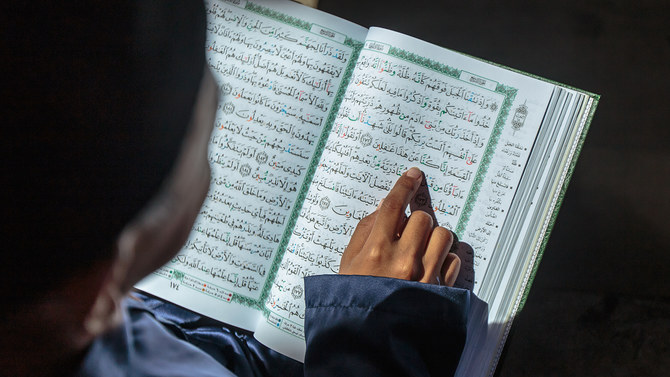
ISLAMABAD: More than 1,400 Pakistanis have registered to participate in Qur’an recitation and Adhan competitions announced by Saudi Arabia’s General Entertainment Authority on May 22, making the South Asian nation the third biggest contestant in the race after the Saudis and Egyptians.
In all, 30,000 Muslims from around the world have registered to participate in the competitions, 17,050 for the Qur’an recitation contest and 12,950 for the Adhan competition. The top five countries in terms of highest registration rates include Saudi Arabia (6,169), Egypt (3,335), Pakistan (1,421), Indonesia (1,184) and India (828).
Saudi authorities announced the unique religious race last month, aiming to highlight “the diversity of the cultures of the Islamic world, which is reflected in the different methods of reciting the Qur’an and raising the Adhan.”
The organizers of the two contests told the media they were hoping to encourage a better understanding of the Qur’an and its recitation among young Muslims and sought to promote moderate Islam that rejected “extremism and intolerance in all its forms.”
The Kingdom’s General Authority for Entertainment on Thursday extended the registration deadline from June 22 to August 18 due to the overwhelming response.
The extension is expected to benefit thousands of aspiring participants who have not managed to register as yet, guaranteeing a large turnout from across the world.
Saudi authorities have also promised to distribute prizes of 12,000,000 riyals among the participants with “the most beautiful and influential voices.”


Sindh assembly passes resolution rejecting move to separate Karachi

Updated 21 February 2026
Follow

Sindh assembly passes resolution rejecting move to separate Karachi

  • Chief Minister Shah cites constitutional safeguards against altering provincial boundaries
  • Calls to separate Karachi intensified amid governance concerns after a mall fire last month

ISLAMABAD: The provincial assembly of Pakistan’s southern Sindh province on Saturday passed a resolution rejecting any move to separate Karachi, declaring its territorial integrity “non-negotiable” amid political calls to carve the city out as a separate administrative unit.

The resolution comes after fresh demands by the Muttahida Qaumi Movement (MQM) and other voices to grant Karachi provincial or federal status following governance challenges highlighted by the deadly Gul Plaza fire earlier this year that killed 80 people.

Karachi, Pakistan’s largest and most densely populated city, is the country’s main commercial hub and contributes a significant share to the national economy.

Chief Minister Syed Murad Ali Shah tabled the resolution in the assembly, condemning what he described as “divisive statements” about breaking up Sindh or detaching Karachi.

“The province that played a foundational role in the creation of Pakistan cannot allow the fragmentation of its own historic homeland,” Shah told lawmakers, adding that any attempt to divide Sindh or separate Karachi was contrary to the constitution and democratic norms.

Citing Article 239 of Pakistan’s 1973 Constitution, which requires the consent of not less than two-thirds of a provincial assembly to alter provincial boundaries, Shah said any such move could not proceed without the assembly’s approval.

“If any such move is attempted, it is this Assembly — by a two-thirds majority — that will decide,” he said.

The resolution reaffirmed that Karachi would “forever remain” an integral part of Sindh and directed the provincial government to forward the motion to the president, prime minister and parliamentary leadership for record.

Shah said the resolution was not aimed at anyone but referred to the shifting stance of MQM in the debate while warning that opposing the resolution would amount to supporting the division of Sindh.

The party has been a major political force in Karachi with a significant vote bank in the city and has frequently criticized Shah’s provincial administration over its governance of Pakistan’s largest metropolis.

Taha Ahmed Khan, a senior MQM leader, acknowledged that his party had “presented its demand openly on television channels with clear and logical arguments” to separate Karachi from Sindh.

“It is a purely constitutional debate,” he told Arab News by phone. “We are aware that the Pakistan Peoples Party, which rules the province, holds a two-thirds majority and that a new province cannot be created at this stage. But that does not mean new provinces can never be formed.”

Calls to alter Karachi’s status have periodically surfaced amid longstanding complaints over governance, infrastructure and administrative control in the megacity, though no formal proposal to redraw provincial boundaries has been introduced at the federal level.