DHAKA: Parvin Begum, who saw her home on a secluded island in northern Bangladesh steadily devoured by floods this month, feels lucky.
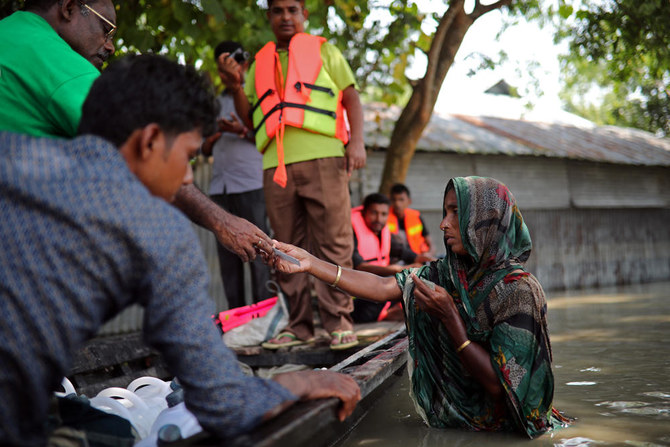
She received some money before the disaster hit under a new form of aid, used for the first time in Bangladesh by the government and humanitarian agencies.
It gives funding to vulnerable people in advance of extreme weather, based on forecasts, so they are better prepared. With her cash, Begum bought food, rented a boat, and took her belongings to a government shelter on a nearby island before the rising water crossed the danger level.
“This is one of the worst floods I have seen in many years,” she told the Thomson Reuters Foundation by phone from Kurigram, a town located about 350 km (217.5 miles) north of Dhaka.
“Things were easier for me because I received 4,500 taka ($53.42) and was prepared — otherwise I would have struggled a lot.”
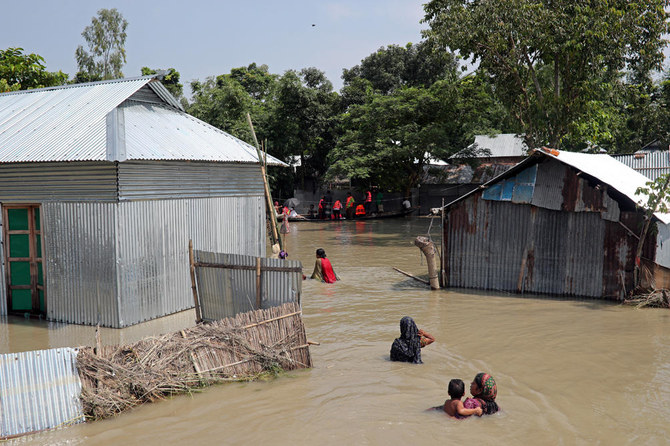
Severe flooding after two weeks of heavy monsoon rain has killed at least 61 people, displaced nearly 800,000, and inundated thousands of homes across Bangladesh, government officials said this week.
Nearly 3 million people are struggling with the impacts of the floods, the worst in two years, according to the disaster management and relief ministry.
Low-lying Bangladesh is extremely vulnerable to climate change, and researchers say people like Begum, who live on river islands that erode and form again, far away from the mainland, are on the frontline.
According to the UN World Food Programme (WFP), Begum is one of 25,000 people in Kurigram district who received aid money via their mobile phones, under the new “forecast-based financing” project.
“This approach uses weather forecasts to trigger early actions such as cash transfers, that can help reduce the impact of natural disasters,” said WFP spokeswoman Maherin Ahmed.
Aside from Bangladesh, the concept, which emerged in 2015, has been used in eight other countries to tackle climate-related shocks, according to the WFP.
The Red Cross has been a strong backer of the approach.
Women know best
Ahmed said research showed that forecast-based funding could lead to more effective use of aid in emergency situations.
A 2018 study in Nepal found it could save $22 million when responding to an emergency of an average size affecting about 175,000 people, she said.
Shah Kamal, secretary of Bangladesh’s disaster ministry, said the project would only really succeed if recipients used the money wisely.
It provides them with a much larger amount than previous cash transfer schemes deployed by the Bangladesh government, he noted.
“They need to invest it right,” said Kamal. “I believe the women here will be key. They are better at assessing their family’s needs.”
He advised participants against using the money to settle loans — which many poor Bangladeshis take out to survive tough times — saying that would not be “productive.”
Dipti Rani, 31, who lives in Kurigram with her husband and daughter, did use part of the money she got to pay off a debt.
But she also spent some on bamboo sticks to raise up her home in the hope of keeping her family safe from river floods.
They were marooned there for 11 days, before the water began to recede.
“I thankfully survived the floods a week ago thanks to the money. But the water has been rising again since yesterday. What am I going to do now?” she asked.


Bangladesh tries new way to aid flood-hit families: cash up front
Bangladesh tries new way to aid flood-hit families: cash up front

- Severe flooding after two weeks of heavy monsoon rain has killed at least 61 people, displaced nearly 800,000, and inundated thousands of homes across Bangladesh
- Low-lying Bangladesh is extremely vulnerable to climate change
Related


Ukraine contacted Musk’s SpaceX over Russian drones using Starlink
- The Russian army used Starlink satellites to guide its drone attacks deep into Ukraine
- ISW said “Russian forces are increasingly using Starlink satellite systems”
KYIV: Ukraine’s Defense Minister Mykhailo Fedorov said on Thursday Kyiv was in contact with Elon Musk’s SpaceX over allegations that Russian drones were using Internet from Starlink satellites during attacks on Ukrainian cities.
“Within hours of Russian drones with Starlink connectivity appearing over Ukrainian cities, the Ministry of Defense team promptly contacted SpaceX and proposed ways to resolve the problem,” Fedorov said on social media.
“I’m grateful to SpaceX President Gwynne Shotwell and personally to Elon Musk for their swift response.”
Fedorov and the US-based Institute for the Study of War said earlier this week that the Russian army used Starlink satellites to guide its drone attacks deep into Ukraine.
Russia has been battering the country’s energy grid as temperatures tumble below freezing and the invasion’s fourth anniversary looms.
The ISW said that “Russian forces are increasingly using Starlink satellite systems to extend the range of BM-35 strike drones to conduct mid-range strikes against the Ukrainian rear.”
Starlink is also widely used by the Ukrainian army for communications.
“Elon Musk’s decision to urgently activate Starlink and send the first batch of terminals to Ukraine at the start of the full-scale invasion was critically important for our country’s resilience,” Fedorov said.
“Western technologies must continue to support the democratic world and protect civilians, not be used for terror and the destruction of peaceful cities.”


