Pakistan aims to send first astronaut into space by 2022

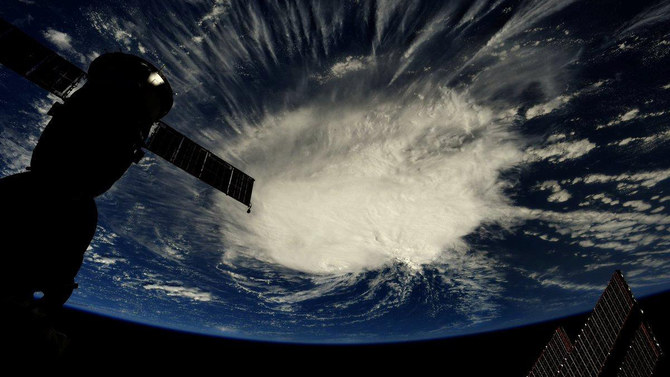
A photo taken from the International Space Station by astronaut Ricky Arnold shows Hurricane Florence over the Atlantic Ocean in the early morning hours of Sept. 6, 2018. (NASA via Reuters/Handout)
Updated 26 July 2019
Follow

Pakistan aims to send first astronaut into space by 2022

  • The country’s minister for science and technology says “this will be the biggest space event of our history”
  • Pakistan has previously developed communication satellites and sent them in outer space

ISLAMABAD: Pakistan said on Thursday it aims to send its first astronaut into space by 2022 and will begin selecting candidates next year.
Neighbor and long-time rival India put its first astronaut into space in 1984 as part of a Soviet-led mission. It launched a rocket into space on Monday in an attempt to safely land a rover on the moon, its most ambitious mission yet.
Pakistan’s program, announced 50 years after the US Apollo 11 mission put the first man on the moon, marks a new departure after focusing on developing communication satellites.
“This will be the biggest space event of our history,” Science and Technology Minister Chaudhry Fawad Hussain said in a tweet.
A selection committee would begin choosing candidates in February, he said.
Pakistan’s National Space Agency SUPARCO (Space and Upper Atmosphere Research Commission) was set up in 1961. It launched its first communication satellite 50 years later with help from a subsidiary of China Aerospace and Technology Corporation.


Four suspected militant commanders killed in security operation in northwest Pakistan

Updated 4 sec ago
Follow

Four suspected militant commanders killed in security operation in northwest Pakistan

  • Police say joint raid targeted Pakistan Taliban faction in Bannu district
  • Operation comes amid surge in militant attacks blamed on Afghanistan-based groups

ISLAMABAD: Four suspected militant commanders were killed in a joint operation by police and security forces in Pakistan’s northwestern Khyber Pakhtunkhwa province, authorities said on Monday, as security forces intensify operations amid a surge in militant attacks in the region.

The operation, conducted in the Bannu district, targeted commanders belonging to a faction of the Tehreek-e-Taliban Pakistan (TTP), also known as the Pakistani Taliban, led by Hafiz Gul Bahadur, police said.

The four suspects were allegedly involved in multiple attacks, including the killing of an assistant commissioner in North Waziristan district, as well as facilitating and recruiting militants, carrying out targeted killings, attacking police checkpoints and stations, and engaging in kidnappings for ransom, according to police. 

Bannu and neighboring districts have seen repeated militant violence since the TTP ended a fragile ceasefire with the Pakistani state in late 2022. The region lies close to the Afghan border and has long been a focal point of Pakistan’s counterinsurgency operations.

“This is a clear message for anti-state elements that there is no safe haven for terrorists in this country,” Deputy Inspector General of Police for the Bannu region, Sajjad Khan, said. “They will not be allowed to hide anywhere. Police and security forces are fully committed to countering terrorism.”

“Anti-state elements will be targeted one by one and completely eliminated. All possible measures will continue to ensure the safety of the public,” he added.

The operation follows an overnight militant attack last week on a police checkpoint in Bannu, in which five police officers were injured after security forces repelled the assault.

Pakistan has accused Afghanistan’s Taliban-led government of allowing militant groups such as the TTP to operate from Afghan territory, allegations Kabul denies. Afghan officials say Pakistan must address its own internal security challenges. The accusations have contributed to strained relations between the two neighbors, including periodic border clashes over the past year.

Pakistan has seen a sharp rise in militant violence over the past two years, with security officials attributing much of the renewed insurgency to TTP fighters allegedly operating from sanctuaries across the border.